
GWR 4079 Pendennis Castle taking water at Didcot, 29th May 1977. Prior to shipment to the Hamersley Iron railway in Australia - Photo © Murgatroyd49
(CC BY-SA 4.0)
If you've read the previous blog entry you will recall that I mentioned about going off to the beach. This was a subtle hint about what our next visiting locomotive is, or to be more specific, what class of locomotive it is. If you visited a sandy beach last summer then you more than likely observed young families armed with the trusty bucket and spade. Many summers in my youth were spent at the beach, both in Blighty and overseas, with Looe, Mevagissey and Santa Ponsa being of notable mention. With the all important tools in hand, I attempted on multiple occasions to construct great fortifications complete with ramparts and the obligatory moat. I am of course referring to the building of sandcastles which, in my opinion, is a mandatory task as far as beach holidays are concerned, not forgetting the delicious ice cream!
Sandcastle construction isn't an exact science, although getting the correct mix of sand and water right to ensure the best consistency for building was always a learning exercise. Knowing my luck, someone has probably written a book on this very subject, however I have yet to come across such a publication. If anyone is aware of said resource then I'll be delighted to hear from you. My endeavours on the beach were beset with challenges, as I was against the weather, the clock, and most importantly, more often than not against the approaching tide. Attempts to increase the size of the moat or add additional walls of sand were often in vain. I was simply delaying the inevitable and my many hours of construction was reduced to a soggy and indistinguishable mess. I laugh at it now but this wasn't particularly amusing at the time!

4079 Pendennis Castle at Swindon (1964) - Photo © Kevin Lane / Michael Brown - https://flic.kr/p/2nrmozo
It will be of no surprise to you now to hear that a member of the 4073 Castle Class will be visiting us, and we're very pleased to announce that this engine is none other than 4079 'Pendennis Castle', courtesy of the Didcot Railway Centre.

4079 'Pendennis Castle' was the seventh of 171 Castles constructed and was completed at at Swindon Works in February 1924. The loco was part of the first lot of 10 Castles built by the GWR between 1923 and 1924 (Lot 224: Nos. 4073–4082, delivered August 1923 to April 1924). The Castles were a Charles Collett design with origins dating back to the highly successful Star Class of 1907, which introduced the basic 4-cyinder 4-6-0 layout with a Belpaire firebox and long-travel valves. This later became a characteristic of GWR express passenger locomotives. Collett designed the Castles to supplement the Stars and replace them on the heaviest express services. The solution was to take the basic Star layout and enhance it by using an extended frame along with a larger and lighter No. 8 boiler, allowing a bigger grate area and a side window cab. As a result, tractive effort increased to 31,625 lb, whilst staying within the 20-ton axle limit.
The well proportioned and attractive locomotive 4079 was named 'Pendennis Castle' after the fortifications at Falmouth.
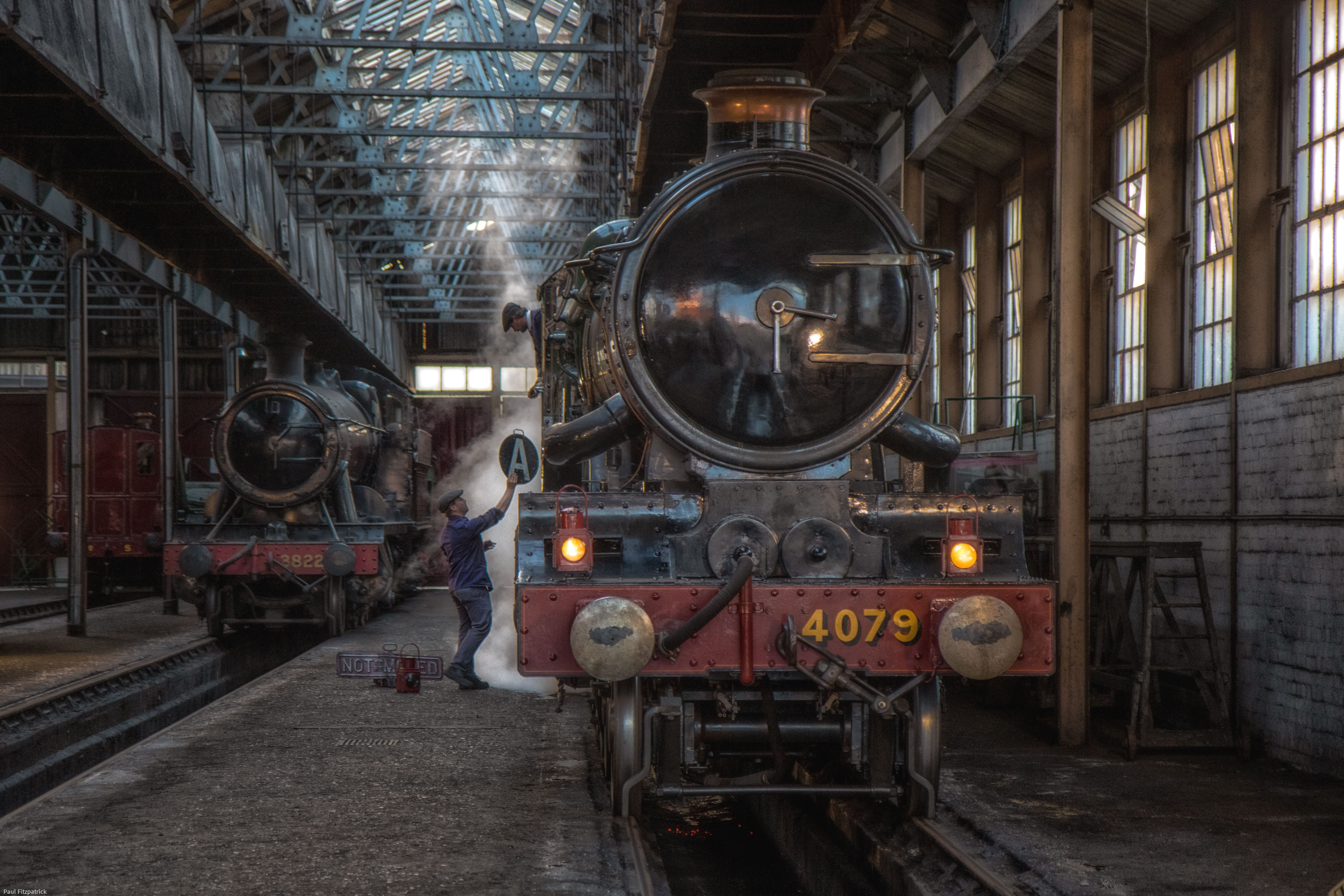
A Timeline Events photo charter with GWR Castle Class 4079 Pendennis Castle at Didcot Railway Centre - Photo ©
Paul Fitzpatrick - https://flic.kr/p/2npXkPc
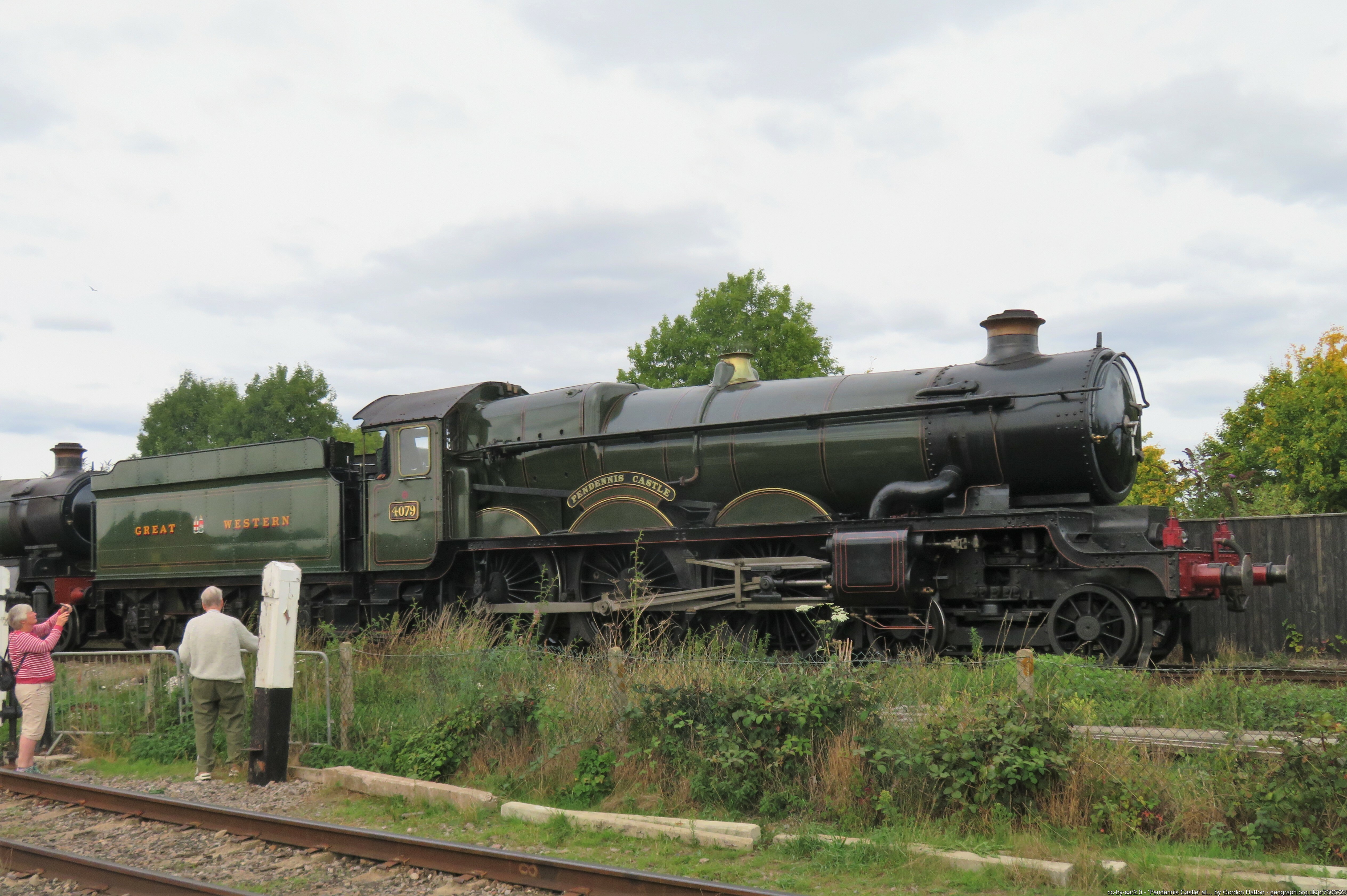
'Pendennis Castle' at Didcot Railway Centre - Photo © Gordon Hatton
(cc-by-sa/2.0) - geograph.org.uk/p/7306723
Avid railway enthusiasts will know that ‘Pendennis Castle's’ claim to fame dates from 1925 when the GWR lent the locomotive to the London & North Eastern Railway (LNER). This was to carry out trials against Sir Nigel Gresley's large new Pacifics, exemplified by No .4472 ‘Flying Scotsman’. Working 16-coach trains on the East Coast main line (ECML) from King's Cross to Doncaster, and King's Cross to Grantham, the loco thoroughly out-performed its larger competitors and covered itself in glory (not forgetting copious amounts of soot!). 4079 made the ascent from King's Cross to Finsbury Park in under six minutes, an achievement that the Gresley Pacifics were unable to match. The exploits of the loco were the talk of every schoolboy in Britain.
Later in the same year, the GWR decided to send 'Pendennis Castle' to the 1925 British Empire Exhibition at Wembley. It was stood alongside 'Flying Scotsman' adorned with a notice proclaiming it to be 'The most powerful passenger express locomotive in Britain'. I doubt that the LNER would have been too pleased about this at the time, though.
GWR Pendennis Castle 4079 - Hamersley Iron Pilbara Railway - Western Australia - 23rd July 1984 - Video © Railway Archives
4079 was initially allocated to Old Oak Common locomotive depot (which sadly no longer exists) and operated on routes to South Wales and the West Country. When the 'Big Four' were nationalised in 1948 to form British Rail, the loco moved and was allocated to Hereford. Between November 1948 and 1964 it had several allocations including: Gloucester, Stafford Road, Bristol Bath Road, Taunton, Swindon*, and St Phillips Marsh, which was to be its final shed allocation before it was withdrawn in May 1964. * Whilst allocated at Swindon, the engine was put into storage for nearly a year.

Ian Allan: Rail Tour 8/8/65 - Newly preserved Collett 4-6-0 No. 4079 Pendennis Castle at Shipton-under-Wychwood on the return leg of this untitled out-and-back tour from Paddington to Worcester - Photo © Mike Morant
On 9th May 1964 a special train was arranged by the Western Region (WR) to run from London Paddington to Plymouth. This was to commemorate the run of 'City of Truro' on the 9th May 1904 when it was officially recorded as reaching a speed of over 100mph. At the time, it was said to be the first time that a steam locomotive had achieved this milestone. Upon arrival at Westbury, all was not well with 'Pendennis Castle', where it was discovered that it had melted its firebars due to the heat of the fire. This was blamed on the provision of coal with an unusually high calorific value, which caused the fire to burn white-hot as the locomotive's speed exceeded 90 mph. British Rail had intentionally sourced the coal.
It is understood that this specially screened coal was supplied as a well meaning gesture in the knowledge that the Castle would be deliberately pushed as close to 100 mph on its last scheduled service - A fitting send-off in many respects. It was reported that the locomotive achieved a speed of 96 mph before it was removed at Westbury. There were no other Castles available at Westbury with the nearest being at Taunton, thus it was left to 'Capel Dewi Hall' to take the train onto Taunton. Research suggests that the final leg of the journey to Plymouth was put in the capable hands to 7025 'Sudeley Castle'. Following withdrawal, 4079 was purchased from British Rail for preservation by Mike Higson.

The locomotive put in an appearance at one of the Great Western Society's (GWS) first open days in 1965. By 1967 she had been sold to Sir William McAlpine and the Honourable John Gretton, having been relocated to the former GWR depot at Didcot (this was shortly before the GWS established the Didcot Railway Centre). Whilst GWS was assembling its collection at Didcot, the engine did the odd excursion before making its next public appearance in 1971. In 1972, it was moved to Market Overton, Rutland and then further relocated to Steamtown, Carnforth by 1975 - The former LMS depot.
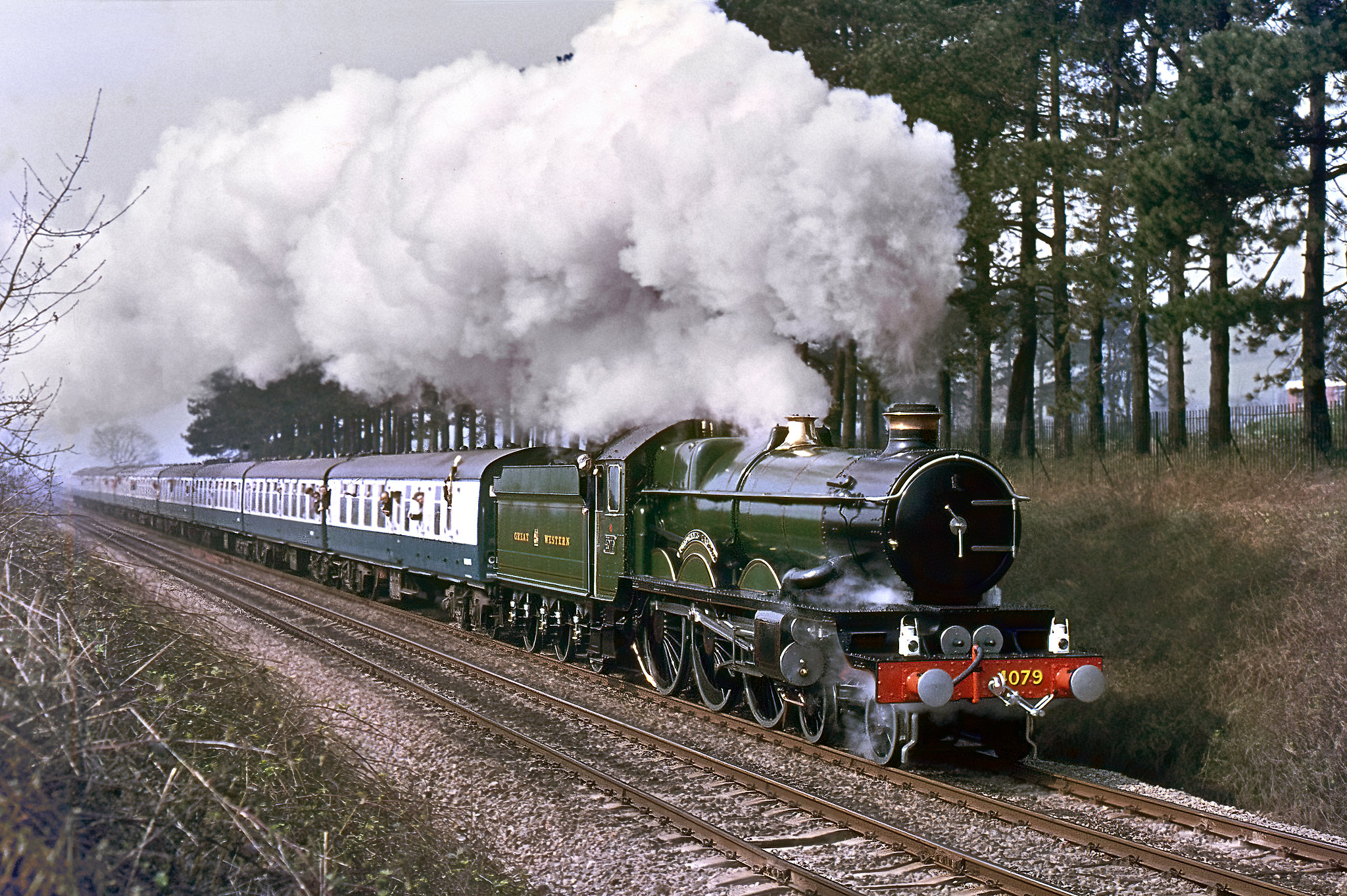
Pendennis pulls away from Newport near Caerleon on 6th April 1974 - Photo ©
Andrew Bell - https://flic.kr/p/2eyyTeo

In 1977 the locomotive was sold once again, but this time to owners and a location far from her home territory - Hamersley Iron - one of the largest iron ore producers in Australia. The intention was for 'Pendennis Castle' to be used on excursion trains on the company's 240-mile ore-carrying railway in the Pilbara region of Western Australia. 4079 left England on the 2nd June 1977 after its farewell run at the head of the Great Western Envoy from Birmingham to Didcot and back on the 29th May. The loco was shipped to Sydney aboard the cargo ship Mishref, having been loaded at Avonmouth Docks. Once 'Down Under' on the 12th July 1977, she was cared for by the Pilbara Railways Historical Society, formed by Hamersley employees. The loco worked many excursion trains through the Chichester Ranges.
Pendennis Castle, Dampier, Western Australia - Video © Mitchell Freeway
Flying Scotsman and Pendennis Castle in Western Australia 1989 - Video © Railway Archives
Whilst in Australia, a highlight for the 'Castle' was being reunited with her old LNER rival 'Flying Scotsman' in Perth in 1989. This was the climax of a tour during the country’s bicentennial celebrations, which also involved Australian legend '3801'. Unfortunately, due to increasing traffic on the Hamersley railway combined with operational difficulties, 4079 was stored out of use for several years. Her final run took place on the 14th October 1994. Since 1978 the loco had carried the name 'River Fe' (River of Iron) and by the mid-90s, Hamersley Iron were looking at possible options, due to an uncertain operational future for the loco, twined with the fact that the boiler ticket had expired and repairs were deemed uneconomical. The key concern was to find a new home along with a secure future, factoring in her English heritage.
In the early days of 2000, the decision was made to offer 'Pendennis Castle' to the Great Western Society (GWR). In exchange for this. the society agreed to pay for the repatriation of the loco, and to restore her to full main-line running condition. The Castle was formally presented to the GWS by Hamersley Iron on the 19th April 2000. It was moved from Dampier to Perth by road, before being shipped to Avonmouth Docks on the 24th April 2000. After a voyage lasting 10 weeks, 'Pendennis Castle' returned to British soil in the 8th July 2000, some 23 years, 1 month and 8 days after she left for Australia. An interesting fact is that it became only the second locomotive after Flying Scotsman to circumnavigate the glove, having travelled to Australia via the Suez Canal and returning via the Panama Canal. Quite an achievement!

4079 was ready to run to the Port of Fremantle for its return to the United Kingdom - Photo ©
8888transportpix - https://flic.kr/p/2nd2dRS

GWR 4079 Pendennis Castle undergoing restoration at Didcot - Photo © Chowells (CC BY-SA 3.0)
Once back at Didcot Railway Centre, restoration work on the loco had started by the mid-2000s and the tender was completed in 2015. The restoration project took longer than anticipated due to the tired state that the loco was in when it returned from Australia. Its last major overhaul was reportedly completed in 1987 after taking well over 2 years to complete. 'Pendennis Castle' was returned to steam for the first time in August 2021 and officially relaunched at a special event at Didcot Railway Centre on the 2nd April 2022. Also present for the occasion was Great Western Railway's Class 57 No. 57604, which shares the same name. Next year marks the centenary of 4079 so it'll be a year of significance.
Pendennis Returns | Didcot Railway Centre - 'Launch of Pendennis Castle' 02/04/2022 - Video © TheSoutherner
It's been several years since a member of the Castle Class has visited us at the GWSR, so to have 4079 will be a sight to behold. Those of you who are well acquainted with the railway, particularly in preservation, will know that over the years we have had visits from a number of engines from the class, including; 5051 Earl Bathurst (Drysllwyn Castle) in 2010, 7029 Clun Castle in 1995, and 5080 Defiant (Ogmore Castle) in 1990. Fingers crossed for more Castles in the future.

In home locomotive news, further progress has been made with 7820 & 35006.
Winter maintenance and work is ongoing to prepare Dinmore Manor for her 'Cold Exam'.

Dinmore Manor's tender undergoing cleaning and maintenance - Photo courtesy of Keith Smith
The tender has been given a thorough clean both internally and externally to remove any built-up muck and detritus. Additional work included greasing and re-oiling underneath, applying a coat of bitumen in the coal space, and cleaning out the water tank. A fairly ugly dent in the fireman's locker lid was discovered and subsequently bashed out. Both locker lids were wire-brushed down due to a lot of rust and surface damage, which was followed by the application of green primer. These will need a layer of undercoat and black glossing. Most of the required work on the tender is now complete.

P&O's drivers side connecting rods have now been refitted after being re-white metalled, ready for the loco to undergo a 'Cold Exam' - This exam is carried out annually by a boiler inspector and required before any steam testing takes place.

Bob, Chris and David at the helm - Photo courtesy of Steve Parker

All back together - Photo courtesy of Steve Parker
I started this blog with the subject of Castles (albeit those of the sandy variety!) and so I'll finish with this video of 5043 'Earl of Mount Edgcumbe'. I was never fortunate to see a steam locomotive at speed on family jaunts up & down the M5.
GWR Castle Class No. 5043 Earl of Mount Edgcumbe races alongside the M5 motorway in Devon with the returning Cornishman railtour which ran from Bristol to Plymouth and back. 28th April 2012 - Video © bigben5051
Important Note: New websites were launched earlier this week for both the GWSR and the GWRT, thus any pre-existing bookmarks to the main blog page via the old GWSR website will no longer work. The new websites can be found by visiting https://www.gwsr.com/ (GWSR) and https://www.gwrt.org.uk/ (GWRT).
All of the departmental blogs can now be found on a new main blog page here: https://www.gwsr.com/knowledge/blogs.
All of the departmental blogs can now be found on a new main blog page here: https://www.gwsr.com/knowledge/blogs.
Until next time folks, further news and announcements are on the way!
Alex (the sooty one!). All published photographs are my own unless otherwise stated/credited.


%20copyright%20Rail-Online%20copy%202.jpg)
%20copy%202.jpg)

%20467%20(1)%20copy%203.jpg)


