I received a few photos from an anonymous correspondent on Wednesday, 76077 was progressing on from having been shot blasted to being coated in primer:
 |
| 76077's frames, now in primer |
 |
| Dinmore Manor was being washed out |
The fact that the external funding is still being negotiated hasn't stopped a few odd jobs progressing with 2874, in the machine shop, a set of bolts to secure the eccentric rods to the eccentric straps were being machined.
 |
| Eccentric bolts being turned. |
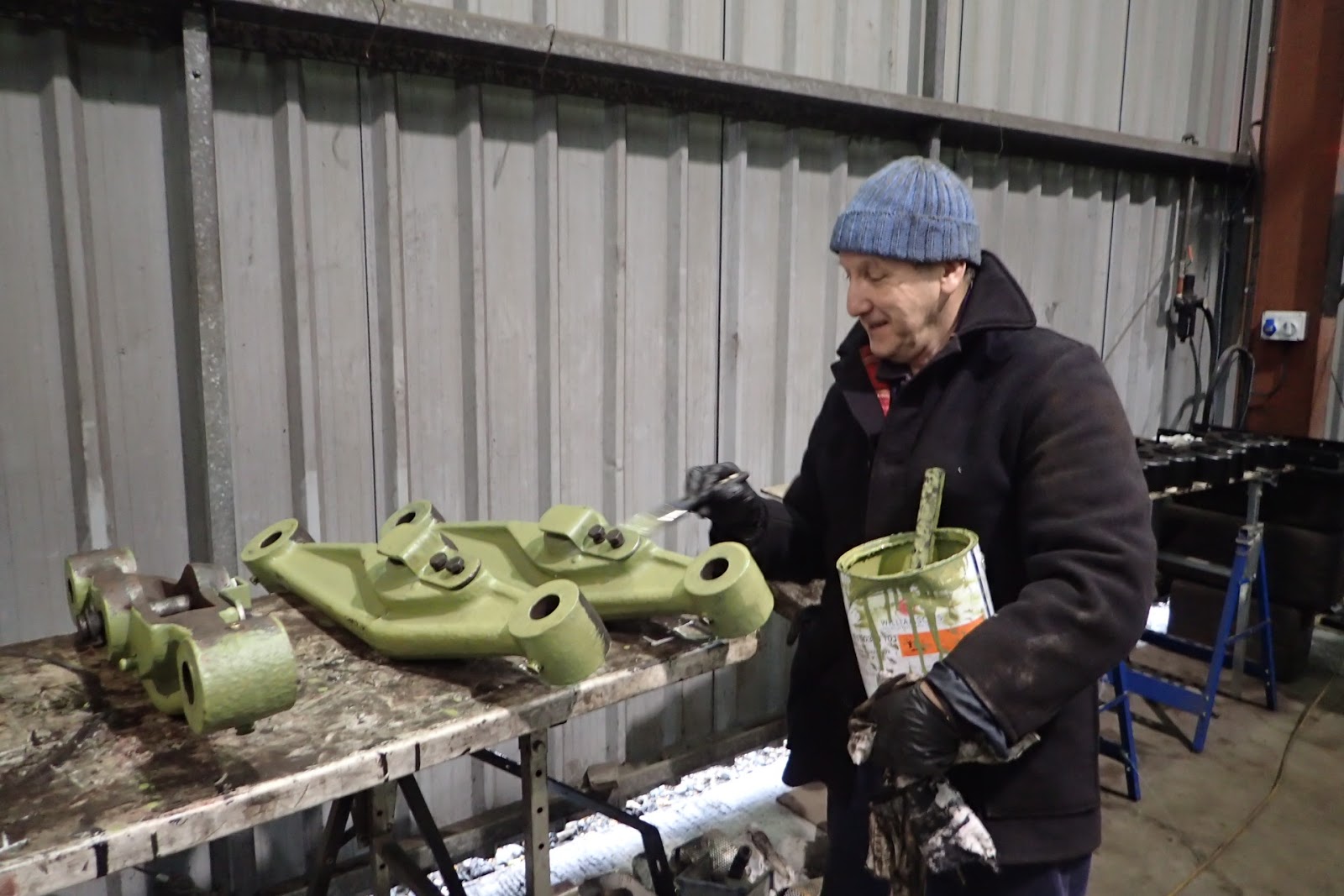
The billets to form the new bogie spring hangers for Dinmore Manor were in the workshop and in the queue for being machined.
3850 has been sidelined a bit by DMLL whilst winter maintenance on Dinmore Manor is carried out, but that hasn't stopped some jobs progressing, a new ejector ring has been in stock for some time, and is now being machined ready to be fitted on the loco when the time comes.
 |
| 3850's ejector ring in the machine shop |
Edit - Apparently this isn't 3850's, it's a new one for Foremarke Hall.
The patterns for 3850's new cylinder block have now been examined and the casting is now imminent. A video of the patterns has appeared on the DMLL facebook page and can be seen by clicking on this link.
Rod has been busy turning up new fusible plugs for our running fleet. Each of our GWR locos requires two fusible plugs in the crown of the firebox, whilst 35006 requires six. The ones for 35006 are rather larger too.
 |
| A GWR fusible (centre), the remainder for 35006. |
On Saturday, Rod moved on to the task of leading the fusible plugs for 35006, being more than a little nosey curious, I watched with interest.
The starting point for leading the fusible plugs is a small crucible.
 |
| A small crucible... |
 |
| ...the fusible plug is inverted and placed in the crucible... |
 |
| ...heat is applied... |
 |
| ...soldering fluid (other brands do exist)... |
 |
| ...soldering fluid is dabbed into the bore of the fusible plug... |
 |
| ...lead is melted into the bore... |
 |
| ...the bore full, more heat is applied |
 |
| ...until the lead runs out at the top of the crucible |
At this point, the fusible plug is left to cool down, and when finished, a pillar drill is used to remove lead form the bore of the fusible plug to the specified depth.
 |
| Drilling out the excess lead |
After that, the plug of lead at the top of the fusible plug is machined to a nice clean finish
 |
| Fully machined examples at the rear, two awaiting machining at the front |
Once all six have been machined, the fusible plugs are then ready to be installed in the firebox crown of 35006.
Foremarke Hall has been receiving a little bit of fettling to the pipe work associated with her ejector
 |
| New pipe being offered up for size |
 |
| Ejector pipe being annealed |
2807's tender was in for a second and final coat of bitumastic paint
 |
| Stuart at work with a paint brush |
It seems that the build up of limescale in the boiler of 3845 is still an issue, with harder to reach bits on top of the firebox crown proving troublesome. A local contractor was on site to see if spraying it with pulverised glass would have the desired effect. It appears to be doing the trick, and the contractor will return in the near future to finish the job.
 |
| Either the contractor at work, or a scene from a sci-fi movie! |
Every time a safety valve lifts, and vents steam into the atmosphere, the high pressure steam flowing past cuts a little into the metal of the safety valve and the seat it sits on. After a period of use, the cuts in the safety valve/seat become enough to allow a constant leakage of steam, which of course accelerates the wear even further and of course wastes steam and therefore coal... which us poor firemen are constantly reminded isn't cheap. I'm only surprised that nobody has suggested putting a direct debit on our bank accounts to cover the coal bill. Anyway, the safety valves and seats need lapping in, or if particularly worn, re-cutting on a regular basis. On Saturday, Dinmore Manor's went to the machine shop for re cutting, and whilst the lathe was set up for the task, 3850's were extracted from the relevant container and sent for machining too.
 |
| Safety valve being turned in a lathe... |
 |
| Before (r) and after (l) |
3850's were loosely put back in place for safe keeping, whilst Dinmore Manor's are awaiting refitting to the loco.
 |
| 3850's, safety valves, returned to store |
Later on, John demonstrated how to lap in the safety valve seats on Foremarke Hall:
 |
| John lapping in Foremarke Hall's safety valve seats |
It's not just 3850's safety valves that were receiving some TLC on Saturday, Stuart was to be found putting a coat of primer on its brake hangers.
 |
| Stuart wielding a paint brush again |
Needless to say, much more painting was going on out in the marquee in the car par, with 76077 being the recipient of the TLC in this case.
The shot blasting had only been able to remove most of the accumulated grime on the wheels, the bits tucked in behind the balance weights had proved to be difficult to access, so that was having to be done by hand.
 |
| Ade removing grime from behind a driving wheel balance weight |
The frames had fewer hard to get at locations, and good progress was being made with them, as they had moved on to being undercoated.
 |
| Frame undercoating in progress |
A problem that had been experienced, was that the large temperature fluctuations in the few days since shot blasting and associated condensation had caused some of the shot blasted areas to start rusting again. It was only a light coating of surface rust, but it did need to be removed before the painting could begin.
 |
| Jonathan removing rust from the pony truck wheels |
The shot blasting process had revealed some interesting details, such as this writing on one of the driving wheels indicating that it had been manufactured in December 1955
 |
| Just in time for Christmas! |
 |
| Later on, Tim painting the pony truck wheel set. |
 |
| One of the driving wheels in primer |
There were a pleasingly large number of people present in the marquee where 76077 is lurking, and I'm sure that it wasn't all down to the fact that there was a heater in there to help keep them all warm:
 |
| Nice and cosy |
If only the David Page shed came equipped with such luxuries! I know that it's short notice, however for any members of the steam locomotive dept with time on their hands on Tuesday or Wednesday this week, there will be further working parties getting on with 76077. Do help out if you can, it needs to be out of the car park in a fortnight's time.
The group working on 35006 appear to have turned to religion in their bid to refit the springs to their loco.
 |
| Facing Mecca! |
Here's something that you don't see everyday, a Merchant Navy flying a foot above the ground
 |
| More of a plane than a steam locomotive |
The leading pair of springs had been refitted on Wednesday, I'm not sure how much progress was made with the driving springs on Saturday, it's not an easy job.
 |
| Springs being manoeuvred into position |
The various clack valves on Dinmore Manor also need lapping in to make them steam tight for another season. The well known ones at the top of the safety valves were lapped in, as well as the rather smaller ones at the injector end of the feed.
 |
| Eleanor lapping in one of the clack valves |
In the good old days, before cars were all of a jelly mould shape and contained mysterious "black boxes" under the bonnet, you could service them yourself without the need for too much by way of specialist tools. Slightly before that again, in the days when lubrication oils and petrol didn't have a bunch of additives to prevent carbon deposits gumming up your engine, one of the service tasks would be to de-coke it. Valves, piston rings cylinder heads etc all acquire a layer of coke and your task was to remove it in order to keep you car or motorbike's engine running efficiently. I'm sure that many of this blog's readers of shall we say more mature years are now fondly reminiscing about spending their weekends de-coking whatever old banger they desperately tried to keep running reliably back in the first austerity period in the hope of being able to impress the young ladies of the day. All these years later, said young ladies having long since married the chaps with the cars/motorbikes, are probably wondering why they ended up married to men who seem to enjoy spending their leisure hours getting grubby by working on steam locomotives. Whether or not they are simply grateful is it means that it gets them out of the house and from under their feet is a different matter altogether. As usual, I digress, the point is that steam locos are very good at building up carbon deposits too and those deposits need removing on a regular basis to keep them running at peak efficiency. The photo below shows one of the piston valves of Dinmore Manor being given some TLC by Jeremy & David
 |
| Jeremy (l) and David |
Martin on the other hand was trying to do one all by himself, and his was still in situ, which doesn't help much as you can't rotate it to get at the underside. The scraper in use is not a specialist tool, just a broken off old hack saw blade.
 |
| Martin, scraping carbon deposits off of the other piston valve |
The valves are designed to expand in their bores and break down into a surprisingly large number of parts
 |
| Jeremy has separated his valve head out |
The nut that secures the outer valve head assembly in place came apart quite easily for Jeremy, the one at David's end was less cooperative. Those useful standbys, brute force & ignorance were called into play once more:
 |
| John applies some therapy with a big hammer |
 |
| The GWSR arm wrestling team practicing their sport |
 |
| John wasn't going to be beaten |
 |
| Who needs to pay gym fees when you could work in the steam loco dept for free? |
You'll be pleased to know that after a little more "gentle persuasion", it did finally come apart and the de-coking exercise could continue.
The oil store isn't the most obvious of locations to paint up three identical new headboards, but that is what was happening on Saturday. The fronts had already been done, and Chris was painting the backs.
 |
| Three new headboards. |
I'll leave it as a guessing game for the time being as to what the boards said and why we want three identical ones. Answers scribbled on the back of twenty pound notes only please and forwarded to me.
Sunday saw me back at the railway again, my medical examination was due. The hearing test was made rather more difficult by the sound of the conversations in the Flag and Whistle next door, by motorbikes out on the main road and by the clock ticking somewhere behind me that I hadn't noticed until I put the headphones on. Before my next medical comes round, we'll have a nice shiny new and more importantly sound proofed room to have the medicals in. I'm not sure if the sound proofing is to keep the external noise from getting in, or to keep the screams of the victims patients from getting out as the electrodes for the ECG are ripped off... and that was even after having had most of my chest hairs unceremoniously shaved off. Fear not gentle reader, I will spare you from the horrors of any photos.
And finally, another photo from my correspondent on Wednesday, Foremarke Hall was being used as a makeshift door stop. Storm Georgina had been passing through and rattling the shutters of the David Page shed, so a suitable length of wood was wedged between Foremarke Hall's buffer beam and the roller door to fortify it against the wind. You may recollect that another storm had caused significant damage to this shutter a few years ago. I somehow doubt that Frederick Hawksworth had this particular use in mind when he designed his Modified Hall class of steam locomotives, but it seemed to do the job very well anyway.
 |
| Georgina spited! |