Thursday, 17 March 2016

Foremarke Hall Returns

There has been lots going on in the last week or so, and far too much to cram into one blog post, so here is a bit of a belated update from last weekend.  The gala details were the most pressing thing to get online, so I covered that first.   If you missed it, then just click onto the post before this one for information on the first of our guest locos for the May 28th-30th, Cotswold Festival of Steam gala, "Swindon Built".

As was mentioned recently, Collett, 2-8-0, 3850 owned by Dinmore Manor Locomotive LTD (DMLL) has suffered a bit of a setback in the form of a cracked cylinder block.  DMLL has decided to launch "Club 3850" (Not to be confused with Club 18-30) as a fund raising exercise.  I was generously offered a helicopter flight along the line on Friday, coinciding with with DMLL's shareholder day to take photos of the event.  My arm didn't need too much twisting.  It's a tough job, but somebody has got to do it!
Ian Shapter, the first "Club 3850" member and our pilot, Lee
On our way
The original plan had been to fly up to Broadway and take a few photos from the air, then rendezvous with Dinmore Manor at Toddington, before following it down the line. Unfortunately there was fog over Broadway and Toddington, which restricted the view, so after a phone call with Mike (who was the fireman), we caught up at Winchcombe.
Dinmore Manor waiting at the newly extended Winchcombe platform 1
Entering Greet tunnel...
...and emerging out the other side.
Passing Gretton
Quite a pleasing double track effect at Gotherington loop
No small number of our volunteers live in Bishops Cleeve, I suspect a fair few people will be saying "I can see my house".
Passing through Bishops Cleeve
The Crew (Steve & Mike) + DMLL shareholders waving us good bye at Cheltenham Race Course
The short return flight to Staverton airport took us over Hunting Butts tunnel, from where the currently disused trackbed snakes off towards Cheltenham town centre.  It has been suggested that once the Broadway extension is done and dusted, that the GWSR should aim to press on in this direction for a short way.
The future?... Hunting Butts tunnel and on to Cheltenham
More photos and a rather fuller discourse on the event can be found on 3850's own blog.

Joining us on the flight was Donna, who has uploaded some video footage of the event to Youtube.

The eagerly awaited return of Foremarke Hall from Tyseley took place last week.  The task of getting her back together and in running order is now being attended to with working parties on three days each week.

In the cab, the backhead and a few of the fittings may have been in place, but there was no thermal insulation cladding in place, so it all had to come off to allow that to be fitted:
Tim (l) and Ade start removing the backhead plates
James cleans the firebox door mechanism
Andy cleaning the gauge frame
Back head plates removed
James cutting the thermal insulation cladding to shape
Ade and James fitting the insulating material
Meanwhile, up at the other end, a small team of people were sorting out the smoke box.  The superheater header and elements were already in place, which is just as well as the header is remarkably heavy and difficult to fit.  Everything else needed fitting though.
Sean (l), Phil (in smoke box) and Steve discuss the tasks ahead.
Sean, besides the newly fitted regulator valve.
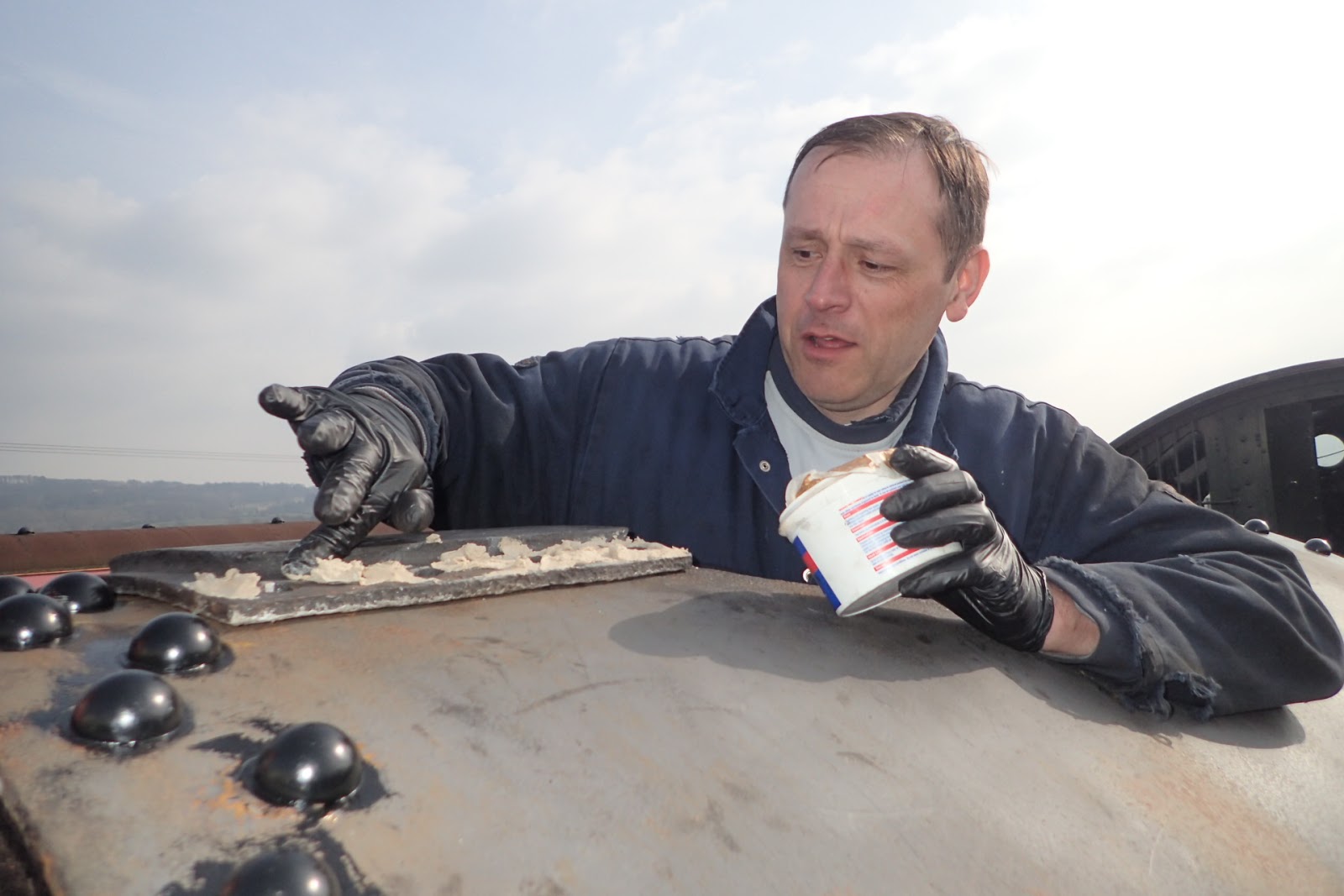
Sean sealing the smoke box plate above the regulator
Phil fetching the chimney for installation.
Foremarke Hall, basking in the sun and enjoying being home again.
New handrails were being bent to shape
Will (l) and John, preparing a hand rail
Test fitting the hand rail
The period of time at Tyseley had been long enough for a bit of surface rust to appear on the previously highly polished connecting rods and coupling rods.  Eleanor got to work with a bit of emery tape to restore the shine
Eleanor at work
The steam pipes needed fitting, and new seals (I was told off for referring to them as gaskets) needed making for the various joints.
Making one of the seals
The faces of the joints of the steam pipes also needed a little bit of attention to make them perfectly flat and hopefully steam tight.
Will and John attending to one of the steam pipe faces
One of the steam pipes had been assembled and fitted by the end of the day.
The piston valve lubrication pipes were assembled into place on both sides, ready for piping to run up under the cladding to the cab.
Lubrication pipes, loosely assembled at this point
A considerable amount of progress was made with Foremarke Hall on Saturday, and by the time that you read this, hopefully even more work will have taken place.   It shouldn't be too much longer before she is back in steam and hauling our trains once more.

As a reminder of what Foremarke Hall will look like again, here is a view of her at the 2013 Christmas Cracker event, just before she was withdrawn from traffic for her 10 year overhaul.
Foremarke Hall, departing Gotherington a little over 2 years ago
It wasn't quite all about Foremarke Hall on Saturday, a small team of people were working on 2807,  Bruce was busy lapping in the pep pipe valve, which had not been very generous with supplying hot water for cleaning the cab and damping down the coal dust hitherto.  Hopefully it will do a better job now.
2807's pep pipe valve
And finally, all of us in the Steam Loco Dept are eagerly awaiting the very generous offer of cake from our friends over in the Carriage & Wagon Dept.

Monday, 14 March 2016

The Cotswold festival of Steam: Swindon Built

The Gloucestershire Warwickshire Railway is delighted to announce some of the details of the Cotswold Festival of Steam gala, taking place at the late May bank holiday weekend (28th - 30th).  

The title for the gala will be "Swindon Built", remembering the 175 years that have elapsed since Sir Daniel Gooch, the GWR's Locomotive Superintendent selected the site at Swindon for locomotive and rolling stock repair and construction.
  
We are well placed at the GWSR to host such an event, as all of our operational home fleet has some connection with Swindon Works.

Home Fleet:


Churchward, 2-8-0, 28XX Class, 2807

To start with, in Churchward 2-8-0, 2807, we have the oldest Swindon Works built steam loco capable of being steamed.  2807 entered traffic in 1905 and continued in service until 1963, an impressively long working life.  She is the oldest loco to have been saved from Barry Island Scrap Yard.  2016 is also the centenary of the first 100 wagon freight train in the United Kingdom, hauled by sister loco 2808. To commemorate this event, it is proposed that on some days, 2807 will be renumbered to be 2808.  The 2800 class was principally designed for use on long haul freight services.
2807 during a recent 'Christmas Cracker' event


Churchward 2-8-0T, 42XX Class, 4270

Another Swindon Built Churchward locomotive is 2-8-0T, 4270.  She was outshopped from Swindon Works at the end of 1919 and remained in traffic until 1962.  She is notable for having retained her original inside steam pipes.  The 42XX class was designed to cope with increasingly large coal trains in the South Wales valleys, using a Swindon number 4 boiler and sperical joints on the coupling rods between the intermediate and trailing wheels permitting the negotiation of relatively tight bends.
4270 on a demonstration goods train at Toddington


Collett, 4-6-0, Manor Class, 7820, Dinmore Manor

Swindon Works continued manufacturing GWR designed steam locos, even after nationalisation in 1948.  An example of this of Collett designed 4-6-0, 7820, Dinmore Manor, built in 1950, the first of a batch of 10 Manors built by BR, following on from the 20 built by the GWR prior to WWII.  Manor class locomotives were a mixed traffic design, designed with a lighter axle weight (17 tons) which permitted them to travel across a number of cross country routes and branch lines which the heavier Hall and Grange 2 cylinder 4-6-0 locomotives were not permitted on.
Dinmore Manor in action at Chicken Curve


Bulleid, Pacific, Merchant Navy class, 35006, Peninsular & Oriental S.N. Co

The final member of our home fleet that it is anticipated will be in steam for the "Swindon Built" gala is at first sight an impostor, Bulleid, Merchant Navy Class, 35006, was indeed built Eastleigh, but in the early days of her preservation, some engineering work on various components took place at Swindon Works, before it was closed in 1986.  A slightly tenuous link to Swindon Works perhaps, but a link nonetheless. This will be 35006's first gala appearance in steam.

35006 on static display at Winchcombe during last year's gala.


The Guest Locomotives:


Riddles, 2-10-0, BR Standard 9F Class, 92214

The first of our guest locomotives to be announced is Riddles, BR Standard 9F Class, 92214.  This locomotive is a perfect fit with our theme, being the youngest surviving Swindon built steam locomotive currently capable of being steamed.  The BR Standard 9F's were the last of the standardised locomotive classes built for British Railways during the 1950's and intended for use on fast heavy long distance freight trains, though some were used on passenger services too, most notably the very last Swindon built steam locomotive, 92220, Evening Star which hauled the final 'Pines Express' over the Somerset & Dorset Joint Railway.  92214 entered traffic on 31/10/59 and was withdrawn less than 6 years later on 30/09/65 in the closing months of steam on the Western region of British Railways.  Fortunately she was sent to Barry Island scrap yard (along with all of our home fleet), from where whe was ultimately saved.  92214 comes to us courtesy of the Great Central Railway.

Riddles, 2-10-0, BR Standard 9F, 92214

We anticipate being able to make further announcements regarding two further guest locomotives in the relatively near future.

Keep an eye out for further announcements regarding the locomotive line up both here, on the main GWSR website and on Twitter.

Monday, 7 March 2016

The 2016 Season Kicks Off

When the C&W blog writer takes a week off to sun himself in the South of France, that's all fine and dandy.  If yours truly takes time off for good behaviour, then it causes a near riot.  Many were the people who reprimanded me for my dereliction of duty last week.  Far from sunning myself in tropical climes, I was out in the fells of the Lake District, enjoying some unseasonably good weather (by which I mean that it didn't rain, and the cloud base was above the fell tops).  I returned home via the Keighley and Worth Valley Railway to enjoy their gala, and discovered an unexpected connection or two with our railway.  For one thing, there were three other members of the steam loco dept up there (who all hid from my camera upon being spotted) and a fourth person, who is not noted for being camera shy:
The S160 approaches Ingrow... the fireman is peering out of the cab...
Cropping in a bit closer... that face looks familiar...
...yes, it was Ben.
It turns out that Ben had been expecting to attend as an owner's rep for Kinlet Hall, until it was deemed out of gauge to make the journey up there.  Ben went along anyway and played with a few toys on the K&WVR.  He was quite taken by the S160.

Friday at Toddington, saw Dinmore Manor taking her annual boiler exam:
Boiler inspector Terry, doing the gauge frame accumulation test. (Photo courtesy of Mike Solloway)
Later on checking inside the smoke box. (Photo courtesy of Mike Solloway)
The weather varied from pleasant sunshine... (Photo courtesy of Mike Solloway)
...to snowing.(Photo courtesy of Mike Solloway)
 With her annual boiler test passed, it was time for a few running in trips up the line to Laverton and back.
On the way back from Laverton, photo courtesy of Mark Harding
Photo courtesy of Mike Solloway
On Saturday morning, I had a meeting to attend (well it's better than working), but being the first day of the season, I thought that I should delegate the task of taking a few photos of the first train departing.  The question was who could I trust with my camera... most people would 'accidentally' drop it in the pit, or tie it to the tracks and run over it with the heaviest loco that was in steam.  Eleanor was the only person around who looked even remotely trustworthy, so my thanks to her for taking the following couple of pictures and most importantly for returning my camera to me (in one piece) later.

Apparently it was Donna's first official cleaning turn.  As luck would have it, she had 5542 for that, which is our smallest and therefore easiest to clean loco... being the first turn out after winter maintenance, it wasn't exactly too grubby in the first place, so a nice easy start for Donna.
Donna, and 5542
5542 gets the season underway in style.
 There was still much to be done in terms of fettling the remainder of our home fleet:
Graham buffs 4270's safety valve bonnet up to a high shine
Neil cleaned the wheels and motion.
 A small wagon has been taken pity on by the steam loco dept and has been given shelter in the David Page shed for a little while now.  I seem to recollect being told that it is a "Starfish", in which case, when fully restored, it will look something like this.
Donna starting to paint the frames of the starfish
 The lifting jacks have returned from being refurbished and are now in the David Page shed awaiting installation on the specially strengthened concrete floor on road 7.
Refurbished lifting jacks.
 Work is progressing smoothly on 35006:
A new deflector plate has arrived
 Connecting up the tender brakes is progressing well
One of the vacuum brake pipes being boiled alive...
...the location on the brake cylinder that it will connect to...
...and the pipe in location.
 The idea was to boil the pipe for a while to make it more malleable, insert it into location and let it cool and set in the shape it is in.  It will have to come off again later to be clamped in place with jubilee clips.

The steam test successfully completed the day before, Dinmore Manor was coming in for a bit more TLC:
David paints the inside of the safety valve bonnet
Tim polished the shiny bits
Roger cleaned the wheels.
Sam (l) and Chris cleaning the outside of the smokebox.
Chris refitting the safety valve bonnet (photo courtesy of Mark Harding)
 The running in on Friday had revealed that the vacuum pump still wasn't quite as it should be.  Closer examination revealed that the spindle had a taper from one end to the other of 20 thousandths of an inch.  Swindon were big on standardisation, so the one from 3850 was nicked and installed in its place.  Dinmore Manor's will be refurbished and will then be fitted to 3850.
Vacuum pump piston and spindle
2807 was undergoing a B exam on Saturday.  This involved Eleanor putting a fire in it, under the supervision of Martin.
Just because she took photos for me earlier, doesn't make her exempt from appearing on the blog
 The B exam involved John getting under the loco and measuring/checking everything that need to be measured/checked.
John underneath 2807
Later in the day, after a quick run up and down siding 1, and disappearing off into platform 1 to take on water, 2807 was declared fit for service.

Whilst we are on the subject of 2807, you may remember that shortly before Christmas, I discovered one of her cabside number plates on the wall of the Steam museum in Swindon.  Brian (who owns the other one) followed up by contacting Steam and reported the following:

"In 2011 they were left a very large donation of GWR "stuff" in a Will. Part of this donation was 70 cab side number plates (inc. 2807) and 6 names plates including three Castles and a Grange. The donation had over 50,000 photos as well as various Swindon works and stock ledgers. This was all privately owned by a gentleman local to Swindon. They do not believe he worked at Swindon but something he had collect for personal interest. They have valued the total donation at over £1/2 million in value. " 


I wish somebody would leave me a lagacy like that.


With Dinmore Manor now largely at the end of its winter maintenance, attention turned to 3850, and removing the damper door linkages and a few bits of the vacuum brake pipework that would still prevent her boiler from being lifted.  I got to remove some of the vacuum brake pipework, including the bit with the pepper pot which limits the amount of vacuum that the ejector can create.
The pepper pot, once I'd removed it and it's pipework from 3850
 The pepper pot needed dismantling, cleaning and checking over to make sure that it was fit for further service
Cover removed
Fully disassembled and about to be cleaned.
 In the absence of a Haynes manual to remind me how it all had to go back together, it was useful to be able to check that I had got it right by looking at the photo above captioned "Cover removed".  Haynes manuals do exist for some steam locos, in fact I have one for King class locomotives, but it is very different in content to those that I've had over the years for various cars and motorbikes, certainly not much help should you happen to be rebuilding one.  I think that there is a bit of a gap in the market there.  If anybody happens to have a Haynes manual or similar (other guides to vehicle repair and maintenance do exist) for rebuilding Collett 2884 class steam locomotives, then please let me know.

Meanwhile, David got on with cleaning various brackets etc that came off of 3850 before giving them a coat of rust inhibiting primer.
David cleans off old flaky paint...
...and primes various small items.
Foremarke Hall has been out of the news for a little while now, but that's going to change in the near future.  Sean and Steve were busy preparing some of the pipe work that will need refitting when she returns from Tyseley.
Sean (l) and Steve.
 And finally, steam locomotive restoration is notorious for the arrival of unexpectedly large bills that land on the doormat with a distinct thump. The recently concluded overhaul of Flying Scotsman has amply reinforced the old adage that "The only way to make a small fortune operating a steam locomotive is to start with a large one".  Perhaps not on the same scale, but dismantling 3850 has thrown up an unexpected failure that will doubtless have a hefty price tag associated with its repair.  There is a large crack in the cylinder block on the fireman's side.  It's a structural part of the casting rather then under steam pressure, but nonetheless, it will need to be rectified.  At the time of writing, it is not known whether or not it can be repaired, or if the casting will need to be replaced.  If it is the replacement option, then it will add a significant amount to that required to return 3850 to steam.
The crack runs vertically for much of the height of the casting

A closer view of the crack in the cylinder casting