Tuesday, 10 February 2015

Under the Hammer

It's not often that I can find something better to do at a weekend than spend time on the GWSR, but this last weekend was one of the rare exceptions.  What could be better than getting grubby at the GWSR? I hear you ask.  Well as it happens, there was an auction taking place at Stoneleigh and one of the lots being bid upon (lot 53) was the smoke box number plate to 2874.  I went along with Len, one of the directors of DMLL who was intending to bid on it.  In recent times, the auctioneers have taken to including a guide price for each of the lots in the auction catalogue and the smoke box number plate was put down at what I thought was a sensible valuation.  As the auction progressed however, it quickly became apparent that the recession is well and truly over and that the guide prices were far short of the mark.  For instance, of local interest at lot number 3, was a GWR signal lever plate:  "2 FROM STRATFORD TO CHELTENHAM HOME".  The guide price of £150 - £300 seemed a little steep to me, but I thought that I might take a punt at it anyway.  The bidding started above £300 and quickly escalated to £1000 (don't forget to add the buyers premium of 10%, plus VAT to that). Needless to say, even though I liked it, I didn't like it that much.  Pretty much all the other lots went for several times their estimated price too.  This didn't bode well for Len.  Such was our concern, that we even discussed pooling resources if need be.  Mercifully the 2874 smoke box number plate went to Len for only a little more than the top end of the guide price and might have been considerably lower had a late entrant to the bidding not stepped in.    Sadly, the couple of items that I had my eye on later in the auction went for far more than I considered them worth, so I dropped out of the bidding.

Len with ex-loco condition 2874 smokebox plate
Most auctions also have a few trade stands at the rear of the venue and Len ferreted his way through stacks of old photos on one stand and turned up the following two that have relevance to the GWSR, along with obtaining permission to post them here:

The first is 2807 on shed at Severn Tunnel Junction on 13th June 1962, behind are 6672, 2895 and 3844.

2807 at Severn Tunnel Junction, photo courtesy of P. Read.
 Secondly, and rather appropriately under the circumstances, Len found this undated shot of 2874 at Shrewsbury.

2874 at Shrewsbury, photo courtesy M. L. Boakes.
 The 'Cycling Lion' logo on the tender implies a date of 1950 or later.  I don't know when, or even if it ever had the 1956 and onwards 'Ferret and Dartboard' logo, so it could be any date from 1950 up to her withdrawal on 31st May 1963.

The good news doesn't stop there though.  This evening I had the pleasure of meeting up with John Violet, a volunteer on the Llangollen Railway to swap a couple of items of railwayana.  I was bringing along a cabside from 2876, the last 2800 in service for BR, which I was trading with him for a cabside of, you guessed it, 2874.

Both plates together
As both locos were built at Swindon, being out shopped on 30/11/18 and 31/01/19, these two plates were probably cast in the same batch.

John had owned the 2874 plate for around 35 years, having swapped it for a smokebox number plate from BR Standard 9F, 92209 which in turn he had won in a raffle on a rail tour.

DMLL will be having several trade stands during the year at various galas, including our own Cotswold Festival of Steam on May 23rd - 25th.  I expect that both 2874's smoke box number plate and cabside number plate will be adorning the stand.

2874 at home, now where to hang it?


Tuesday, 3 February 2015

Hug a Hoodie?

Winter has arrived on the GWSR, there was a light covering of snow on the ground at Toddington and even more visible up on the nearby hills.
If only it had been like this for the Santa Specials back in December
 A mini-360 degree excavator was busy clearing out ballast on road 8 for more floor concreting to take place.  Much more work is planned for concreting the floor in the coming months.
Clearing out the ballast
You'll note that an interloper has appeared in the shed, it must have been cold out there if the diesels want to come indoors.

Work continues on Foremarke Hall, one of the connecting rods was refitted on Wednesday, today was the turn of the other one.
Refitted, oiled up to prevent rust and covered to stop dust accumulating
The first task was to manoeuvre Foremarke Hall into a position such that the crank pin was in the correct location.
John shunts Foremarke Hall the hard way.
 Next job was to fetch across the nicely polished con rod.  I've seen old video footage of 8 or 10 people picking con rods up by hand and shuffling it into the right position.  We used a hydraulic table to do all the hard work, "Work smarter not harder" is a good maxim.
John picks up the con rod.
 It was then just a simple case of wheeling it into the right position.
Getting the con rod where it wants to be
 And after lubricating the crank pin with motion oil, sliding it into place.
Sean popping the con rod onto the crank pin
Looking good at the big end
The little end is still to be connected to the cross head
Persuading the cross head back along the slide bars far enough to engage with the little end was achieved by way of a wooden lever.
John encourages the cross head to meet the con rod
 Amusingly, although not in any of these photos, the 35006 gang appeared and took notes on how it should be done.  It seems that they are not too far from refitting their three con rods.  I suspect that refitting the middle cylinder's con rod will be an interesting exercise.

Needless to say, getting the cross head in exactly the right position for the gudgeon pin was a slightly protracted process, as we went too far and had to go back a bit several times before it would fit.
Nearly there.
Finished job
 Refitting the big end nut and the little end gudgeon pin was followed by cleaning and then oiling the rods prior to covering with sheets to keep them clean and rust free.

 Another job that wanted doing was insulating the steam heat pipe.  Unsurprisingly, they get rather hot when in use, so lagging them with insulation prevents them wasting a lot of energy by heating up the area under the loco and also preventing crews inadvertently burning themselves during disposal.
John lines up the insulation, Sean holds the roll, Jeff (out of sight on the left) rotates the pipe.
Finally at  the far end, John clamps it in place with a jubilee clip
 In an attempt to bind the insulation together and prevent it slipping on the pipe, a coat or two of gloss black paint was applied.
Sean painting the insulation.
 Later on, Aaron helped Sean out. 
Aaron and Sean
 You will note that Sean has taken to wearing a hoodie to avoid being identified in photos.  Various reasons as to why that might be were put forward by others present.  My favourite was Crimewatch the Prime Minister's relatively recent advice to "Hug a Hoodie".

4270 will be disappearing off for a while to star in a couple of galas at the Llangollen Railway and the West Somerset Railway.  A few details needed attending to before she went.  It seems that a GWR shed code of NPT for Newport is incorrect. There were two sheds in Newport, EBBW and PILL, and EBBW is the one that she should have.  Andy set to correct this anomaly.
Andy marks out the "EBBW" on each side.
Ready for painting
And here is the first coat applied.
 The route indicator disc and power classification were also applied
Andy paints in the route indicator disc
 This indicates that she can only run routes that can accept an axle weight of up to 20 tons and that she has a tractive effort of between 33,001 lbf and 38,000 lbf. 

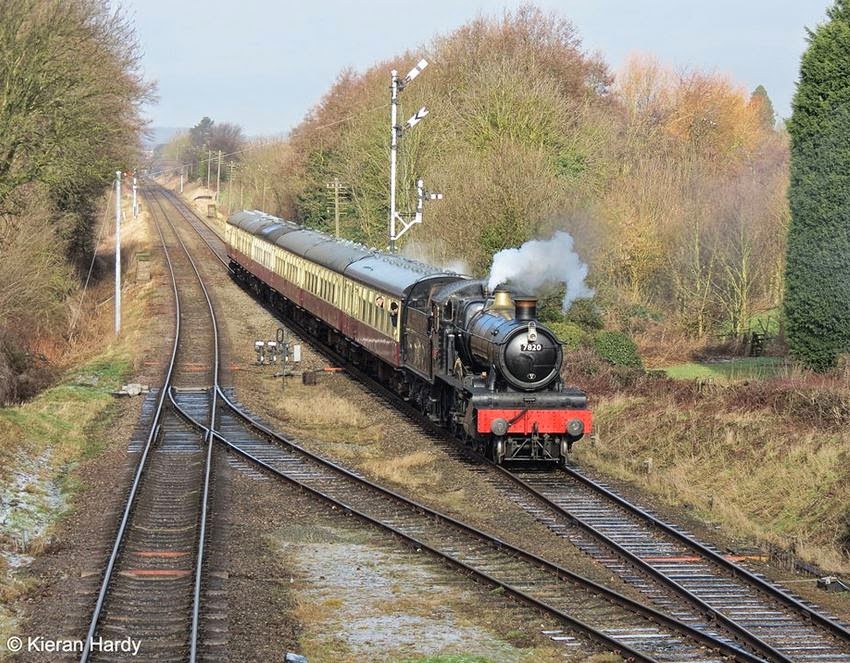
 Dinmore Manor is off for her holidays on the Great Central Railway for their gala.  I wasn't able to attend myself, but others who did make it have kindly provided a selection of photos.
Dinmore Manor on the GCR, photo courtesy of Mike Solloway
Photo courtesy of Mike Solloway


Photo courtesy of Mike Solloway

Photo courtesy of Dan Wigg

Photo courtesy of Kieran Hardy

Left back at Toddington was the skeleton of Dinmore Manor's own tender.  Work has continued on that.
Some of the recently inserted rivets
Some lengths of angle bracket were required to support a replacement section of the frames.  The frame section was not parallel to the others though, offset from the others by 7 degrees.  This required lengths of angle bracket to be created set at 83 degrees and 97 degrees to support it in the correct plane.
Jeff cutting some angle brackets
Here's one that Ian prepared earlier
And here is another one being finished off
Mark looking very pleased at the trial fitting of the frame section
Also in the machine shop, a bit of welding was taking place on the brake rigging of 35006's tender.

And finally, I don't think that we've had had any cartoons on this blog before, but here is one.  Apparently sometime last year, one of our number decided to descend from the running plate of Foremarke Hall by jumping down rather than walking back to the cab end and using the steps.  This amused those who observed this unexpected feat of athleticism as all they could see of him when he landed was his head and boots, thus prompting the cartoon.
He'll be using the steps next time I expect.

Tuesday, 27 January 2015

But Not Too welcoming

Saturday saw the steam loco dept's AGM.   The great and the good of the steam loco dept's management committee gathered together to report on what had happened last year and what will hopefully be happening during 2015.  There were also reports from the various loco owning groups and a few other items/speakers.  The highlight for me was when Ed spoke about the new volunteers that had recently been recruited and encouraged us to be very welcoming to them, but not too welcoming though as one of them is his girlfriend.

There were also "Percy Pig" awards for the footplatemen who had hogged the most turns during 2014.  The runner up was Clive:
Clive(l) receives his certificate from Chairman, Mark.
 For the second year running, John was the winner. 
John receives his certificate from Mark
 At this rate, John will need to move to a larger house in order to have enough wall space to frame and hang all his certificates.

There was a slot in the proceedings for somebody to speak about the gala.  As all the other gala committee members were absent (well in theory they were all absent, Paul appeared anyway), yours truly got stitched up with that one.   Although invitations have been sent out, there are as yet no confirmations of visiting locos, in spite of what you may have read in one of the railway magazines.  The gala for the coming year will be in its usual end of May bank holiday weekend slot (23rd - 25th) and will have a particular theme.  Here is a clue:
Hmmm!
More details will of course be revealed on this blog as things become confirmed.  If we get the locos that we have asked for, it will be a fantastic line up.  Watch this space and keep the gala weekend free in your diaries.

The upheaval at Toddington station is still ongoing, but it is starting to take shape again.  As of Saturday, new ballast had been laid in the platforms, and new wooden sleepers and track were being laid in platform 1.  The Permanent Way gang are doing a great job.
Track retuning to platform 1
 The boiler tubes on steam locos clog up with soot after a while, which obviously impairs the ability of the boiler to raise steam.  They need regular sweeping just like house chimneys do, well at least they do for people who still have coal fires at home.  One of the least popular jobs on a steam loco is cleaning out the boiler tubes.  Usually these days it is done with compressed air blown through a lance inserted into the tubes.  Hit a particularly badly blocked tube and the result is that you get a high pressure face full of soot.  Dust masks and goggles are a must for doing this job, followed by several hours in the bath/shower when you get home.  The 2807 group as it turns out had a cunning plan.
The 2807 group plotting
 Just visible in the above shot is Roger, who is inside the firebox.   Here is a better view of him.   Roger has a length of copper pipe which he is inserting into each tube, connected to a flexible hose.  You will note that the brick arch is missing, usually you would be perched on top of it for this kind of operation.
Roger in 2807's firebox

 There were copper pipe extensions available to allow him to get to the far end of the boiler tubes:
Copper pipe extension waiting in the wings
 The cunning part of the plan, was that rather than using an air line blowing through the tubes, they had a vacuum cleaner sucking the soot out. 
Vacuum cleaner
 I am wary of putting this information out here on the blog as there is a very real danger that some of our better halves may see this and run away with the idea that we have skills from the railway that could be used in a domestic setting.  Real men of course have no idea what a vacuum cleaner might be, much less how to use one.  It is a risk that I shall take though.  I expect to be much chastised for revealing this next time I show my face at the railway.

Just some of the soot extracted from 2807's boiler tubes

 There isn't much call for riveting as far as domestic chores are concerned, so I think that I'm moving onto safer ground here.  There wasn't much sign of activity on Dinmore Manor's tender on Saturday, but work had been progressing with riveting some of the sections together during the week.

Rivets awaiting use on Saturday
Riveting plates together midweek, photo courtesy of Mike Solloway
 Dinmore Manor was being readied for her trip to the Great Central Railway to star in their gala.  There is a lot that needs doing to be ready for that.  For a start, spare springs need to be sent up with the loco, in case one needs replacing.  Locomotive springs are not particularly lightweight items:
Mark and Clive fetch a spare spring.
 The tender needs separating from the loco, which involves draining the tender of water, disconnecting water pipes, steam heat pipes and vacuum brake pipes as well as the physical connections.
Cliff separating 7820 from her (well, OK, 9017's) tender.
 There was still some unfinished business left over from setting up Dinmore Manor's valve timing.  Last week the eccentrics had been shimmed up to get the valve events occurring at the right time, this now meant that some of the split pins could no longer fit in the holes that they had come out of.  The solution was to get the nuts turned down a little on a lathe so that the split pins would fit again.
Nut, lock nut, no split pins though
 Rod in the machine shop kindly turned the nuts down by the required amount:
Rod at work
Shaving off 20 thousands of an inch at a time.
Mike refits the nuts and split pins
All present and correct again
 As mentioned last week, the hanging link brackets needed painting.  I did that bit myself, but although I took a 'before' photo, I seem to have omitted the 'after' photo.... you just can't get the staff.

Hanging link bracket before painting.
Once again, painting is one of those tasks that our better halves may well think we should be undertaking in our domestic lives, I'm back on thin ice again now.

The last thing to do was to put onto the tender the spare chimney that had once graced 7820 during the early days of her first boiler ticket in preservation and which prior to that had been on a Hall class loco.  It has been sold for use on Pitchfork Pitchford Hall which is currently being restored on the GCR.
If you thought springs were heavy....
Landing the chimney on the tender.
 I have noticed that an upcoming auction has listed amongst the items for sale, a chimney from 5009, Shrewsbury Castle.  I quite fancy the idea of replacing the chimney on my house with it.  If I could find a brass safety valve bonnet to go up there and perhaps a pair of GWR whistles too, it would all look stunning.  The prospect of collecting the chimney from the vendor many miles away and somehow elevating it onto my roof is rather too daunting though. 

And finally,  7820, Dinmore Manor arrived on Monday at Quorn & Woodhouse on the Great Central Railway.
Arriving on the GCR,  Photo courtesy of Mike Solloway
 She'll be running at the their gala and on selected dates over the next few weeks.