Wednesday, 17 May 2023

Off to the races... and beyond!

Under starters orders! 35006 & 7820 prepare to depart for the Cheltenham Festival - Photo courtesy of Ade Showell
 
Good afternoon one and all and I trust that you are keeping well and enjoying the Spring sunshine, long may it continue! Although saying that, I can see some clouds approaching, thus I've probably gone and jinxed it now! Perhaps I should telephone Michael Fish and ask if there's a hurricane on the way? Anyway, that's enough talk about the British weather.
 
Time certainly flies by (or should that be steams by) when you're having fun and the past few months have been very busy for the steam locomotive department, mind you, I'd be hard pushed to find a time when we're not busy with one thing or another. It was a case of 'all-hands on shed' to get things spick and span for the start of the 2023 season which fell on the first weekend in March. The final week before we started operating involved a fair amount of cleaning, tinkering, testing (not to be confused with playing!) and the mandatory boiler inspections and any outstanding steam tests/exams.

Storing our locomotives in a dry and covered steam shed has many benefits as I've mentioned before (most notably protecting the engines and us from the elements during the winter months!). However, one very minor issue in the grand scheme of things is that dust and detritus from the shed quickly builds up on the fleet over time, due to the ongoing maintenance and restoration projects. Therefore, it's very important that we try and stay on top of the cleaning activities.
 
7820 'Dinmore Manor' rests inside the DP shed - 28th February 2023
 
Cleaning a locomotive is very much a manual affair and unlike some depots and facilities on the mainline railway network, we do not have a flash wash plant at our disposal. Despite my best efforts, unfortunately the showers in our changing area wont quite fit a locomotive in (something to add to the agenda for the next management meeting I think!). I personally find cleaning rather therapeutic and on a glorious sunny day it's good to stand back and admire the fruits of your labour, and spot the bits that you've missed cleaning (as they tend to stand out somewhat). However, on a very wet and miserable day, your efforts almost seem pointless and pretty futile but we do try our best all the same. It all adds up.
 
To new volunteers in the department with no prior experience of steam locomotives, the prospect of cleaning a locomotive can be a little daunting, although in reality it's actually more straightforward than you initially might suspect. What I tend to say to new members is to think of it as a bit like washing your own car or bike for example - it's essentially the same sort of process but simply on a much larger scale. It's important to treat our locomotives with care and respect as one would with your own possessions. Our fleet of engines are the stars of the show for visitors so they need to look their best.  
 
David giving 35006 a polish - 28th February 2023
 
In terms of how we do cleaning, well, we use wash & wax for the locomotive paintwork (boiler barrel, roof, cab sides and tender), and kerosene to clean below the running plate (wheels, motion, locomotive frames, buffer beams). All the above is generally done in a wipe-on wipe-off approach to leave a good shine behind and to prevent streaking. Having a hosepipe handy with good water pressure on tap certainly helps with washing things down afterwards. It's important that any areas where crews will be walking or stepping on are made thoroughly dry at the end to minimise the risk of anyone slipping.
 
The running plates and smokebox area are cleaned with a damp rags or a towel and carefully dried off once complete - both areas are also painted, hence the care required. The running plates tend to need a lot of work due to the amount of dirt that accumulates over time and recently we have been using traffic film remover which helps cut through the really stubborn stuff. The brass-work, nameplates and numberplates are cleaned either using Brasso or Peak - I find the latter works better as Brasso has a tendency to leave white marks behind which has to be cleaned off. The footplate is also given a good sweep and the loco controls and pipework receives the same Brasso/Peak treatment where applicable.
 
A clean and tidy footplate on 35006 - Photo courtesy of Gwendolyne Wood
 
To give a really good shine, we apply coats of polish to the locomotive paintwork which really stands out in the sunshine.
 
Top Tip: Clean and re-oil the locomotive motion at the end after the engine has been disposed. Otherwise it's deja-vu!   

John giving 35006 a polish -
28th February 2023
 
To clean and polish a locomotive properly you really need a small team of people to help with each engine, and cleaning the fleet regularly helps with the workload. It's only when you get up close with these magnificent machines that you realise how much needs to be done. One day I felt a real sense of achievement when I'd cleaned the driver's side of 7820, only for it to dawn on me that I still had the fireman's side to do. There's a lot to be said for model railways! I say in jest!

Meanwhile, our friends from the diesel department and permanent way had been out and about on ballasting duties.


7820 being readied for her boiler inspection - Video courtesy of Mike Solloway - 2nd March 2023
 
With the home fleet being readied for service and inspections on Friday 3rd March, I thought I'd head down to assist as I usually do on a Friday. Unfortunately, I was in for an eventful morning and just getting down to Toddington turned out to be a rather challenging and nerve-wracking experience all in itself. As I was driving away from a roundabout on the A46 southbound I heard an almighty bang inside my car, followed by some serious resistance whenever I tried to accelerate, along with a rather uncomfortable droning noise - not particularly reassuring when you're travelling at around 50mph at the time on a dual-carriageway! With next to no power, my car quite evidently in 'limp mode' and sounding like a Flymo mower under the bonnet (I initially thought it was a car behind me with a dodgy exhaust), I managed to make it to shed!
 
Suffice to say, I didn't stay around long and after taking a few photographs below I decided to see if I could make it back home and to the local garage (sods law my MOT was due only a few days later). Trying to accelerate up a hill with next to nothing is not particularly pleasant. However, I survived the return journey and I'm still here to tell the tale as it were!    

Things are steaming up on shed!
- 3rd March 2023
 
Chris Smith in charge of 7903 'Foremarke Hall' - 3rd March 2023

7903 'Foremarke Hall' - 3rd March 2023
 
I'm pleased to report that the home locomotive fleet passed their tests with flying colours and 7820 operated the first service trains on the 4th & 5th March. 35006 & 7903 spent the weekend out on test runs to ensure that all of the winter maintenance tasks had been successful. If only the same could be said of my car, which required a new turbo diverter valve amongst other things. So much for 'German Reliability' and all that - a penny-farthing would seem a more reliable option at this point! Onwards and upwards as they say and let us move on to something rather more exciting... horses!
 
Speaking of horses, the second week of the month saw the arrival of some visiting horsepower in the form of No. 75014.

BR Standard Class 4 4-6-0 No. 75014 'Braveheart' arrives at Toddington - Photo courtesy of GWSR

The third week in March heralded the return of the Cheltenham Festival between the 14th & 17th which is always a great event for both the railway and festival goers. We saw a lot of visitors and many happy smiling faces (even before the odd drink or several had been consumed!). Don't worry, we don't drink and drive as far as our steam locomotives are concerned, well, other than being under the influence of tea and the odd bacon roll anyway! Hmm I wish I hadn't just typed that as now I'm hankering for my fix of bacon. Sadly, I've just been down and checked the fridge and there's none.
 
7820 'Dinmore Manor' - Video courtesy of Kevin Jarvis
 
35006 & 7820 prepare to depart for the Cheltenham Festival - Photo courtesy of Dominic Roe
 
This year's Cheltenham Festival brought a little bit more attention to the GWSR as we were very fortunate to be visited by ITV Racing, along with Charlotte Hawkins and Mark Hayes. Quite a lot of work 'off camera' went into organising the visit.
 
Charlotte Hawkins & Mark Heyes - Photo courtesy of GWSR
 
All aboard P&O - Ed, Ade, Charlotte, Jamie & Gwendolyne - Photo courtesy of Jamie Christie
 
ITV Racing on the GWSR at the Cheltenham Festival - Video courtesy of ITV
 
Here's a selection of photographs taken by our resident photographer and The Cornishman editor, Jack Boskett.
 
35006 'P&O' powers out of Greet Tunnel heading south to Gotherington and Cheltenham Racecourse
 
Paul at the controls of 35006
 
Approaching Cheltenham Racecourse - A race between P&O and the helicopter?
 
More money in the meter, or should that be coal!
 
Bryony on firing duty aboard 7903 at Toddington
 
7820 en-route to Cheltenham Racecourse on Gold Cup day
 

7820 runs through Greet en-route to Cheltenham Racecourse on Gold Cup day

John with 7903 at Cheltenham Racecourse

7903 at Cheltenham Racecourse
 
7903 runs round the coaching stock at Cheltenham Racecourse
 
7903 passes the signal-box at Cheltenham Racecourse
 
A view of Cheltenham Racecourse taken from Cleeve Hill
 
The best view from high up in the air!
 
7903 works through Gotherington with a ECS move from Cheltenham Racecourse to Toddington
 
Rather full of happy racegoers!
 
 
You couldn't have asked for better weather!
 
As the light fades, the last 'At The Races' festival train heads out of Cheltenham Racecourse Station for Broadway on the 17th March 2023, with Modified Hall No. 7903 at the helm - Video courtesy of GWSR 
 
BR Standard Class 4 4-6-0 No. 75014 'Braveheart' being shunted in Toddington yard - Photo courtesy of Andrew Stratford.
 
With the Cheltenham Festival in full swing, work on-shed continued with getting 75014 together and ready to run. All visiting locomotives to the GWSR must have a fitness to run exam (FTR), a steam test, and be weighed before they can enter active service. On Thursday 16th March, test runs were carried out between Toddington and Winchcombe to ensure all was well. Ben and Tom from the Paignton & Dartmouth, along with John & Ben took charge of the fun filled activities.
 
 Look at those happy steamers! - Photo courtesy of Steve Parker
 
75014 sets off on a test run to Winchcombe - Video courtesy of Steve Parker


In restoration news, further progress had been made by mid-March on 3850 with both the tender and locomotive.

Tender brake hangers re-hung with tie-bars - Photo courtesy of Kenneth Sims

Tender rear buffer beam sanded and filled - Photo courtesy of Kenneth Sims
 
More black top coat applied -
Photo courtesy of Kenneth Sims
 
The driver's side water valve was fitted -
Photo courtesy of Kenneth Sims
 

Progress continued with the fitment of the axle-boxes - Photo courtesy of Mike Solloway

 
News from the footplate
 
In more recent department news we're delighted to report that Ed Brooks has now passed out as a driver. Well done Ed!
 
Right away driver! - Photo courtesy of Ed Brooks / Ray O'Hara
 
GWRT £1.5m Stanway Viaduct Appeal
 
On a completely different subject, please consider donating to the GWRT's £1.5m appeal for Stanway Viaduct if you can.

Further information about the appeal can be found on the Stanway Viaduct Appeal page. See here for details.


Important Note: New websites were launched in February for both the GWSR and the GWRT, thus any pre-existing bookmarks to the main blog page via the old GWSR website will no longer work. The new websites can be found by visiting https://www.gwsr.com/ (GWSR) and https://www.gwrt.org.uk/ (GWRT).

All of the departmental blogs can now be found on a new main blog page here: https://www.gwsr.com/knowledge/blogs

Until next time folks, there's another two months worth of stuff on the way so please stay tuned!

PS I'll leave you with the legendary Michael Fish - 15th October 1987 hurricane forecast
 
Alex (the sooty one!). 
 
All published photographs are my own unless otherwise stated/credited.

Friday, 14 April 2023

Anyone fancy a ride with a U-Boat?

Maunsell SR ‘U’ Class 2-6-0 Mogul No. 31806 - Photo courtesy of Kenny Felstead
 
Following a couple of rather hectic days in the steam department over the past week, I am now back and armed with my trusty keyboard once more. I wouldn't advise trying to type with a shovel as the results are below par at best and would be rather costly - My current desktop is on its last legs and much like our steam locomotives, could rightly be considered as 'heritage' by modern standards, although it's not quite in the same league as the Commodore 64! Anyway, unlike the title asks, we're not going to be submerging ourselves as part of a re-enactment exercise and so those of you with a claustrophobic disposition needn't fear. Without further ado, I can now confirm our fifth and final visiting locomotive.
 
A 97-year-old Southern Railway (SR) 2-6-0 light passenger steam locomotive is to join the roster of visiting engines for the Gloucestershire Warwickshire Steam Railway’s (GWSR) Cotswold Festival of Steam in May. The locomotive in question is SR ‘U’ Class 2-6-0 Mogul No. 31806, and is appearing courtesy of the Swanage Railway and JMB Locomotive Services. The visit of 31806 is subject to completion of scheduled maintenance, thus all fingers are crossed!
 
Maunsell SR ‘U’ Class 2-6-0 Mogul No. 31806 - Photo courtesy of Kenny Felstead
 
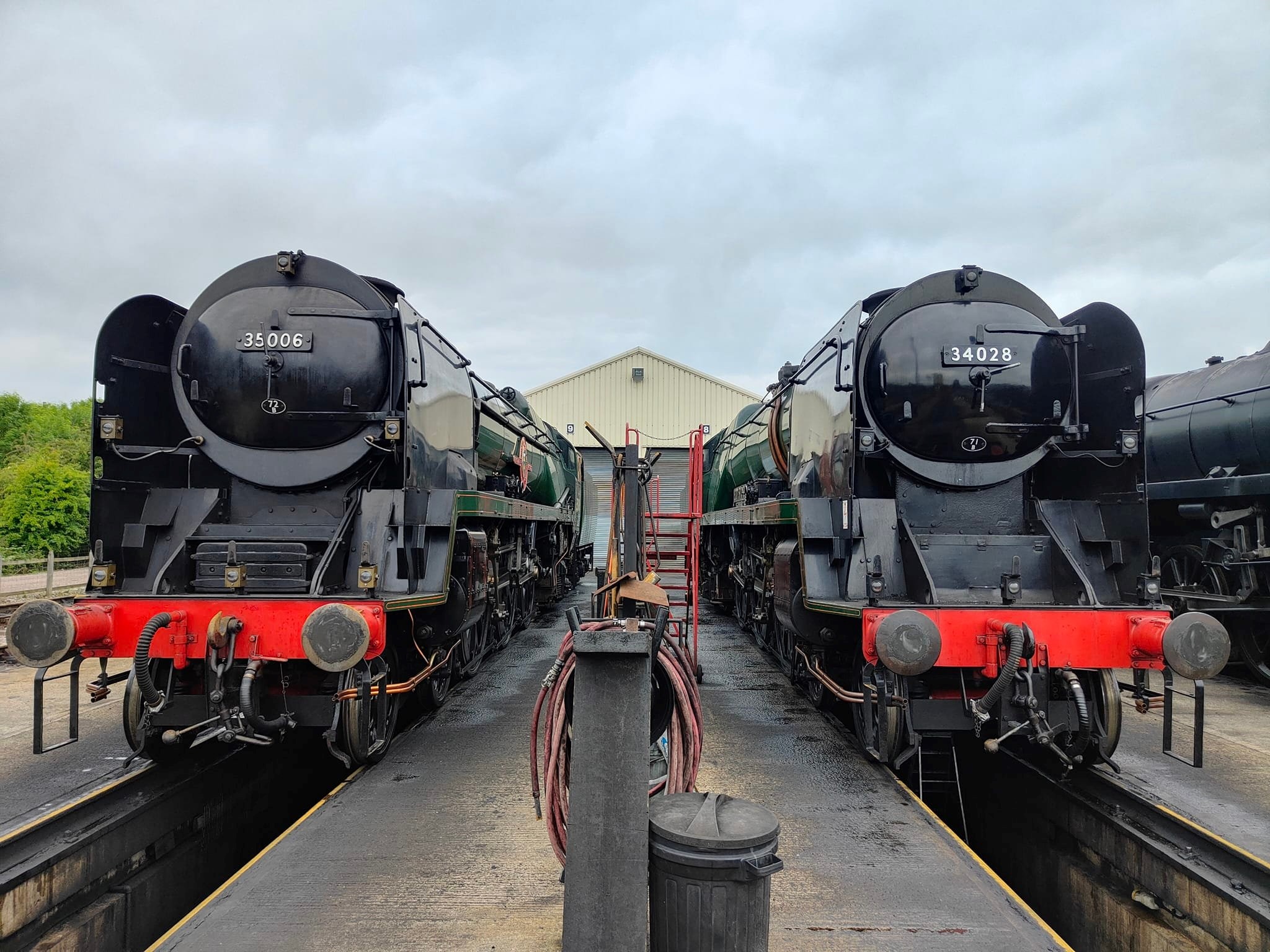
The visit of ‘U’ Class 31806 ensures that once again, the railway’s resident SR rebuilt Merchant Navy Class 4-6-2 locomotive No. 35006 ‘Peninsular & Oriental S. N. Co.’, has some Southern Region company for the prestigious event in 2023. Visitors to last year’s Cotswold Festival of Steam will remember the sights and sounds of SR rebuilt West County Class 4-6-2 No. 34028 ‘Eddystone’, which like 31806, appeared thanks to the support of our Swanage Railway friends.


A pair of Bulleids! - 35006 ‘Peninsular & Oriental S. N. Co.’ & 34028 ‘Eddystone’ on shed – 6th June 2022
 
Time for a little bit of history on the Southern’s link with Cheltenham and ‘U’ Class No. 31806.

The SR reached Cheltenham via the former Midland & South Western Junction Railway from Andover via Swindon, Cirencester and Andoversford. At Cheltenham, the SR trains originally used the former Midland station at Cheltenham Spa but latterly Cheltenham St. James, the SR locomotives being serviced at Cheltenham Malvern Road depot. 31806, which is known to have visited Cheltenham, is one of Richard Maunsell’s attractive and successful light passenger engines introduced in 1928.

 
Maunsell SR ‘U’ Class 2-6-0 Mogul No. 31806 - Photo courtesy of Kenny Felstead
 
The design took many principles from Churchward’s GW locomotives including long-travel valves.  The first 20, including 31806, were rebuilds of Maunsell’s ill-fated ‘River’ (‘K’) Class 2-6-4Ts, with the ‘U’ Class’s development and construction being accelerated in part as a result of the Sevenoaks railway accident on 24th August 1927. The 50 members of the class were built (or re-built) at Ashford, Brighton and Eastleigh. 31806 was re-built at Brighton in 1928 from a 1926 2-6-4T – ‘K’ Class No. A806 ‘River Torridge’. The class gained the nickname ‘U-Boats’ after the submarine warfare of the First World War and in reference to their 'go anywhere' nature - the 'U's operated widely across the Southern Region. 
 
The Sevenoaks Railway Accident - Video © Phoenix History
 
Maunsell SR ‘U’ Class 2-6-0 Mogul No. 31806 - Photo courtesy of Ethan Waller
 
Locomotive A806 entered service in 1928 and by nationalisation it had spent time at Nine Elms (9E, circa 21st March 1932) Basingstoke (BAS, 1939), Redhill (RED), and Guildford (GFD) sheds. The ‘U’ Class numbering was rationalized when the final batch of ‘U’s were constructed between 1932 & 1934, which resulted in the ‘A’ prefix being dropped and replaced with a ‘1’. 
 
31806 arriving at Highley - Photo © Tony Hisgett (CC BY 2.0) - https://flic.kr/p/djSpcU
 
Records indicate that A806 left Ashford Works paint shop on the 1st September 1932, wearing the number 1806. By December 1934, the locomotive had acquired the rather distinctive ‘half height’ smoke deflectors.

In 1945, 1806 underwent minor repairs at Guildford (GFD) and the loco remained there until after nationalisation. It left the paint shop on the 1st April 1949 renumbered as 31806 and wearing BR Mixed Traffic Black livery. In 1953, a new 4000-gallon tender was fitted replacing its original as-supplied 3500-gallon tender. 31806s BR motive power depot allocations since 1948 also included; Basingstoke (70D), Faversham (FAV), Nine Elms (70A) and Stewarts Lane (BAT).
 
SR U Class No. 31806 at Alresford, Hampshire. Seen about to run round its train, following the arrival from Alton - Photo © Peter Trimming (cc-by-sa/2.0) - geograph.org.uk/p/2881891
 
The Return of a Mainline U Class - 31806 Test Run 13/04/18 - Video ©
FrontLineSteam
 
As the 1960’s was approaching, it was evident that a number of the class were suffering from cracks in the light weight frames and worn out cylinders. In September 1957, having covered nearly 836,000 miles, 31806 travelled to Ashford Works where it was fitted with a ‘new front end’ which comprised of a new blast pipe, chimney and BR type 4 cylinder blocks. In addition, its tender was swapped back to the same 3500-gallon type which it had been supplied with in 1928. 
 
The locomotive retuned to traffic on the 1st November 1957. Records indicate that the last modification made during its SR/BR career was the fitment of the Automatic Waning System (AWS). This work was carried out at some point between 1957 and April 1963 when it returned to Guildford (70C).
 
U class 2-6-0 No. 31806 at Ropley depot on the Mid Hants Railway (MHR) - Photo © Bob Walters (cc-by-sa/2.0) - geograph.org.uk/p/7365231
 
31806 at Kidderminster - Photo © Tony Hisgett (CC BY 2.0) - https://flic.kr/p/djHtae
 
Its successful career ended when it was withdrawn at Guildford shed on the 5th January 1964 after 34 years & 7 months of service, by which time it had covered nearly 1 million miles. Later in 1964, it was sent to Woodham’s Scrapyard at Barry, South Wales where it remained for over 12 years.

The locomotive was rescued by John Bunch for preservation at the Mid-Hants Railway in October 1976. Restoration commenced in 1979 and 31806 was returned to service in April 1981.

 
31806 & 61306 "Mayflower" power through Hampshire - Steam Dreams Excursion 20/06/2021 - Video
© TheSoutherner
 
After 10 years of service at the Mid-Hants Railway, its boiler ticket expired and the locomotive remained out of service pending overhaul. 31806 eventually re-entered traffic on the railway in 2011. In 2014, it moved to its current home at the Swanage Railway and forms part of the railway’s resident fleet. The ‘U-Boat’ has proven to be easy to maintain, efficient and is very popular with the locomotive crews and visitors alike.

The engine is the oldest of the four ‘U’ Classes in preservation and the only ‘River’ rebuild still in existence.


Tickets for the Festival are available online at www.gwsr.com. With up to eight steam locomotives running, it will offer an action-packed timetable of trains, including goods trains and shunting demonstrations. The locomotive and carriage & wagon workshops will throw open their doors for rare behind-the-scenes visits and there will be plenty of other activity at the railway’s stations. The opportunity to travel between the only operational ‘U’ is not to be missed.
 
The ‘U-Boat’ is the fifth visiting engine to be confirmed.  Four other visiting locomotives have been confirmed for the event: Standard Class 4 4-6-0 No. 75014 Braveheart, appearing courtesy of the Dartmouth Steam Railway, Great Western Railway ‘Castle’ Class No. 4079 Pendennis Castle, appearing courtesy of the Great Western Society at Didcot Railway Centre,  L&Y ‘Pug’ No. 11243, appearing courtesy of the Lancashire & Yorkshire Trust based on the East Lancashire Railway, and Standard Class 2 2-6-0 No. 78019, appearing courtesy of the Loughborough Standard Locomotive Group and the Great Central Railway.
 
Maunsell SR ‘U’ Class 2-6-0 Mogul No. 31806 - Photo courtesy of Ethan Waller

 
Further information about 31806 can be found here: https://www.swanagerailway.co.uk/locomotives-stock/sr-2-6-0-u-class-no-31806
 
Important Note: New websites were launched earlier this year for both the GWSR and the GWRT, thus any pre-existing bookmarks to the main blog page via the old GWSR website will no longer work. The new websites can be found by visiting https://www.gwsr.com/ (GWSR) and https://www.gwrt.org.uk/ (GWRT).

All of the departmental blogs can now be found on a new main blog page here: https://www.gwsr.com/knowledge/blogs

A general steam department blog update is to follow in due course. Recent loco announcements have jumped the queue.
 
Alex (the sooty one!).
 
All published photographs are my own unless otherwise stated/credited.

Wednesday, 5 April 2023

All good things come in twos!

BR Standard Class 2 2-6-0 No. 78019 - Photo courtesy of Peter Hackney
 
To allay any potential fears that I have been missing in action over the past month or so, I can confirm that I have not been living under the proverbial rock, which would be rather uncomfortable to say the least! I've been merely juggling a number of GWSR related 'hats' so to speak, or to coin the phrase 'the spinning of multiple plates!' - Sadly, I don't have a turntable at my disposal to spin, thus a few plates will have to suffice in this particular instance. Towards the end of February I was approached by the railway's resident Press Officer, Ian, to see if I would be interested in joining the PR & Communications team. As you might have guessed, Ian's proposition was dully accepted and I now have another hat!
 
My days now usually consist of multiple emails and a fair few Zoom meetings, but it's all good fun and helps keep things chuffing along the track. When I'm not chained to my keyboard I do get let out for good behaviour and I'm still very much an active member of the steam department. I jest of course, but a top tip for any budding volunteer is to make sure that you don't sit still for too long otherwise you may find yourself commandeered for other purposes. PR activities and particularly those in relation to gala planning have taken priority of late, hence why it's been a bit quiet on the steam department blog front. I will endeavour to keep you updated on activities as and when I can, so please don't worry folks.
 
BR Standard Class 4 4-6-0 No. 75014 'Braveheart' prepares to depart Winchcombe - 4th April 2023
 
Having already announced a Great Western Railway ‘Castle’ class, a British Railways Standard class 4 and a former Lancashire & Yorkshire Railway ‘Pug’ tank locomotive for the ‘Cotswold Festival of Steam’ (12-14 May 2023), I can now confirm the fourth visiting locomotive. The opening photograph is a bit of a giveaway but a versatile and popular 69-year-old British Railways mixed traffic 2-6-0 is to join the roster. The locomotive in question is BR Standard Class 2MT 2-6-0 Mogul No. 78019, and is appearing by courtesy of the Great Central Railway, the Loughborough Standard Locomotive Group and the Charles Newton Trust.  78019 will be operating at the May festival alongside its previously announced bigger brother - BR Standard Class 4MT 4-6-0 No. 75014 ‘Braveheart’, adding to an already impressive line-up.

78019 working the local service out of Quorn on GCR D6535 on the rear - Video © RawRails
 
The BR Standard 2 2-6-0s were derived from the earlier LMS Ivatt 2-6-0 moguls, of which 65 were constructed at Darlington Works between 1952 & 1956. They were assigned the 78XXX number range (78000–78064) and predominantly designed for light passenger work. From a mechanical perspective, they were virtually identical to their Ivatt predecessors, with some changes made to the controls and cab to enable the locomotives to fit within a universal loading gauge. Grease lubrication points were added along with the use of BR standard injectors and clacks.

The locomotives were fitted with BR3 3,000-gallon tenders, which, like the Ivatt moguls, featured a tender cab to improve visibility and crew protection when operating tender first. A further improvement with the tender involved using Timken roller bearings on the wheelsets. The locomotives gained a reputation amongst crews for being very sure footed and soon received the nickname ‘Mickey Mouse’ (as did their LMS Ivatt brethren). Speaking of LMS Ivatts, readers will remember that 46521 visited us last year for CFoS 2022 and then stayed with us throughout the summer holidays. We did have fun!
 
BR Standard Class 2 2-6-0 No. 78019 - Photo courtesy of Peter Hackney

All 65 locomotives were in service by the start of 1957, with up to 10 being allocated to the Western Region (WR) between 1955 and 1966. Standard 2s could be found at Hereford (86C), Machynlleth (89C), Oswestry (89A), Worcester (85A) and Gloucester. Between 1962 and December 1965, a small number were allocated between Gloucester Barnwood (85E/85C) and Gloucester Horton Road (85B), including: 78001, 78004, 78005, 78006 & 78009. Barnwood shed closed on the 4th May 1964, which resulted in 3 being transferred to Horton Road - records indicate that these locomotives were: 78001, 78005 & 78006. Before and after the merger of the Gloucester sheds, one of the Standard 2s regular workings was the goods on the ex-Midland branch from Stonehouse to Stroud, Dudbridge, Woodchester and Nailsworth. The class were also used on passenger workings between Hereford and Gloucester and beyond.  

Gloucester Horton Road shed was closed to steam on the 1st January 1966. Withdrawals of the class started in late 1963 with the final examples being withdrawn in May 1967.
 
BR Standard Class 2 2-6-0 No. 78019 - Photo courtesy of Peter Hackney

78019 was completed at Darlington in March 1954 and spent its early years in the North East and North West. Between 1954 and May 1963 the locomotive spent time at Kirkby Stephen (51H), Springs Branch (Wigan) (8F) and Northwich (8E). In late May 1963, 78019 was allocated to Willesden (1A), alongside a small group of 78XXXs to work empty stock trains out of Euston until the end of steam there. After spending some time at Crewe South (5B), 78019 was withdrawn from BR service in November 1966 - Like many of the BR Standard classes, the Standard 2s sadly had a very short life in active service. In hindsight, it was very short sighted, but the writing was on the wall with dieselisation picking up pace.   

The locomotive was sold to Woodham’s yard in Barry, South Wales and remained there until March 1973. 78019 was purchased by Charles Newton and initially moved to a private site, before being transferred to the Severn Valley Railway where it sat for over 20 years. In 1998, following a deal between Loughborough Standard Locomotive Group Ltd and 78019’s owner, Charles Newton – where joint equal ownership was agreed, the locomotive moved to Loughborough and restoration began. 78019 was returned to steam on the Great Central Railway in 2004 and appeared at its Summer Gala.
 
BR Standard Class 2 2-6-0 No. 78019 - Photo courtesy of Peter Hackney
 
Since being returned to steam, the Standard 2 operated successfully for ten years and went through routine maintenance, proving itself to be both an economical and capable locomotive. The boiler ticket expired in May 2015 and 78019 was subsequently put through heavy overhaul at Loughborough, with some work including the boiler being carried out at Tyseley.

78019’s overhaul was completed during 2022 before being returned to traffic again in November in time for the railways ‘Last Hurrah’ Gala, where it worked alongside sister locomotive no 78018.

Great Central Railway welcomes back 78019 at the 'Last Hurrah' Gala 20/11/22 - Video © FrontLineSteam
 
78019 is notable for being involved in a rescue effort when 78018 got stuck in a snowdrift at Bleath Gill near Stainmore Summit at 5am on the morning of the 24th February 1955. 78018 had departed Kirkby Stephen with a 4:20am goods train, made up of 20-ton wagons of limestone and minerals. The incident was the subject of the 1955 British Transport Film documentary ‘Snowdrift at Bleath Gill’ directed by Kenneth Fairbairn.
 
Snowdrift at Bleath Gill (1955) - Video © BFI

Tickets for the Festival are available online at https://www.gwsr.com/galas/steam-gala. With up to eight steam locomotives running, it will offer an action-packed timetable of trains, including goods trains and shunting demonstrations.  The locomotive and carriage & wagon workshops will throw open their doors for rare behind-the-scenes visits and there will be plenty of other activity at the railway’s stations. The opportunity to travel between two visiting ‘Standards’ is not to be missed.


Further information about 78019 can be found here: https://www.gcrailway.co.uk/the-railway/locomotives/78019-2/
 
Important Note: New websites were launched earlier this year for both the GWSR and the GWRT, thus any pre-existing bookmarks to the main blog page via the old GWSR website will no longer work. The new websites can be found by visiting https://www.gwsr.com/ (GWSR) and https://www.gwrt.org.uk/ (GWRT).

All of the departmental blogs can now be found on a new main blog page here: https://www.gwsr.com/knowledge/blogs

Until next time folks, further news and announcements are on the way!
 
A general steam department blog update is to follow in due course.
 
Alex (the sooty one!).
 
All published photographs are my own unless otherwise stated/credited.