Monday, 19 March 2018

While The Cat's Away

Your humble blogger took a week's holiday and has had to depend on his network of spies to compile the blog this week.  The world of espionage is indeed a hazardous one, but before anybody gets too concerned, they are probably all safe from revenge "Novichok" attacks by foreign governments.... well fairly safe anyway, though there is no harm in their relatives taking out extra life insurance on them I suppose.

My holiday wasn't entirely steam free, as one day was spent on the Keighley & Worth Valley Railway playing with what was so nearly one of our gala guests last year.
S&DJR 7F, 53808, plus convenient puddle in Mytholmes Tunnel
We are now just getting into our stride with the 2018 operating season, with the last week seeing the running of a series of race trains to the Cheltenham Gold Cup horse racing event.  Toddington effectively becomes a park and ride terminus for the race goers.  35006 along with Foremarke Hall and Dinmore Manor shared the duties this year.
35006 departs Toddington for Cheltenham Race Course (photo courtesy of Chris Ardy)
  You may remember that this time last year, one of our drivers, Andy, was interviewed live on BBC Radio 2 by Chris Evans.  History has repeated itself, and this time Chris Evans was there in person, along with Olympic cyclist and now horse jockey, Victoria Pendleton.
L-r, Andy, Chris Evans, Victoria Pendleton, Ben (photo courtesy of Luke Hudman) 
On the platform wearing the blue top, is Chris, the GWSR's volunteer finance director, who was interviewed on Chris Evans' show, you can find a recording of the interview by clicking on this link and scrolling forward 2 hours and 47 minutes.

Just because our locomotives & rolling stock are from a bygone age, doesn't mean that we shouldn't embrace modern technology when it is appropriate.  I'll infer from the fact that you are reading this blog that you agree. One appropriate advance in technology of recent years is low power LED lights of which the first five have now been installed in the David Page shed by Nigel & Peter.  We'll have better lighting and rack up lower electricity bills.
Five up, thirty more to go (photo courtesy of Peter Gutteridge)
 With the running fleet mostly being out earning their keep on the line, there has been little going on by way of maintenance.  2807's group have got to the end of their winter maintenance jobs and have focused on lubricating, cleaning and changing a wrong sized split pin.  There are still the various restoration projects to be worked on of course, and now that Dinmore Manor's winter maintenance has come to an end, the DMLL group have returned their attention to 3850. On Saturday, Matt, Anthony & Sam cracked on with wire brushing & painting the frames. Several people have forwarded photos to me.
Frame stretchers wire brushed & primed (photo courtesy of Sam Perry)
More frame stretchers wire brushed & primed (photo courtesy of Sam Perry)

You will note from the above photo that the old cylinder block is still fitted.  We are hoping that the new one will be cast in the near future, watch this space.
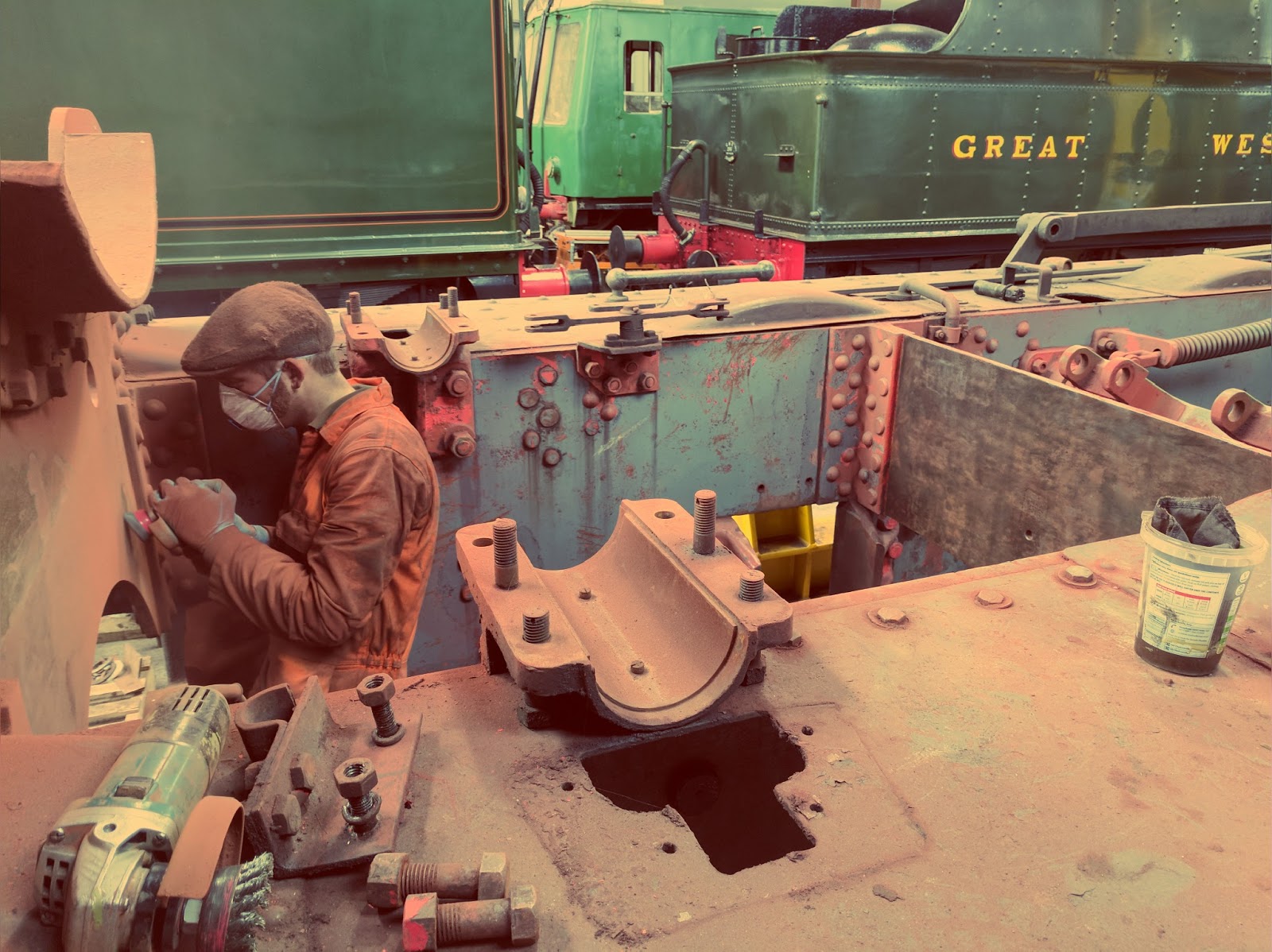
Sam at work (photo courtesy of Matt Hill)
Drag box now in top coat (photo courtesy of Matt Hill)
While much of the outside of the frames is in undercoat (photo courtesy of Matt Hill)
Last, but far from least regarding 3850, is that the boiler from 3845 that will now be used on 3850 has been sent to Ian Riley & Son for refurbishment.
3845's boiler in flight (photo courtesy of Mark Young)
3845's boiler about to depart (photo courtesy of Mark Young)
 As I have seen several people enquiring on various online forums regarding what is to happen to 3845, although it has lost its boiler, it remains very much in the DMLL restoration queue and will be restored in its own right when funds and volunteer resources permit, probably using 3850's old boiler.

And finally, we unfortunately lost another running day due to the unseasonably late snow on Sunday. The following four photos are all courtesy of Nick Carter
Toddington was snowbound once more...
...35006 was once more a block of ice
 The only sensible recourse of action if you can't light up a loco and keep warm by the fire, is to do some work, in this case making sparks fly on Dinmore Manor's old tender (T1761), which needed some old bits of the rotted floor plate removing before new sections can be welded in.
Making sparks fly
Ready for a new floor to be welded in

Here's hoping that there are no more "beasts from the East" to torment us for a while, especially over the Broadway opening weekend.  Keep your fingers crossed!


Sunday, 11 March 2018

First Steam to Broadway

The big news this week is that Foremarke Hall has become the first steam locomotive to arrive at Broadway station under its own steam in the heritage era.  She went there on a gauging run on Friday.
Foremarke Hall at Broadway (photo copyright Jack Boskett)
Jack is in the happy position of being able to make a living out of photography, if you want to now more about the services he can offer, please follow this link.

Saturday marked the first running day of the new season, with Foremarke Hall rostered to pull the first train:
The view from the footplate at Cheltenham Racecourse (photo courtesy of Andy Beale)
I have received a few more photos of the steam test last Friday showing the work done by the select band of volunteers who battled through the snow

Dinmore Manor's snow covered safety valve bonnet (photo courtesy of Chris Smith)
Winter wonderland in the shed (photo courtesy of Chris Smith)
2807 & Dinmore Manor in steam (photo courtesy of Chris Smith)
Warming up injectors in a snow filled pit (photo courtesy of Chris Smith)
The drive home (photo courtesy of Chris Smith)

Those of you who have been keenly following the progress of 76077 will be pleased to know that the frames and wheel sets have now been ferried off to Loughborough where they will be converted into a rolling chassis by LMS (Locomotive Maintenance Services).  The boiler has remained with us, work won't start on that until the rolling chassis is further advanced.
Waiting patiently
 For some locos, Saturday marked the final day of winter maintenance, with Dinmore Manor finally receiving her new bogie spring hangers.
Spring hangers being fitted (photo courtesy of Keith Smith)
The 2807 group have also been running their winter maintenance programme up to the last minute, and have ticked off the various snags that needed attending to, such as missing split pins and a leaking steam feed to the driver's side injector.  One thing that was on the list was that the inner locking arm of the smoke box door had come adrift from its centre ring and needed welding up.  I happen to know who the culprit is (obviously doesn't know his own strength). 
2807's locking arm, in more bits than it should be.
Name withheld to protect the guilty.

And finally, Dinmore Manor (along with Foremarke Hall and 2807) will be hauling the first public trains to Broadway commencing on Friday 30th March (tickets sold out for the Friday, but later dates in the Easter weekend are still available).  To make sure that she is looking her absolute best, she has been lined out.  
Looking smart
7820
 Dinmore Manor first entered traffic in 1950 in lined black, before converting to unlined black in 1955.  It is appropriate therefore that she retains the early crest on her tender.
Cycling lion
 She even got dragged out into the sun on Saturday:
Dinmore Manor, all lined out and basking in the sun (photo courtesy of Mike Solloway)
 

Saturday, 3 March 2018

Keeping the Home Fleet Fires Burning

 The boiler inspector had been expected on Thursday, most of our home fleet being due their annual boiler inspections.  There was a late change of plan, and the inspections got deferred until Friday.  Yours truly, along with Pete had been rostered to turn up and bring the locos into steam on Thursday, in the event, all that was required was to put warming fires in.

Unless you have been hiding under a rock for the last few days, lurid headlines regarding "The beast from the East" and the rather less aggressive sounding "Emma" (How did we get to storm Emma?  We have already had storm Eleanor and even Georgina this year.  Doesn't the Met office know the alphabet?).  Regardless, it was certainly cold enough to have ensured that any self respecting brass monkeys had long since headed far south for the sun rather than face the  certain emasculation that accompanies such low temperatures.

The beast from the East and Emma had conspired to deposit a lot of snow on the marquee that 76077 is hiding under, its temporary home looking rather like an igloo. Inside, snug and warm, 76077 is now looking rather smart, with pretty much everything that needs to be painted now in top coat
Gloss black frames...
...red on the inside...
...and black driving wheels.
 It's looking very smart indeed.  We are now getting very close to the time that much of what you see in the photos will disappear off to Loughborough for the necessary mechanical attention.

The winter wonderland conditions looked rather delightful, but there were a few drawbacks.  The first of these was that there was no running water in the mess coach, all the pipes were frozen.  This is of course a calamitous state of affairs, it is well known that the steam loco dept is utterly incapacitated without tea.  Disaster was averted by Andy M kindly delivering 6 large plastic bottles of water.
Mike filling the kettle from a bottle of water
 Every cloud has a silver lining of course... no water meant having a good excuse to not do the washing up.

In anticipation of the steam test, 35006 had been in steam on Wednesday with a view to setting her safety valves.  Having been left overnight to cool down, and with still 20 PSI on the pressure gauge, it was a little surprising to discover that she was coated in a mass of icicles
From her motion...
... to her steam heat pipes...
...and even her cylinder drain cocks.
 The first task of the day was to do the usual pre-light up checks on Dinmore Manor, Foremarke Hall,  35006 and 2807.  Nothing noteworthy was discovered, except that on testing 2807's water gauge, Pete noticed that the water in the glass didn't drop as it should have done.  The cause unsurprisingly was that the water had frozen in the glass.  Fearing that the pressure of the ice would have compromised the integrity of the glass, it was decided to change it. 
Frozen
 Changing gauge glasses is something that I have never had to do in anger... and to be honest I don't fancy changing one when a loco is in steam.  Changing one whilst the boiler is cold is a much more appealing prospect.

Not everything is best done cold though, the new spring hanger bolts for Dinmore Manor's bogie had been machined and once we found where they had been hidden, they wanted painting.  Paint doesn't work very well when there is a wind chill of -11 (neither do I if I'm being honest), so a cunning plan was put into place.  First, some of the precious water was boiled and poured into a bucket.  The paint tin was then placed in the bucket, and after a few minutes, the paint had warmed up sufficiently to flow as it should.
Green primer warming!
 The next step was to paint the spring hangers, but not in one of the containers or even the shed, it was still far too cold to paint out there.  The cunning plan was to arrange the spring hanger bolts above new the radiator in the mess coach, where the paint would dry nicely in a fairly short time.
Pete applies primer
 Later in the day, I returned to apply a layer of grey undercoat.  The stock of water was much diminished by this point in time, so I dispensed with the nicety of warming the paint in a bucket of boiling water.
Soon be ready for a top coat
 There was no escaping it though, at some point I would have to forge a path through the Toddington tundra and brave the frozen wastes of the David Page shed to tick off a few more items on Dinmore Manor's winter maintenance schedule.  It may come as something of a surprise to you, but it seems that the roof of the David Page shed is entirely unable to prevent the ingress of snow.  If you look carefully at the photo below, taken fairly early in the day, you'll note that snow is falling and settling on the running plate of Dinmore Manor, exactly where I intended to work.  By the end of the day, it was much deeper.  The worst thing was, that if you leaned forward a bit to work on something, the snow flakes made their way down the back of your neck... highly unpleasant.  The inside of the shed in a number of places owed more to the frozen wastes of Antarctica than it did to the Cotswolds.
Snowing in the David Page shed
I started off with the straight forward task of refitting the steam heat gauge.  After that, the fireman's side piston valve had been inserted into its cylinder last weekend, it needed it's end cover fitting, packing at each end, lubrication fittings attached and the valve spindle crosshead re-installing.
Piston valve in its bore...
...front cover fitted
...packing in place and lubrication fitted.
 You may recollect from a recent blog that the 2807 group are considering fitting a lubricator similar to the above to the valve spindles on their loco.  The Churchward 2-8-0's didn't have them and the spindles tend to wear prematurely.
Valve spindle cross head fitted and ready for further service.
 There was no time to refit the section of running plate that gave access to the piston valves, it was time to pull out the locos onto the apron and commence the warming fires.  A minor hitch was that 35006, which had appeared to have enough water to put a warming fire in when checked first thing, had by now cooled down considerably since then and the water level was now too low and wanted topping up.  At this point, the recently installed hydrants capable of delivering water at a commendable rate of knots would have been pressed into service, however there was a slight issue, no water issued forth when the tap was opened
Oh dear!
 A couple of kettles full of the ever diminishing precious supply of bottled water were poured over the hydrant to try to thaw it out, all to no avail.  Eventually we tumbled to the fact that it had been winterised (can't imagine why, Thursday was the first day of Spring) and when the supply was turned back on, all was well.
Pumping water into a connector attached to 35006's blow down valve
 The serious matter of getting the locos nice and warm for their boiler tests on Friday could begin.  Although the fires were lit out in the yard, it was judged kinder to the locos to fetch them back into the shed when the worst of the smoke had died down.
Foremarke Hall, warming up back in the shed
Dinmore Manor, just lit up out in the cold
 35006's injectors were still frozen up at this point in time, a brazier was lit up nearby to help thaw them out.  It acted like a magnet for the poor frozen souls present at the time.
(l-r) Dan, Mike and Mark trying to warm up.
All warming fires lit, I beat a hasty retreat home, which was not as uneventful as I might have liked, the sight of a car pirouetting down the middle of the motorway in my rear view mirror was mildly disconcerting, the lorry that I passed on a hill with its driving wheels spinning furiously, yet still rolling backwards was quite alarming.  I was extremely grateful to my better half for letting me borrow her 4x4 for the day.
Apparently the boiler inspector braved the elements and made his way to Toddington on Friday, and now all of our home fleet with the exception of 4270 which is still at Crewe have successfully passed their annual assessments.  The following selection of photos from Friday's boiler test are all courtesy of Mike Solloway.
The home fleet (minus 4270) in steam
Dinmore Manor's bogie, with the broken spring hanger bolt that will soon be replaced
Foremarke Hall and 35006
35006's injectors needed warming through
Just getting into the signing off point was a challenge
 And finally, I mentioned a while ago the existence of the L Shed, the repository for artifacts that were not currently being publicly exhibited at the M Shed (previously better known at Bristol's Industrial Museum).  I finally managed to get enough stars in alignment to be able to pay it a visit during this last week.  I was rather privileged to be in a tour party of just one person, with a very knowledgable chap called Dave as my guide.  It was jam packed with interesting items, several Douglas motorcycles, horse drawn carriages etc and of course a wide variety of GWR railwayana.  If they were to auction it, they would make a small fortune.  The collection of name plates included the obvious Bristol connection in Colston Hall, though Edward Colston is nowadays a controversial figure as although his philanthropy is well known, so is the fact that he made his fortune from the slave trade.  The name plate at the top in the photo below, "Inkermann" is an Alma class 4-2-2 broad gauge locomotive which had a relatively short life from 1870 until 1892 when broad gauge was replaced by standard gauge on the GWR. 
L Shed nameplates
 There were numerous other items of railwayana, cast iron signs, wagon plates, station signs of various sorts and of course a selection of cab side number plates, including our own 3850.  I asked the obvious question of course, but apparently the curator would be highly unlikely to want to part with it.
3850 and friends
For the benefit of those who may not be able to remember all the numbers of GWR steam locomotives, 5923 was the number of Colston Hall and 4008 was the number of Royal Star. Umberslade Hall's cab side (4975) doesn't appear to be in the collection.  The price of admission was very reasonably priced in my opinion at absolutely free, and a tour is available on every Tuesday to Saturday..