Monday, 19 February 2018

De-Regulated

Sam sent in a few photos a week ago, within half an hour of me posting the last blog, of the various things that he had got up to on the Sunday::
The exposed part of Dinmore Manor's throat plate was painted...
...3850's drag box was undercoated...
...and more of 3850's frames were wire brushed & primed.
All the above photos courtesy of Sam Perry.

Moving along to this weekend, further progress was made on painting 3850's frames and tender T1761 by Anthony and Roger.
Anthony wire brushing 3850's frames
Roger applying top coat to tender T1761
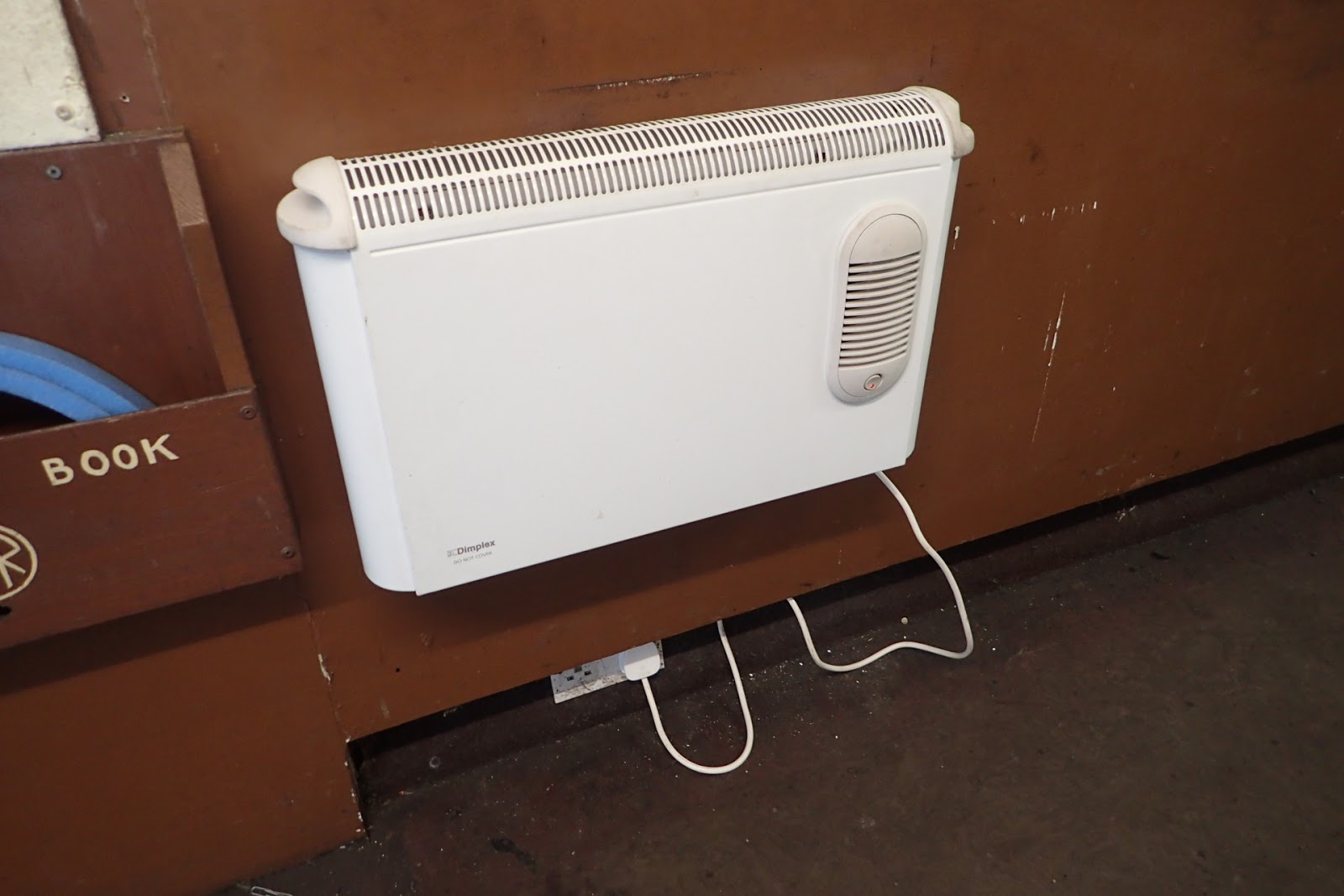
Saturday morning turned up a treasure trove of photo opportunities in the mess coach.  First, and by no means least, new wall mounted electric heaters have appeared.  The mess coach was toasty warm, and it proved hard to extract the volunteers from the kettle and the heaters to go and do some work.  No doubt when the powers that be realise that the electricity bill has gone up and productivity has gone down, then the heaters will disappear, never to be seen again.  We'll enjoy them while we can. 
A most welcome addition!
 As you may dimly recollect from school Physics lessons, white is a poor choice of colour for a radiator from the ability to transfer heat into a room point of view. Never mind, after a few weeks in the mess coach, they will doubtless change to a coal shade of black

An item that I have been most remiss in failing to mention is the our beloved mess coach is soon to be superseded by a nice shiny new "Welfare Building"... translated from management speak, that is a mess coach without wheels.  The plans have been on the mess coach wall for a few weeks now.  The good news is that it will be in brick and will continue seamlessly on from the goods shed in the same style.  There is no bad news, except that if the diagrams on the wall are anything to go by, we'll have to change out of our overalls and put on pin stripe suits and carry about brief cases and umbrellas.  Some have noticed that there is considerable attic space available and are plotting immense model railway layouts (though why bother when there is a 12" to the foot version right outside the window).  Others have noted the opportunity for setting up a barbecue and watching the trains go by on the raised platform at the south end.
Pin stripe suit, brief case & brolly
 A feature that appeared in the shed a little while back and received little publicity on this blog, was the fire hydrants.  Not fire hydrants for the purposes of putting out fires... we usually like to keep them going here, these are for filling boilers and tenders.
A hydrant in use...
...filling Foremarke Hall's tender.
 Whilst on the subject of Foremarke Hall, John C was keen to point out a modified feature (well it is a Modified Hall after all) that John H had recently installed:
Foremarke Hall's pep pipe handle
It looks like any other GWR pep pipe handle, however it is a slightly larger body than usual and has been stuffed with Klinger (no, nothing to do with Captain James T. Kirk's arch enemies) packing, and has been tested and found to be drip free, even with 450 PSI applied to it.  Should the boiler pressure actually reach 450 PSI, you'll know by the fact that I will be running away from it at great speed!

The excesses of the Yuletide turkey etc have yet to disappear from my waistline, so when Mike said "You're nice and slim, I've got just the job for you", I was suckered in and fell for the flattery.  The task was to investigate Dinmore Manor's tender and find out why it appeared to mildly flex occasionally.  I've been inside tenders before, not the nicest of jobs.  "It is dry in there isn't it?" I asked... "Oh yes, perfectly dry, it's been drained since the end of the season".  This turned out to be a new usage of the word "dry" with which I was not familiar.  Needless to say, I had also turned up in a freshly washed pair of overalls.

For those of you who have never experienced the unbridled joys of entering the water space of a tender, it is divided internally into a number of compartments to minimise the water sloshing around and upsetting the stability of the tender whilst in motion.  The holes between compartments are of course designed for malnourished Victorian waifs and strays who had only just been barred from cleaning chimneys from the inside, and not well fed middle aged men.  Crawling around on your hands and knees and attempting feats of contortionism that would be more suited to a teenage gymnast is the order of the day. 
Not for the claustrophobic
 My inspection was inconclusive, no welds had given way and everything appeared to be rock solid
I went all the way to the float chamber in my fruitless endeavour.
To make matters worse, Eleanor, who was on the footplate at the time dropped a large piece of wood into the coal space of the tender that had until recently taken on the function of a comfortable seat for the team rebuilding the grate in the firebox.  This caused some amusement to others present on the footplate suggesting that it would have deafened me.  She claims to this day that she didn't know that I was inside the tender.

For your amusement, this is how you look after emerging from the sludge at the bottom of the tender:
My legs were wet for much of the rest of the day
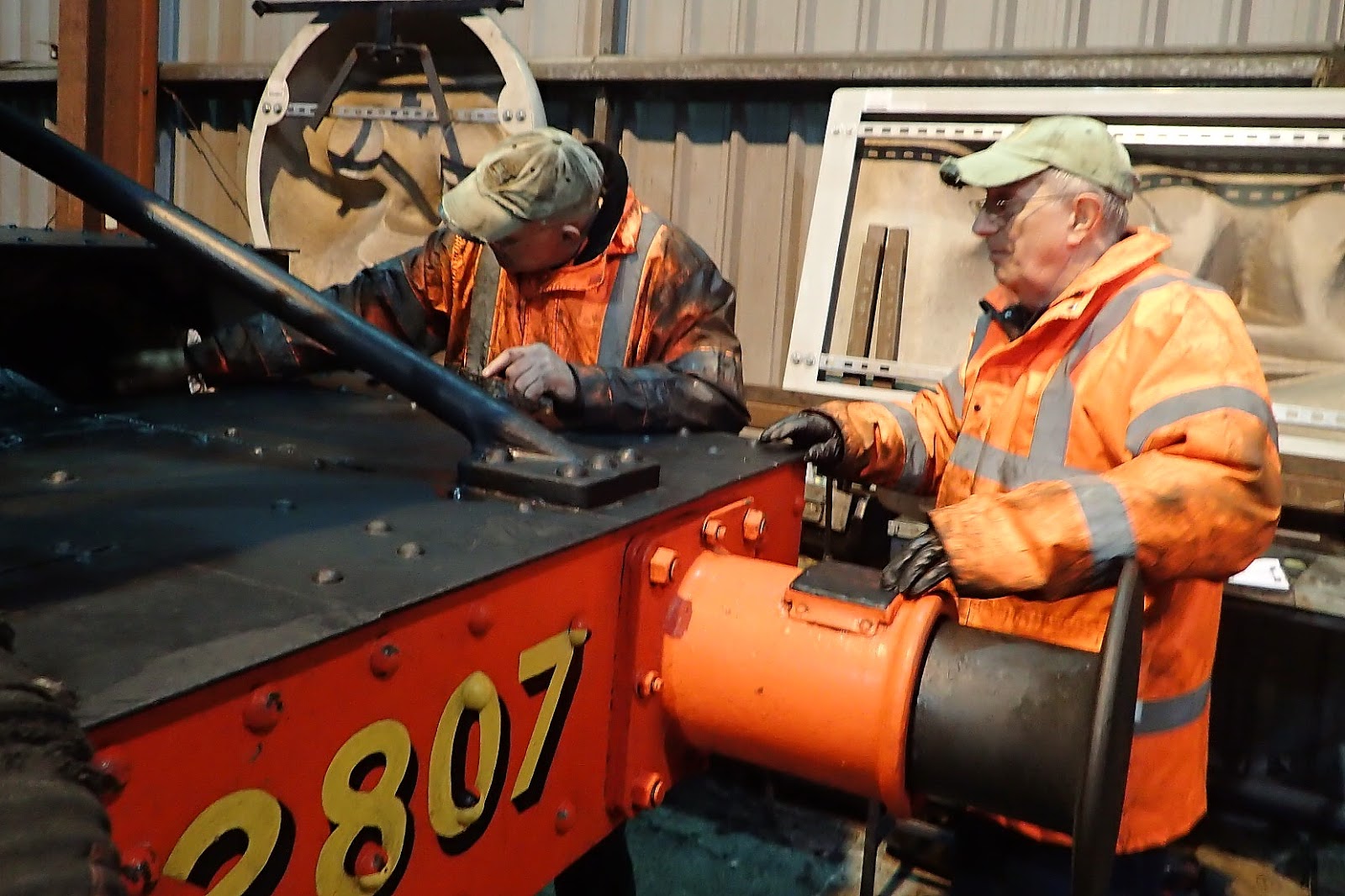
The big task for the 2807 group on Saturday was to press in the bushes into the coupling rods and start to re-fit them to the loco.
A highly visible Graham and 2807's coupling rods
 Cleaning the rear faces of coupling rods is a tricky and as nobody ever sees them fairly pointless thing to do, so they are usually protected from the elements by a good coat or two of paint.  The face presented to the public when 2807 reappears in traffic will of course be the bare steel currently on the underneath in the above photo.
Pressing in one of the bushes

 By the end of the day, one of the coupling rods was back in place.
Trailing coupling rod re-fitted

The cylinders that the piston valves live in can be re-bored rather like a car engines cylinders can be.  To accommodate the larger bore size, the heads for the piston valves come in two sizes, A (small) and B (large).  Although Dinmore Manor's fireman's side has been bored out large enough to warrant a B size set of piston valve heads, none were available at the time, so she has run with the A size heads.  A set of B size heads have now been sourced and will be installed for the new season.  My next job was to dismantle the piston valves and put on the B size heads 
A size heads in place
The steam side of the B size heads in position.
 The merry band of people painting 76077 in the marquee in the car park have made excellent progress, with much of it now in a second undercoat (the orange/brown colour in the photos below), with some of the wheels even progressing into a top coat of black.
Cliff undercoating 76077's frames
 I had noticed that in several places, there were black crosses marked.  Apparently this doesn't signify the location of buried treasure, just that no more paint should be applied.
X marks the spot!
Top coated wheels.
 You may recollect from this blog a few weeks ago that a side fire bar from 2807 had a split in one part of it.  A new one was quoted as having a lengthy lead time, so a decision was taken to repair the old one as an interim solution and will at least allow it to be steam tested in the near future.

Before it could be welded, it needed to be heated up
Eleanor heating the fire bar...
...and Joe welding it back together again.
 Next stop for Dinmore Manor was out in the yard to get coaled up.
Jeff dropping the first of a number of bucket loads of coal
 Meanwhile, John finished off installing the mud hole doors.  The tried and trusted method of warming up the neoprene sealing rings in a tea pot full of boiling water was employed.
I'll stick to peppermint tea thanks.
John installing one of the less accessible mud hole doors.
 The other major task taking place was the extraction of the regulator housing from 3845's boiler.  This is not a simple task, it's a pretty heavy lump of cast iron securely affixed to the smoke box tube plate and from a health and safety point of view, you really don't want it to come crashing down on you when you finally pry it loose, the paperwork involved would be horrendous.  It probably wouldn't do the casting any good either.   The trick was to gas-axe the nuts that held it in place off, whilst using the forks of the telehandler to make sure that if it did break free, that it couldn't fall. Once the nuts were all off, the next step was to heat the casing cherry red, stand well clear and let the telehandler give it a few nudges to free it up and then lift it down.
Heat being applied...
...it's coming free...
...regulator housing in flight...
...and left to cool down for a while.


Sunday, 11 February 2018

How Many Kings?

As I'm sure you're aware, we're well into the winter maintenance season now, in fact quite scarily we have less than a month before the start of the 2018 season.  As a consequence there has been much beavering away at the various operational locos lately.   That isn't to say that the operational side has taken a complete back seat, many people turned up on Saturday, unrecognisable in normal clothes rather than grubby overalls to take their biennial rules & signals exams.  Last week, there were plenty of people similarly attired in normal clothing to have a mutual improvement session on the changes that will take place to the rule book and also a little on how the Broadway section will operate.

The winter maintenance on the operational fleet hasn't precluded a limited amount of work on 3850, work has started on wire brushing and priming sections of the frames.  I received this photo from Sam almost a fortnight ago now showing that the drag box had been primed:
3850's drag box (Photo courtesy of Sam Perry)

On Saturday, I noted that the drag box was now in grey undercoat and a section of the frames has received primer:
Slow but sure progress
 Tony & Devindra continued the process
Tony wire brushing 3850's frames
 I even did a bit myself:
The other side of 3850's frames
Dinmore Manor's driver's side piston valve had been reassembled and was ready to be reinstalled
7820's piston valve
 The recent weather had caused significant condensation in the valve bores, which had in its turn caused a light glazing of rust to appear.  In order to remove the rust prior to reinstalling the piston valve, Tony gave the bore a quick rub down with some very fine grade wet & dry paper.  The far end was out of reach, and the hole for the spindle to small to admit a hand, so the wet & dry paper was secured to a piece of wood by a cable tie and the far end could be treated.
Tony removing rust at the near end...
...then at the far end.
Later in the day, Will returned the piston valve back into its bore and attached the lubrication mechanism to the end of the spindle.
Will attaching the valve spindle lubricator
 Remember the presence of the valve spindle lubricator, I shall return to that topic in this post.
Will and Donna refitting the covers on the running plate.
Mark measuring tolerances on the fireman's side piston valve.
As mentioned earlier, not all the work on the go at the moment is related to winter maintenance, the Peckett, John, is still being slowly worked on by a small team, mostly working on Sundays.
Tom refitting the Peckett's slide valves
 2807 is making sound progress towards being ready for the start of the season:
Bruce refitting the innards of one of the injectors
 One of the double width fire bars has been discovered to have a crack through it, a new one is on order.
It might get welded and held in reserve as a spare
 I mentioned above that the topic of valve spindle lubrication would be returned to.  Due to excessive wear on the valve spindles of the 2800 2-8-0's, when Collett introduced his 2884 class (essentially an upgraded version of the 2800), amongst the items that he added was a lubricator on the end of the spindle.  The modification wasn't retrofitted to the earlier 2800 class.  Wear has been noted on the valve spindles of 2807, and the owning group are mulling over the idea of modifying 2807 to incorporate a suitable lubricator.
No lubricator here, compare to the photo of Dinmore Manor back up above somewhere.
Gil & Bruce, weighing up the pros and cons
 The change if it were to be made would be noticeable externally, note the raised bump in the valve inspection cover on Dinmore Manor to accommodate the lubricator, and the small oil filler pot on top of the running plate.
Something like how it may end up looking
35006 has her springs refitted now and is back down on her wheels again, but there is still plenty to be done.
Jamie was refitting the washout plugs...
...whilst the buffer beam accoutrements were being refitted
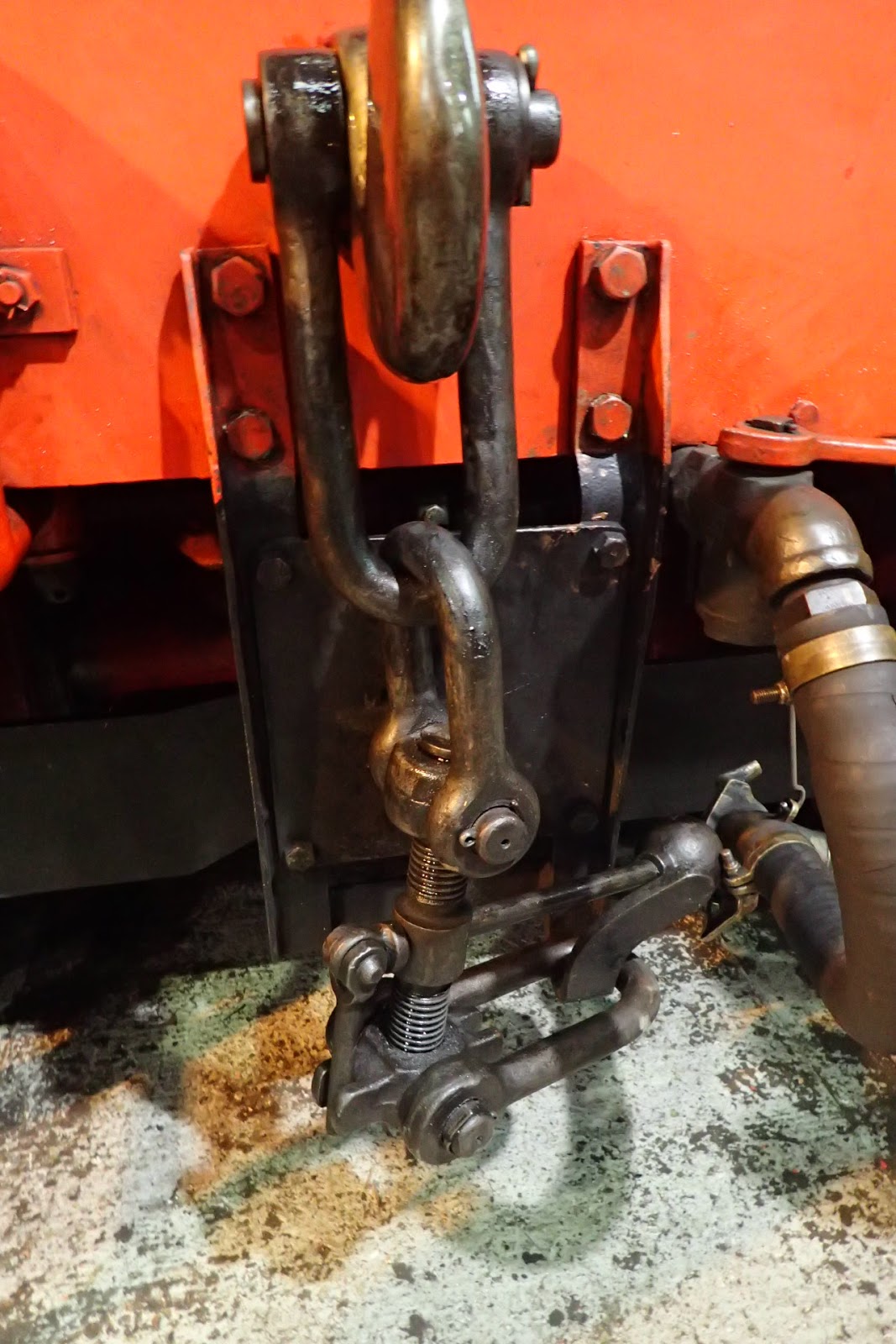
 Steve was keen for me to point out to our crews that the front coupling should be stowed as shown in the photo below when not in use... apparently not everybody gets it right.
Like this!
The painting of 76077 before its departure to Locomotive Maintenance Services in Loughborough has been coming on very well.  The frames, wheels & pony truck have all been primed and mostly put into grey undercoat by the start of Saturday, and by the end of the day, much of it had gained a second undercoat, this time in brown.
Pony truck...
...frames...
...and wheels, in grey undercoat
 Towards the end of Saturday:
Chris H, finishing off the grey undercoat...
L-R, Ade, Gwendolynne & Chris I putting on brown undercoat...
...the fruits of their labours later on.
And finally, reverting back to the story of last week's blog, the (subject to contract) booking of 6023, King Edward II for our Cotswold Festival of Steam gala on May 26th - 28th, I'd firstly like to say thank you to Steve O, who burnt some midnight oil in making the web pages fully visible.  Our website (yes, the recently updated and "improved" one) is still rather painful to upload information to, and my efforts as it turned out were only partially successful.  You will find that much more information is now present and correct.  Advance ticket sales for the Cotswold Festival of Steam Gala have just become available, click here to order yours now.

The second point is that several people have come up to me enquiring about were there really 30 Kings made, or 31?  For reasons that I shan't bore you with, this is a topic that is of interest to me and a number of years ago I spent a little time researching it.  The confusion arises from the Shrivenham Railway Accident of 15th January 1936.  The official report, linked to above is an interesting read and explains why having tail lights fitted onto the ends of trains is so important, and why signalmen should check that they are present and correct when trains pass their signal boxes.  In short, 6007, King William III at approx 05:30 on the morning of 15th January 1936 crashed into the back of a five wagons and a brake van that had become detached from a preceding goods train hauled by 2802.  Apart from being a cautionary tale regarding the duties of signalmen & guards, it is also a reminder that coupling hooks need to be manufactured to a high standard.  It's a little hard to track down these days, but "Peto's Register of Great Western Locomotives Volume one" is probably the definitive guide to what happened after the accident as the late Bill Peto was working with the benefit of the having the archives of the GWR available to him.  The accident itself was covered on page 36 and on page 37 he goes on to list the substantial number of damaged items to both the locomotive and its tender.  He goes on to say that for accounting purposes, the loco was condemned on the 5th of March and a new locomotive was ordered under lot 309 at a cost of £4,393.  Conclusive evidence that there were in fact 31 Kings you may think, but not so.  The "replacement" loco, also numbered 6007 and named King William III incorporated the frames and even the boiler of the original 6007, in fact there was no need to even remove the boiler from the frames to effect the repairs necessary.  She was even returned to traffic on March 24th 1936 paired with the same tender.  Laurence Waters' book "The Power of the Kings" covers the accident on pages 14 & 15 in rather less detail than Bill Peto, stating "No 6007 was nominally condemned on 5 March 1936 but was in fact rebuilt using the same boiler, frame and tender, being returned to service at Old Oak Common on 24 March 1936."  Kevin McCormack's "Haynes Great Locomotive Series, Great Western Kings" on pages 49 & 50 reports  "As a result of the necessary repairs which exceeded that or a normal overhaul, a new lot number was issued and, for accounting purposes, the locomotive was officially condemned on 5 March 1936 (i.e. the company's asset was written off).  This seems to have caused some people to conclude that an entirely new locomotive was constructed but, as can be seen from the accompanying photograph, the engine was certainly not destroyed. Many parts were re-used, including major items such as the frames, boiler and tender".   The photograph referred to above is the aerial photo which appears on the Shrivenham Heritage Society's website.  
It just goes to show that you can't always believe what you read on the web, even on normally reliable sources like Wikipedia.   Just in case somebody decides to change it on the strength of reading this, it currently says:
 And...


Monday, 5 February 2018

A Regal Gala Visitor

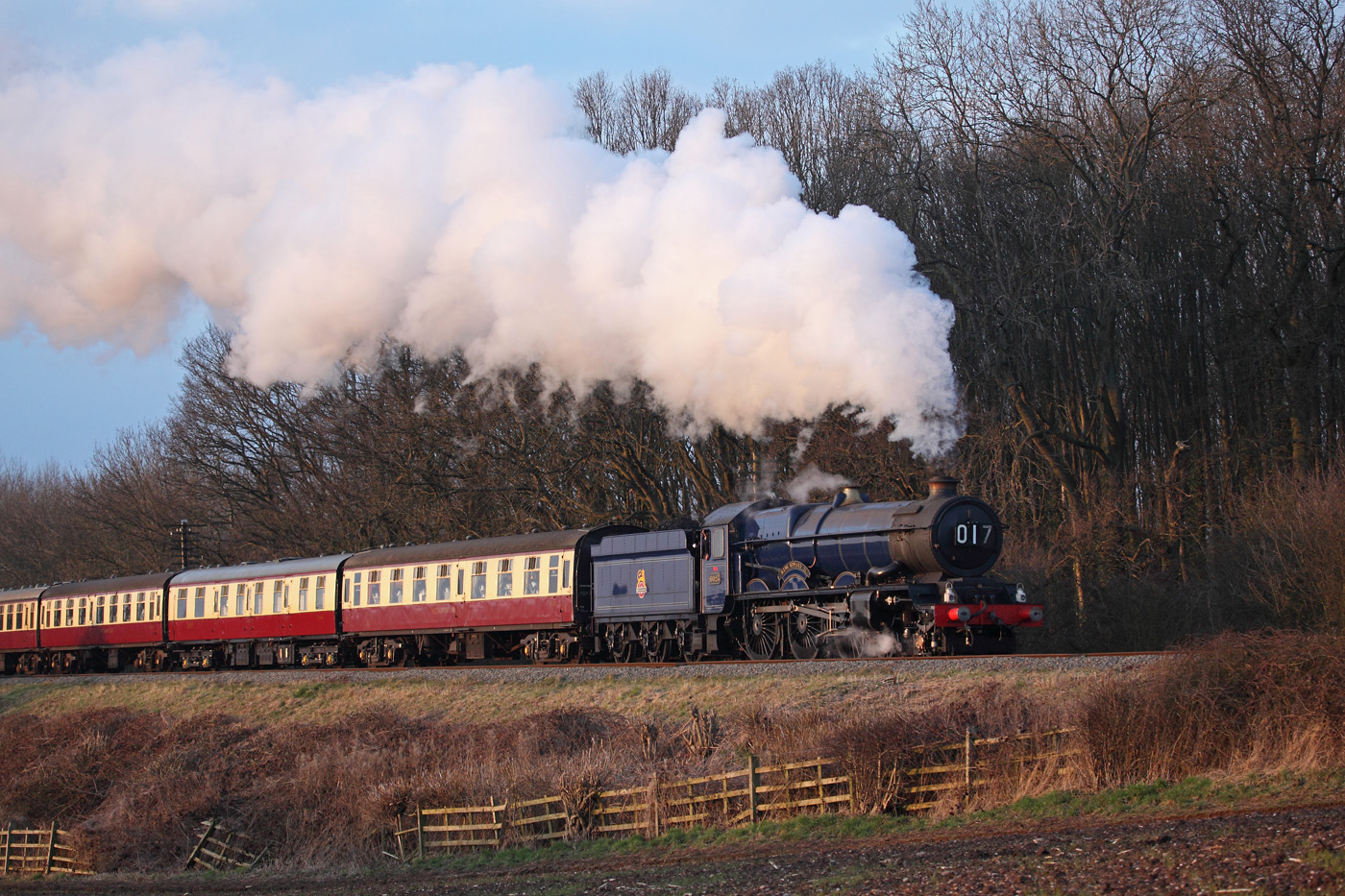
I can now confirm that we are in negotiation with the Didcot Railway Centre, and subject to contract, I am more than a little pleased to be able to present to you the first guest engine that we can announce for the Cotswold Festival of Steam "Give My Regards to Broadway" gala on the 26th - 28th May in the shape of 6023, King Edward II.


The King class, was Collett's upgrade to his own already extremely successful Castle class, which in turn was an upgrade on Churchward's Star class, all of a 4 cylinder design and 4-6-0 wheel arrangement.  The King's were of course the most powerful class of locomotives built by the Great Western Railway, a total of 30 (not 31 as is erroneously held out in some quarters) being built for working crack passenger trains between London Paddington and the Midlands, and the South West.


6023, King Edward II was built under lot 267 in 1930 at Swindon and spent most of its life based in Newton Abbot or Plymouth Laira, from where it would have been engaged in hauling expresses between Plymouth and London Paddington.  Its final shed was Cardiff Canton, from where it was withdrawn in June 1962 (the year that all King's were withdrawn).  


Post withdrawal, both 6023 and 6024 (King Edward I) were used as dead weights to test a bridge near Caldicot, and after that were sent to the legendary Barry Island Scrap Yard for disposal rather than Swindon.  That of course resulted in them both being saved for posterity, though 6023 suffered the ignominy of having a driving wheel cut through after a derailing incident in the scrap yard.  For this reason, many potential rescuers deemed it too difficult a restoration project and it remained at Barry until December 1984, becoming the 159th departure after waiting for 22 years.  She had been acquired by Harvey's of Bristol, who moved her to the fish dock at Bristol Temple Meads station for restoration, and it was subsequently purchased in 1990 by the Great Western Society based at Didcot Railway Centre.


The King that 6023 is named after, was the fourth son of Edward I, born on the 25th of April 1284 and dying on the 21st of September 1327, succeeding to the throne in 1307. As King's go, he fared poorly, aspersions were cast about his personal life and in particular the possibility of a (for that time) improper relationship with Piers Gaveston.  He famously lost the battle of Bannockburn to Robert the Bruce in 1314.  After a civil war led by his wife Isabella & her lover Sir Roger Mortimer against him, Edward II was forced to abdicate in 1327, dying later that year in suspicious circumstances whilst being held prisoner in Berkeley Castle (not 4085, but the building in Gloucestershire).


Although two other Kings survive, 6000, King George V and 6024, King Edward I, 6023 is the only one at the time of writing that has a current boiler ticket.  She is turned out in the attractive BR passenger blue livery worn by the class in the early BR period and sports the early lion and wheel crest on her tender.  In BR ownership, she wore this livery from August 1950 until March 1952. The restoration project by the Great Western Society took over 20 years to complete, with 6023 finally moving under her own steam again in 2011.  

Kings were originally built to a loading gauge of 13'1", which is too tall for use on the mainline today, so she has been trimmed down a few inches by lowering the cab roof and safety valve bonnet, as well as canting the whistles over to one side. As built originally, 6023 had a single chimney, which was replaced by a double chimney in June 1957.  She now has a single chimney again in keeping with her early 1950's livery, although she now sports a four port blast pipe in her smoke box to aid performance.


Eagle-eyed readers of this blog will have noticed that in September 2017, 6023 was a guest at the Old Oak Common open day, displayed alongside our own home fleet engine, 7903 Foremarke Hall.

6023 & 7903 around a turntable at Old Oak Common in 1960, photo courtesy of Dick Blenkinsop
 Note the double chimney in the above shot, which 6023 acquired in June 1957

6023 & 7903 together again at Old Oak Common in 2017, photo courtesy of John Cruxon

Further announcements regarding the details of the gala and further visiting loco announcements will be made on this blog and the main GWSR website nearer the time.  The official gala pages on the website went live about 5 minutes before this blog post, and can be found by clicking this link.