On the table you can find all kinds of literature to read while whilst drinking a cup of the best tea or eating the finest sandwich that the local shop has to offer. You might find the odd copy of Classic Car Weekly, a newsletter from a far-off railway, Railwayana auction booklets, numerous Steam monthlies. And, just occasionally, you might find gold.
No, not the shiny, 24ct kind, but still a nugget nonetheless - a nugget of GWSR gold in the form of a well-thumbed copy of our quarterly magazine, The Cornishman. On this occasion I was thrilled to find a copy from the Summer of 1996 - a time when British Rail was being privatised, Damon Hill won the Formula 1 Championship, The Spice Girls were just making their debut, Dolly the sheep was created, and your very own blogger here was still at junior school...! A little bundle of history, a snapshot of time when our Railway was just a little bit different. I hope you will find this as interesting as I did, either to bring back memories or to learn more about the modern history of the 'Friendly Line in the Cotswolds'.
 |
| The Cornishman from Summer 1996 Cover image by Steve Standbridge |
At a time when we are looking forward in anticipation to the opening of Broadway in 2018, sometimes it is a good idea to stop to appreciate and look back at just how much has been achieved in the last 3 decades.
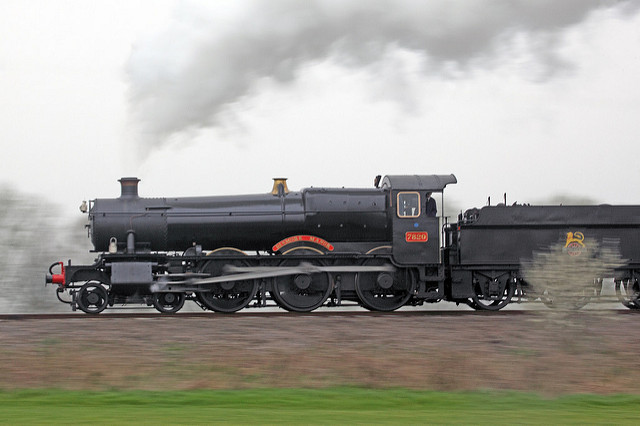
I discovered this issue not too long after I'd visited the South Devon Railway and seen 4920 Dumbleton Hall in the sidings needing quite a bit of attention. I was told that she had visited the GWSR some time ago, so how strange for this to turn up with none other than 4920 on the front cover. It's interesting to note the changes to the magazine over the last 21 years - cover price has gone from £1.50 to £2.80, however the 1996 copy (Issue 57) has just 46 pages in comparison to Issue 140 which sports 74.
The GWSR is a story of successes and 1995/96 was no different, with passenger figures up due to the early arrival of 4920 and a high profile marketing campaign.
Finger through the pages of Issue 57 and they are mostly black and white with a centre spread of colour photographs, dedicated for the 1995 Photographic Competition, with the following image being chosen as the winner.
 |
| The 1995 Photographic Competition Winner - No. 7752 near Hailes Abbey (30/3/1991) Photo by Ralph Ward |
Over 100 people took part in a sponsored walk in the February, raising £2,200 for the GWRL. Here they are seen walking down onto the old platform at Cheltenham:
 |
| Sponsored Walk 18/02/96. Photo by Wayne Finch |
 |
| CRC as it is today |
It's interesting to note the lack of rails and the general condition of the walkways compared to how it looks today, because, of course, the GWSR would not finish the line to Cheltenham until November 2002 (although initial tracks were laid in the station in 1998 to launch the share issue).
Indeed, even the 1.5 miles of track from Winchcombe to Gotherington would not open until a year later in 1997, meaning that at the time the line was only 5 miles long compared to today's 12 miles, running from Toddington to Far Stanley.
Another visitor to the GWSR for the 1996 season bears some similarities to the 'Workhorses of Steam' 2017 Gala - a USA S160 No. 3278 'Franklin D. Roosevelt' from Mid Hants visited two decades ago, to replace GWR 7752 which was due instead.
 |
| USA S160 No. 3278 'Franklin D. Roosevelt' visited here over 20 years ago. Photo by Wayne Finch |
 |
| USATC S160 6046 visiting in 2017 |
The Goods Shed was on its way to becoming what we know it as today.
"Work on the goods shed continues to make progress, despite the Railway Inspector asking us to move the track over by 5" at one end. We have replaced all the wooden sleepers at the Toddington end of the shed with concrete ones and we are now ready for our first load of concrete. The old cabin inside the shed is being demolished ready for the first section of floor to be removed. This is due to much good work by Dave Scott and Nigel Hawkins."
An interesting reference to sleepers in the shed - I'm not sure that there are any in there nowadays, perhaps the goods shed was used for the locos prior to the David Page Shed going up?
Talking of the DP Shed, 1996 was the year when initial meetings were taking place to discuss its building. Now it stands proudly in the car park, with most its floor having been concreted over the last couple of years. Interestingly, there was a turntable on the site where the shed sits today. It was moved to a new location - where was that?
The steam locos that lived at, and visited the GWSR in 1996 were very different to those in the home fleet today. Rather than the full size GWR 2-8-0s, Manors and Halls, there were a couple of 0-6-0s.
"4920 Dumbleton Hall arrived in March and is in regular use." As mentioned, can now be found at the South Devon Railway.
"King George The frames for this loco have now been moved across to the loco shed, with some minor work to be done. On the boiler front, the new foundation ring is back from Roger Pridham, together with the new side plates. On first offering of the ring up to the boiler, it looks good. Copper stay manufacturing is under way in our own machine shop, courtesy of Rod Minchin who has to make around 200 stays on our new Capstan lathe using our newly purchased tooling. Thanks go to Kevin Markham and Ian Windscheffel for their good work in this area." Refers to Hunslet 0-6-0ST King George No. 1 (or was it 2409?), which has since been converted to a Thomas the Tank Engine. King George was also the first steam loco to travel to CRC in over 30 years.
"Robert Nelson No. 4 In spite of some minor mechanical problems, it remains available for service." I couldn't find much out about this loco, where is it today?
"6984 Owsden Hall Is now back on her wheels at the SVR with some small jobs underway at Toddington, such as the cab structure. We plan to start the boiler later this year." Owsden Hall is currently under restoration at the Swindon & Cricklade Railway.
"Franklin D. Roosevelt We took delivery of this S160 from the Mid Hants during May. It is totally different to any locomotive we have had on the line in the past and we feel it will prove a big attraction as it is as powerful as an 8F." Currently under restoration at Tyseley.
In 1996 there was also the first 'Ladies Day' - no, I don't mean to do with the Cheltenham Races, but a day where there is an emphasis on the ladies that undertake duties on the railway. It was cleverly held on Mother's Day, March 17th 1996 where there was an all-female footplate crew on 4920 Dumbleton Hall, plus a female guard and TTI, booking office and shop staff.
 |
| (l-r) Judith Crockford (fireman), Betty Dixon (guard), Joanna Elvey (driver), Sheila Deakin (TTI). Photographer unknown. |
 |
| With the first two trips under her belt, Joanna enjoys a chat with some of our visitors. Photographer unknown. |
 |
| Joanna Elvey and Judith Crockford became the GWSR's first all female footplate crew when they took charge of No. 4920 Gumbleton Hall. Photographer unknown. |
There is quite a similarity to May 11th 2016, when, 20 years later, there was yet another Ladies Day (details here), with Tina as the fireman and myself as cleaner. Unfortunately we are lacking in the lady driver department in 2017, perhaps that will change soon?
 |
| Myself (left), cleaner, with Tina the fireman. Photo by Malcolm Ranieri |
 |
| (l-r) Tina, myself, Theresa, Sally and Mary (Photo by Malcolm Ranieri |
'Membership Matters' says there were a total of 2,039 members in March '96. Fast forward to early 2017 and that number has over doubled to 4,248.
Any visitor or volunteer should be familiar with 'The Flag and Whistle' tea room and the food it has to offer. Off limits to the public is the staff canteen to the rear of the tea room, but it hasn't always been like this. There used to be another canteen on the premises which is reported to have been demolished in less than a week, and parts of it were recycled and used in the building of the Flag and Whistle extension.
 |
| The 'Flag and Whistle' extension, April '96 (Photo by Bryan Merrett) |
 |
| 21 years later, the F&W extension today |
The car park had also been levelled/resurfaced, with an average of 5" fill, the deepest depression receiving nearly 11" of fill.
 |
| The car park being levelled. It looked so bare before the DP shed was built! |
Meanwhile, the oldest privately owned GWR loco in preservation was undergoing its restoration - the magnificent 2807. She wouldn't be complete until 2010 but the cab sides were receiving some attention:
 |
| Mark Taft at work on one of 2807's cab sides at Toddington, 30th March 1996 (Photo by Martyn Hall) |
The next article, 'Cab Chat', is something I'd like to share with you as it's an account of life as a fireman on a push/pull locomotive on The Honeybourne Line. You may recognise the first image - just so happens to be the same historic photo that is included in the last blog post! I gather it's a famous image but it is so appropriate given the visiting loco for the Gala and the official opening of Hailes Abbey Halt soon.
 |
| As GWR No. 1424 (in unlined green) draws away from Hailes Abbey Halt with auto trailer No. W238W working the 1.17pm Honeybourne to Cheltenham, water surges out of the full side tanks (probably replenished at Toddington) 27th February 1960 (Photo by Hugh Ballantyne) |
Cab Chat by 'N.C.J' (Norman Gibbs)
"Joining the GWR and receiving the 'Cornishman' has brought back many memories of my time on the original GWR (the one that built the Honeybourne Line). I started as a cleaner at Malvern Road loco shed, later being sent away on promotion to fireman before moving back to Malvern Road, eventually becoming a passenger fireman. My next move would have been to driver, but it was not to be - another story.
The Honeybourne Line was one of our normal runs and we knew every bank, bend, cutting and bridge. For a couple of years I was in the 'Auto Link' (two coaches and a loco in push/pull mode) and the first run of the day left St. James station about 6am. With about an hour to prepare the engine, this meant rising about 4:15am (no central heating then, we were a tough lot!). Once we had moved off shed to St. James, we hooked on to the auto coaches and connected the vacuum and steam pipes, plus a fiddly system of rods and levers to enable the driver to work the regulator from the other end. A length of cable with a hook (but very often a length of string) was also needed to attach the engine's whistle. We were definitely not in the 'fly by wire' or 'computer control era', more like the 'iron age'. We didn't like the rod to regulator system. It was very hit and miss and sometimes caused a nasty blowback from the fire if the regulator was slammed shut without the blower being on, doing a 'nasty' to your eyebrows and lashes.
The crews in the loco department will agree with me, so we usually ran with the rod and regulator uncoupled, the fireman doing the lot, hurriedly hooking them back if anyone important was looking! The driver was quite happy and trusting as he still had the main vacuum brake, a big pedal operated bell and if the string held, the engine whistle in case of emergency.
The early run only went up to Broadway as there were not many passengers, but we had the daily papers on board. As we only stopped at stations, the papers were thrown into the tin sheds of the halts by the guard as we went by. The earlier we got to Broadway the longer breakfast break we had, so we didn't hang about, sometimes causing the guard to miss the tin sheds with the bundles of papers. If any of the permanent way staff find fifty-year-old bundles of newspapers around the areas of Gretton, Hailes and Willersey, they should now have a good idea how they got there!
Leaving Broadway, we picked up all and sundry school kids, shop girls, folk going to town, bikes, prams etc., arriving at St. James pretty solid. The next shift took them all back after school had finished and the shops had closed. During the blackout in the war, with no lights at the halts, we needed all the knowledge of the line mentioned earlier to find them. The Autos on the Honeybourne Line did a very useful and important job as there were very few cars or buses around in those days.
Alas, old father time marches on and all my old drivers have now passed over to that 'great engine shed in the sky' - still trying to get their tea cans filled I suppose. They're probably having some difficulty getting their breakfasts cooked on the shovel though, the other place would have been better for that (heaven forbid!).
By the way, the shovel was not only used for frying up, it also made a good wash basin when placed across the tender. It could also be used to lay back on when placed between the fireman's jump seat and the tender handbrake. Very comfortable with an upturned bucket to put your feet on, so long as it wasn't raining!!!! Happy Days."
Finally I will leave you with a bit of humour.
The Innocent Visitor - Part IV by Justin Thyme
[I'd love to know what parts I, II and III were like]
Arriving early one morning, I admired the freshly-filled rock pools which had been carefully placed in the car park. Clearly, some enterprising member had decided to compete with the nearby garden centre. An oily pair of overalls strolling past explained that it was something to do with the water-table. When I asked him if there were plans to install water-beds and water-chairs, he stared into the distance and muttered something about a pillock. Presumably this is a small Cotswold hillock.
Feeling rather thirsty and in need of a cup of tea, I wandered down the yard because someone had said that a kettle was brewing up. After some time, I noticed a large cloud of black smoke making strange noises. Closer examination revealed a steam engine apparently trying to hide from the sunny day. A stoker was loading coal into the coal-house on the back of the engine, playing a game called 'one on the engine and two on the track'. Hiding around the corner of the goods shed was the duty officer, muttering "there goes another forty chuffs-worth. It's a pity they don't have to pay for it".
Using the greasy poles on either side of the door, I climbed up into the cockpit. I knew what it was called because the nice diesel men had told me. "You're standing on my footplate!" said the driver. "Sorry," I replied, looking round for the broken crockery. Next, I gazed in awe at the tangle of tubes and levers on the front wall. Obviously, someone had been messing about. It looked like an explosion in a pipe works.
Pointing to a thingy, I enquired what it was for. "It controls the vacuum." said the driver, but didn't say if it was for a Hoover or an Electrolux. "That's the regulator and those are the injectors." he continued. I knew what injectors were because they have them on diesels - they squirt fuel somewhere. Presumably, the injectors squirt steam somewhere on this engine, probably to make it start easier in cold weather, like a choke on a car. This technical stuff is quite easy once you understand it.
The driver now put his hand on the reversing gear and talked about a 'short cut-off'. This puzzled me because his trousers looked the right length to me. "Tell me," I asked, "where's the woo-woo valve?" This time it was the driver's turn to look baffled, so I said, "you know, the thing on the roof that goes 'woo, woo, woo' when you get near the station."
Suddenly, the driver sat down and seemed to lose interest. He offered me a drink from the billy-can on the mantlepiece over the fireplace. As the neat tannic acid scorched my throat, I wondered if this sort of chemical warfare had been banned by the Geneva Convention. Have you ever tasted a steam-man's brew?
By now, the man who had been playing with the coal climbed up onto the feet-plate (well, they'd both got two legs, so how can it be a foot-plate?). I asked him how long he'd been a coal-man but he grumpily replied that he was a fireman. That explained the small fire engine just outside the fence which he probably used to get to work. It must be nice to have two jobs, so these steam men are obviously very wealthy. The stoker now proceeded to shovel some coal onto the bonfire in the grate. Someone must have upset him (or we was very inexperienced), because every time his spade came back, it only just missed my nose. Clumsy fellow. The crew now indulged in a technical discussion that I was able to follow because of my wide experience. Reference to a 'clack box' obviously meant that one of them had a sore throat. Further reference to 'trimmings' showed that one of them was a barber. Drain cocks puzzled me as I hadn't seen any sign of poultry by the man-hole cover at the station. However, a comment about the 'smoke box' showed that there was a small room somewhere where you could go to light a cigarette and a comment about the 'blower' showed that they had a telephone somewhere around.
Leaving the feet-plate, I examined the long metal bar fixed to the wheels to stop them falling off. Some shorter rods go into things that look like oil drums on each side of the engine. "What's in here?" I called to the driver. "Pistons." he replied. Completely misunderstanding him, I relieved myself on a wheel. Dodging the lumps of coal, I wondered if anyone would like to get involved with steam locos. If so, write to the Station Master at Toddington. Maybe you would enjoy having coal dust blown into bloodshot eyes when working tender-first on a dry day, or oiling up the inside bits, hoping no one will buffer-up, thereby turning you into mincemeat. Alternatively, maybe you'd like to work on restoring locos, leaving the skin of your knuckles on rusty iron, or walking with a permanent limp after something heavy has been dropped on your foot. Express the preference for whatever kind of purgatory interests you, and your enquiry will be directed for the appropriate department.
While resting on the rusty turntable, I wondered if the visitor coach 'trains' passengers? Is a 'steam chest' something to do with asthma? Does the 'Fat Controller' live in the elephant van? Can you get a 'cheque-rail' from a bank? But these are other stories...
The moral of the blog is - always keep your issues of The Cornishman! As you never know when you might fancy a trip back in time...
Thanks to whoever it was that dropped this in - it will be making its way back to the mess coach soon.
In addition I have some photographs and a report from ex-steam dept member Dave Scott, recalling the days of the installation of the goods shed floor, when it seemed to resemble more of a sandy beach than anything else!


Now we will make a zig-zag in time and come back to 2017, when we are actually hopping back to the 1940s and enjoying a selection of photos from Wartime in the Cotswolds.
On arrival at Toddington there were the sweet sounds of music emanating from the car park, and scores of people in 1940s dress were milling around, leaving yours truly feeling rather under dressed.
The first attraction was a 1940s style cafe adorned with union flags:

On the left there was the recruitment office for the Local Defence Volunteers (later to become the Home Guard). It looks decidedly empty, perhaps they went for tea?
In addition I have some photographs and a report from ex-steam dept member Dave Scott, recalling the days of the installation of the goods shed floor, when it seemed to resemble more of a sandy beach than anything else!


Toddington Goods Shed Floor
"The Photographs that were taken in the process of laying the new floor in the Goods Shed do not really tell the true story. To refresh my memory I had to go back to the “ Cornishman “ from 1996 and look forward. The whole project surprisingly took almost four years to complete.
Initially we actually started outside of the shed on the North side and as has already been mentioned in Donna’s Blog the wooden sleepers were removed and replaced by concrete from the end of the pit right up to the end door. At this time the departments Messing arrangements were in a cabin that sat on the original floor on the South end of the shed. To enable us to move out we needed a new home and this is where the current Loco Departments mess coach made an appearance. Once we had “moved” we were able to make a start on replacing the floor with the concrete that we have today.
Having got rid of “King George” out of the shed we were able to make a start. The first phase was to concrete between the rails that ran through the shed. Fortunately the rail already stood on concrete so it was just a matter of filling in between the wall and the inside of the rails. It was then time to remove the cabin which went to scrap. However the stairs that went up to the cabin top where we had a rudimentary stores were retained and used to access the mezzanine floor when that was erected, some way down the line.
We needed to maintain the usability of the shed so the next part of the project was to move the fitting benches onto the now concreted track area and rearrange everything so the we could split the floor replacement into two or three phases starting on the area from the centre sliding door to the Southern end of the shed. There was a natural break in the floor as originally there had been a loading dock inside of the sliding door.
The next task was to remove the wooden floor itself. After some head scratching we decided to start at the long side wall to remove the floorboards as these were showing signs of being rotten and might give a bit easier. This was a fortunate move as it revealed that the boards were nailed , with forged nails , to each other. With the use of crowbars we were able to remove the boards in this section in a sideways movement very quickly. We think that the building was erected in 1904 or 1905 when the line was being built and we were amazed that when we turned the boards over after removal that they were as clean as the day that they were laid. Some of these exist on the railway today. We shipped them off to C & W and they were used to re-floor some of our wagon fleet.
Once the floor was out the next task was to remove the supporting walls that the floor sat on. Interestingly they had no foundations save for a series of stepped courses at the bottom. We only had to take them down to below the new floor level and we used the rubble as the first level of hard-core. We were lucky that we had had a dry spell of weather as there was evidence on the walls that the water table used to come up under the floor.
It was now time to start to relay the floor. However, all that we had to start with was a large hole. Myself and Nigel Hawkins spent a happy Bank Holiday weekend on Mini-Digger and our department loading shovel filling the base with Eighty Tons of hardcore. This was all rolled to make it compact with Building Services Mini Vibrating Roller, and yes it is the same one that is used today on current projects.
Once this was rolled and levelled we laid a blind of sand, damp proof course and steel reinforcing sheets before laying ten inches of concrete in a two or three pours. The concrete was finished off with a levelling machine.
Once the Concrete had set on the first half of the new floor the next job in hand was to move everything that was in the shed off the old wooden floor at the North end of the shed onto the new floor. If my memory is correct we used a 5 Ton Hand Crane to do the lifting.
Things are never easy. We thought we would get a straight run at taking the remaining floor out and repeating the process. We had reckoned without the Great Western Railway installing a crane in the shed. Yes, you have guessed it, the base was still there lurking under the floor when we removed it. The GWR made things to last. They had used what looked like ballast and Flint along with other aggregates to construct it. We had to get someone with a compressor and “Jack Hammer” to break it down to beneath the new floor level. It took a few weeks to remove. We were then able to proceed with the new floor in the same fashion as the first half.
We did have one problem however when we were laying the Concrete in the sliding door area. We were delivered a very wet batch of mix which we had problems finishing as it took an age to get anywhere near where we could get a machine on to level off. Hence to this day there is a dip in the floor in that area.
Once the floor was in we thought that we could take a break and get on with some more serious work of running trains but no. We still had the mezzanine floor to install and get new wiring added plus some new lighting. As always if a job is worth doing once then why not do it twice. How many members will remember that the mezzanine floor was originally erected at the South End of the shed?
And so after about four years of mainly Sunday working the Goods Shed was transformed. I can only thank my partner in crime Nigel Hawkins for his unwavering support in bringing the project together along with the many other past and present members who got stuck in to achieve our objective.
For further reading there is an excellent ode written by Nigel Brown on page 38 of the Autumn 2000 edition of the “Cornishman” which tells the story in an amusing way. It is also accompanied by a picture by Steve Standbridge showing the laying of the concrete at the North end of the shed described earlier.
As an amusing aside, during this period of construction I was also a member of the Operations Dept. team. On this particular Tuesday evening I had been at Toddington to a monthly meeting. As usual we had finished about 10.15 pm and a few of us had gone around to the “Pheasant” for a quick one before going home. I guess I had left about 11.15 pm and was making my way back across the Cotswolds to my home in Daventry. Travelling along the A44 between Broadway and Moreton in Marsh the road forks. From a distance away I could see blue flashing lights. My thoughts were that there had been an accident. On pulling up alongside the policeman at the junction the conversation went something like “ where are you going” I told him. “ The reason for stopping you was that there had been some burglaries in the area and they were trying to catch the felons. You don’t look like a burglar to me, good night. To which I went on my way.
A few yards down the road I thought “ Thank goodness he didn’t look in the Boot”. I had been at Toddington on the Sunday and not taken my tools out of the car – Bolt Cutters, Crowbar, Sledge Hammer, Large screwdriver etc. I can’t imagine how long it would have taken me to explain all that."
Dave Scott
Kirkby Stephen
Cumbria
Thank you very much Dave for the photos and the informative text!
Now we will make a zig-zag in time and come back to 2017, when we are actually hopping back to the 1940s and enjoying a selection of photos from Wartime in the Cotswolds.
On arrival at Toddington there were the sweet sounds of music emanating from the car park, and scores of people in 1940s dress were milling around, leaving yours truly feeling rather under dressed.
The first attraction was a 1940s style cafe adorned with union flags:

 |
| The Local Defence Volunteers' Recruitment Office. |
There were classic vehicles of all shapes and sizes in the car park, both military and civilian, all adding to the sights and smells of the 1940s weekend.
And of course there were a lot of people adding to the occasion by going about their daily business as would have occurred back then.
 |
| A fantastic display of vehicles line the car park. Meanwhile, the gentleman on the right looks like he's forgotten something! |
 |
| An impressive tank sits proudly, while the truck next to it wears a bright red poppy in remembrance |
 |
| The replica Spitfire was a big attraction, offering pre-booked sit-ins (for want of a better expression), even with the engine running if you so wished. It sounded fantastic! |
 |
| An RAF serviceman surveys the scene while the Spitfire receives some attention |
 |
| Military meets civilian with this pair |
 |
| Wartime transport of all different shapes and sizes, from 2 wheels and up! |
 |
| Uniformed ladies pass by a smart line-up of Willys Jeeps |
 |
| Unloading sandbags at Toddington |
 |
| Whilst doing the housework, this lady decided to show me how well her whites come up! |
 |
| The admin cabin well camouflaged to hinder any attack |
 |
| The LDV's plan for machine gun posts in Warmington on Sea |
 |
 |
| Our very own Kate in period dress waits for her train |
 |
| Dinmore Manor at Toddington |
 |
| Andy and his trusty steed |
 |
| A 40s-looking Winchcombe Platform 2, with the waiting room turned into an air raid shelter |
 |
| A band plays on Platform 1 |
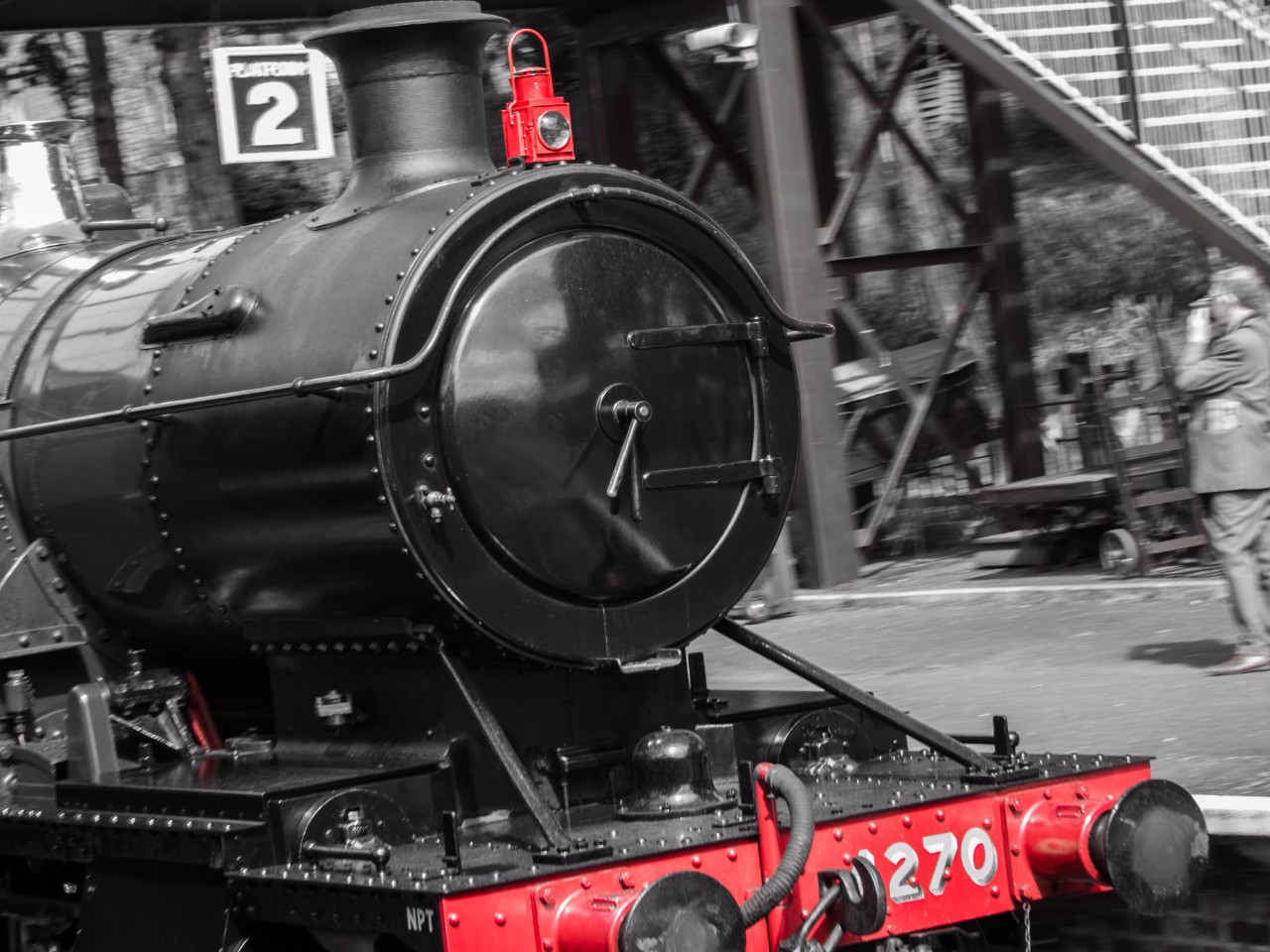 |
| 4270 pulling into Winchcombe, sporting the new red lamps |
"As you many of you would know 2807 & 4207 are both historic engines, in terms of longevity of life.
Well the early loco lamps were painted red and didn’t change until mid-1920’s to white.
And so as we have two locos pre that era we have painted two lamps red.
However before you say wrong shade of red, if that is your view, please respond with the correct shade of red, guesses Are not allowed. Our sincere thanks go to Chris Smith of the Steam Department for his loco lamp repair work and the repainting of these lamps."
 |
| A pair of finished lamps (photo by John Cruxon) |
 |
| As fitted to 4270 (photo by John Cruxon) |
 |
| Fireman Chris (who also happens to be good at painting) poses for a photo whilst watering up a very clean and shiny 4270 |
 |
| Watering up complete, Chris closes the tank lid |
 |
| When the air raid siren sounds, it's time to take cover |
 |
| I wonder what they were talking about? |
 |
| A family chats to the dental officer |
 |
| 4270 about to leave Winchcombe |
 |
| And they're off - Chris watches the train out of the platform |
Later that afternoon I was able to catch a video of the Spitfire fly-past at lunchtime - it passed over three times and at the last pass it seemed much lower than the other times. I happened to be at home in the garden at the time (it's great to be this close to the railway) but had my camera ready. At the end of the video, my better half rightly points out, "You couldn't have got more perfect than that."
You can watch the footage here: Spitfire Fly-Past