Thursday, 7 May 2015

The Third Gala Visitor

Getting hold of visiting locos for our gala this year has been a painfully difficult task.  I have lost track of the number of times that I have written & re-written this article over the last few months featuring different anticipated locos only to find that the plans wouldn't quite come off.  I won't list the locos concerned, but for one of them in particular I would have thought all my birthdays and Christmases had come at once if it had happened.  For many of the others, I would have merely been over the moon if we had got them. Photos from my archives were lined up from a variety of photo charters and in three cases, from mainline excursions over amongst other locations, the Settle & Carlisle line.  I have fewer photos of what has finally turned out to be our third visiting loco.  Many thanks indeed to Andy our loco procurement officer, who has put in a Herculean amount of work into getting us our visiting locos.

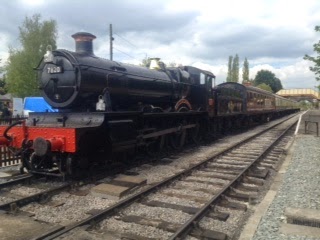
Anyway, enough of this, for what I sincerely hope will be the last update to the lineup for the Speed to the West gala on the 23rd - 25th May, I am delighted to be able to announce that courtesy of the West Somerset Railway  and the owner, Jeremy Hosking, we will be having ex-GWR Modified Hall, 6960, Raveningham Hall as our third and final visiting gala locomotive. This fits in very nicely with our theme of holiday trains as Modified Halls would often have been used on holiday trains to the West country.  For those of you with very long memories, Raveningham Hall was also once one of our home fleet many years ago.

Raveningham Hall on the turntable at Minehead
Raveningham Hall at Washford on the WSR
Raveningham Hall departing Williton towards Bishops Lydeard
So to recap, the full line-up is as follows:


Home fleet:


Churchward, 2-8-0, 2807:
2807 approaching the aqueduct

Churchward, 2-8-0T, 4270:
 
4270 with the freight train at Toddington during last year's "Back to Black" gala.

 Collett small prairie, 5542:
 
5542 approaching Didbrook

Collett, 4-6-0, Manor Class, 7820 Dinmore Manor:
Dinmore Manor passing Didbrook

 Visting Locos:


Bulleid pacific, West Country Class, 34007, Wadebridge
34007, Wadebridge at Boscarne on the Bodmin & Wenford Railway
Bulleid pacific, West Country Class, 34092, Wells:
34092 Wells, photo courtesy of John Sagar
Hawksworth Modified Hall, 6960, Raveningham Hall:

Raveningham Hall at Whisky Trail Crossing on the WSR
I'm sure that you'll agree that is a stunning line up and well worth coming along to the GWSR for.  It is intended to have both the Bulleids facing north, so interesting double header options for both West Countries should be in the timetable.  I currently expect all the home fleet locos to be facing south.  No decision has yet been taken on the orientation of Raveningham Hall.

 Footplate rides on home fleet (book in advance) and brake van rides too.  More details to be found on the main GWSR website.


Tuesday, 5 May 2015

Future Darwin Award Nominees

First some excellent news,  Bill Tyndall, one of the GWSR's signalmen who as you may recollect from my report on the steam loco dept's away weekend last year moonlights as a passed fireman on the Talyllyn railway.  Well, I should say that he did moonlight as a passed fireman, as of Sunday, he has now passed out as a driver.  Congratulations Bill.
Bill & his daughter Juliet, who is a guard on the Talyllyn railway.
I wasn't able to be around for last week's Wartime in the Cotswolds event, however Chris has sent me a few photos of our locos in action.
2807 departing Toddongton, photo courtesy of Chris Crump.
Dinmore Manor about to depart from Toddington, photo courtesy of Chris Crump
Nothing to do with steam, but one of the highlights of the weekend was a Spitfire overflight on the Sunday.  Rumours that the Spitfire was being flown by Steve, our head of training, turned out not to be true, much as he might have liked it to have been.

I received a message in the middle of the week from Phil which read simply "Do you want to swap engines on Sunday?".  I was able to infer from that several important things; it was forecast to rain, that I was to be on 4270, and Phil was getting one of our tender engines.  Not being a complete idiot, I declined his offer, preferring to stay nice and warm and dry on 4270 than getting soaked on Dinmore Manor or 2807.   On Friday as I was passing Toddington on the way back from a work event, I called in to make sure that 4270 was also running on the Saturday and wouldn't therefore need a warming fire putting in.  Whilst I was there doing that I took the opportunity to have a quick look round and see what else was going on:

For the very first time, I found somebody depositing rags into our rag collection bin in the yard.  I've emptied the bin on many occasions, but never yet seen anybody put anything into it.  I'm afraid that I don't know this gentleman's name, but I did discover that he is from our Signal & Telegraph dept.
Thank you.
 I haven't mentioned the rag collection point for some time, as it has been extremely successful and we have had quite a pile of rags. The gala however is only a few weeks away and we will be requiring more, so this would be a good time to ask for any old rags if you have them.

The pit on road 7 is looking good, the area around it has been leveled ready for concreting and  notice a drainage inspection hole has appeared next to it.
It's looking good.
 George was busy at work on the one car DMU, well DMU is a bit of a misnomer really as there is only the one of it, DSU would be more apt. Most people just refer to it as the "Bubble car".  Regardless, George was busy welding in some new sections of body work.
Who was that masked man?
The bubble car has been in the David Page shed for a while now and has inevitably picked up a good layer of dust.  I noticed that one of our resident artists (I suspect I know which one) has been at work:
Perhaps the bubble car is aspiring to being a steam engine...
... or perhaps it is just dreaming of being as free as a bird.
 Dinmore Manor's real tender is making good progress, Roy & Ian (camera shy, stepped out of the way at the last moment) were hard at work on it.
Roy, suddenly alone.
 Move on to Sunday morning, your's truly arrives bright and early to light up 4270 for the day's work.  As I had inferred from Phil's plea, it was raining, quite heavily
Steve, trying to keep dry on Dinmore Manor.
 Today was John's first driver training lesson under the tutelage of Neil, our Operations Manager.  Just because it is raining is no excuse not to do the oiling up. You'll notice that I took this next photo of them oiling up from a nice dry cab.  To tell the truth, I was already soaked through from emptying the smoke box.  I had been surprised at just how much ash had accumulated in the smoke box and I will confess, I harboured dark thoughts about the previous day's fireman who couldn't possibly have emptied it out on Saturday morning.  Later on in evening when we got back and I checked the smoke box, even though I had diligently cleaned it all out in he morning, it still contained just as much as I had cleared out.  Maybe with the current coal, 4270 really does generate that much ash in the smokebox.
Neil watches John oiling up 4270
One of the one and a half bins of ash that I emptied out of the smokebox.
 After I'd got my fire going and done a bit of cleaning in the cab, it was time for a brew:
I'm sure we get through more tea than coal
 Just before we left the shed, the rain cleared up and Steve had a stab at polishing Dinmore Manor's brass work.  Not so easy when it's wet.  Mercifully for them, the rain cleared up then for the rest of the day.
Steve at work
 4270 was blowing light and had been left with no water space in the boiler, I was keen to see her attached to the stock and get the steam heating attached so that I could lose a bit of surplus steam.  

Neil fetched us both breakfast from the Flag & Whistle.
John (l) and Neil with breakfast
I noted form the Carriage and Wagon blog that they have put up a couple of seats to allow them to watch the action from the upcoming "Speed to the West" gala on May 23rd - 24th.  If you're reading this chaps, please don't put a BBQ out there too, it will guarantee that we get rain.
Carriage and Wagon's new benches.
John did remarkably well on his first driver training lesson and coped unphased with a number of incidents that came up.  The first was the signal for the loop at Gotherington (the box being open for signalman training) which wouldn't come off.  Neil phoned the signal box, walked up the track to check that the points had swing across and that the interlocking had locked the points in place before reporting back to say that we were authorised by the signalman to pass the signal at danger. 
Neil off to check the points
 The second incident was on the second trip whilst running around at Cheltenham Race Course.  As we were just setting off back from the Hunting Butts tunnel end, Neil shouted "Stop, stop, stop" with some urgency.  Thinking that something dreadful had happened, John immediately slammed on the brakes bringing us to a halt as quickly as 4270 can manage.  Whilst we had been in the platform, Neil had revisited some of the oiling & grease points on 4270 and had not placed the grease gun securely back in container in the cab and when we set off it had rolled out of the cab.  Needless to say, it was the poor fireman who had to wander back and retrieve it and of course it was the fireman's fault.  I'd have passed the blame onto the cleaner if we'd had one, but we didn't, so the blame stopped with me.
Grease gun by the track, 4270 waits.
 Later on, Neil commented on one of the runs that John was looking much more confident, not feeling the need to keep one hand on the regulator all the time.
Look mum.... no hands.
And finally, I try to keep the tone of this blog fairly light hearted, I will confess to having received report cards at school with the word "Flippant" appearing on them and even once a detention for "Passing a comment calculated to disrupt".  There are times however to be serious and this I'm afraid is one of them.  Please do not read any further than this is you are of a squeamish or sensitive nature, unless you are the parent of a teenager living in Bishops Cleeve, in which case please read on.

In fact, I'll start with parenting in general. One of the fireman's duties is to watch the train into and out of station platforms and make sure that there are no problems that would require the train to stop.  One of the things that scares the hell out of me is when arriving in a platform and some youngster decides to race the train along the platform.  One trip, roll the wrong way, and the consequences really don't bear thinking about.  On Sunday, there was even a young girl doing cartwheels on platform 1 at Toddington as we pulled into the station.  It is lovely to see our visitors enjoying themselves, but there are times and places for everything and our platforms are really not the place.  There is a perfectly good children's amusement area behind the Flag & Whistle at Toddington for your children to let off a little steam of their own if they need to.  It pains me to say it, but I have no doubt that when I was of Junior school age, I too would have raced our trains along platforms given half the chance.  Parents, please discourage your children from doing it, I really don't need any more grey hairs and I doubt that the paper work involved afterwards would be much fun either.

Anyway, to the main point, excluding barrow crossings at the ends of some of our platforms, there are seven (from memory) crossings on our line where people may, if no trains are coming, walk across the line.  Six of those are in the middle of nowhere and you rarely ever see a soul crossing them, the seventh however is in the middle of the busy town of Bishops Cleeve.  It is rare that you go through Bishops Cleeve without seeing somebody on the crossing, usually they are stood on one side or the other, behind the gates just watching the trains pass by, which is fine.  Occasionally we see people crossing when we are some way off, it causes comment in the cab and the use of the whistle, but it's not a major concern.  We have a speed restriction of 15 MPH for some distance either side of the crossing.  15 MPH may not sound like much.  It is fair to say that I have been heard to complain at great length to anybody who will listen about a certain Mayor who has introduced a blanket 20 MPH speed limit in the city that I live.  There is however a world of difference between being struck by a car at 20 MPH or even 30 MPH and being struck by a train at 15 MPH.  For an adult, hit head on by a car at 30 MPH, chances are that the impact will be mitigated by the point of impact being your lower legs, your torso will usually roll over the bonnet.  Your legs might be a bit mashed up, but the survival statistics are very good.  It's also fair to say that the brakes on a modern car are also extremely efficient (regardless of what the Highway Code would have you believe) and can stop in a fairly short distance.  The brakes of one of our steam trains however are trying to stop a combined weight of carriages, loco and passengers well in excess of 300 tons.  You shouldn't be surprised to discover that bringing 300 tons to a halt doesn't happen in a hurry.  The dynamics of being hit by a train are also very different to that of being hit by a car, the point of impact will be much higher, you won't just roll over it, you'll go under and no matter how slim you might be, there is a lot of stuff under a steam loco to hit you, it won't just roll over you letting you emerge unscathed at the other end. I did write out a description of what the likely effect on the human body would be of being run over by one of our trains, but have decided to edit it out.  The bottom line is that it won't end well. In an argument between a human being and a train there is only ever going to be one winner.  I was about to say that there are no prizes for coming second, but then I remembered the title of this blog post. All of the above should really be common sense.  Unfortunately in spite of its name, common sense appears to be a scarce commodity amongst some of the youth of Bishops Cleeve who have taken it into their heads that "playing chicken" with the trains is a good idea.  

It is worth remembering that this was John's first driving lesson, it is just as well that he wasn't flustered and managed to bring the train safely to a halt albeit just yards short of the crossing. A less proficient trainee may not have been so quick off the mark.  As it was, if we had been going in the downhill direction rather than uphill and if one of the half a dozen or so kids involved had tripped, or slipped on a wet rail etc then we could easily have been looking at a fatality.

If you are the parent or teacher of a teenager living in or around Bishops Cleeve, please do try and make them aware of the dangers and encourage them to see the error of their ways. I'm fairly sure that I have linked to this video in the past, but there is no harm in repeating myself, it's an important message to get across.  Unless you want your kids to receive Darwin Award nominations (look it up if you don't know), please educate them about the dangers of railway crossings.

Edit:  changed link above to go to the right place.

Tuesday, 28 April 2015

49007

It is a fair while since I last inflicted provided you with a profile of a member of the steam loco dept. Mostly because those who have been approached have been far too sensible to agree to it.  Derek Smith however has kindly agreed though and presents an interesting subject as his life on the footplate spans not only around a decade on the GWSR, but also time on British Railways in both its Western & Southern regions as well as South Africa. 

Unless otherwise stated, all photographs were kindly provided for this article by Derek himself.

 Derek was born at an early age and started his working career with steam as a locomotive cleaner at Gloucester Horton Road (85B) on the 8th of May 1958.  There were no fireman vacancies at 85B at the time that he attained the grade of passed cleaner, so he transferred to the number 4 roundhouse at 81A Old Oak Common (OOC) on 15th February 1960. 

In his own words:

After engine cleaning, some of the time of which I served behind the booking on/off office window hatch, checking men in and off for their turns, plus occasionally going out on the shed call bike with messages for crew. (I had been recognised as being able to read and write well so.....), I got passed out as a Passed Cleaner prior to the Spring of '59.

At OOC, being freshly made up to fireman, I was largely in the prep gang and on the 'Ups and Downs'. Prepping was hard work, getting to do around six engines in a shift, but, did the lot, "Kings", "Castles", other W.R. 4-6-0'S, 92'S, one sole "County" 1025,('Radnor), (On that occasion, taking it tender first to Paddington where we were relieved by the train men working the (Bristol?) passenger train. We also prepped 61's, Panniers of all sorts, the occasional Stanier 8F and virtually any other Class of WR loco's there. Ups and downs generally involved preparing or taking to a ready prepped engine, then, to either OOC or West London carriage sidings. Mostly 15XX's, the 9400-9409 'fleet' and other of the class, plus ordinary Panniers. Sometimes we had a 61xx, remembering a pretty clapped out 6121 as a regular. 
6862, Derwent Grange

Sometimes we'd use a freshly prepared train locomotive to take the empty Coaching Stock (ECS) up to the stops at Paddington. Then, once the train had left us, we'd go outside and wait until we backed on to a main line job, have relief, then go and relieve an incoming express. The driver and fireman were generally well on the way to the cabin for their grub and a brew before passengers from the second or third coach back got near the cab! Many's the time we've accepted "Good trip up today" and similar accolades! Once the up and down engine had coupled onto the country end of the stock, it was either trail down, cutting off at the entrance to the relevant carriage sidings, and either standing just outside and waiting for an arrival, then with the Main Line engine, taking the ECS tender first to the sidings. It was on one such occasion that the "King" we'd taken over had gone onto a later arrival to do just this, I gained great pleasure in getting a few shovelfuls down the front of that long box, great! I was 17 at the time (Also had my first ever shave in the BR hostel I stayed in!). 

When you worked the stock to the carriage sidings or sheds, same as if you'd cut off after being trailed down, i.e., taking the engine onto the shed "run" (Entry pit road for the fire droppers to do the fire, ash pan and smoke box, then, (Also a job I was often on), place the engine under the coal stage, move to take water if needed, then into one of the 4 Roundhouses and turn it off onto the track for it's next trip, or for repair/washout or the like. 

The other alternative at Paddington was, follow the stock down, then go Light Engine (LE) to Ranelagh Bridge depot, just near the terminus, to turn, take water and for the coal men there to shovel all the coal forward for say, a return Wolverhampton. When the Kings were on a job, (Euston rebuilding leading to a much more intensive service), if 84A. Wolverhampton Stafford Road, had coaled with hard coal, the pile would be well eaten into and I'm told they frequently got back with very little left! Stafford Road or Tyseley men used to work the jobs both ways on a lot of the turns, just having relief in Paddington, then walking up to the departure end after their 'snap', and boarding their steed for the return! 

The furthest I ever got was the Express Dairy shunt at Wood Lane or, Acton Main Line pilot shunt jobs. I well remember an ex Gloucester driver who'd gone to OOC for his driving job, leaving me to hit 'em up and knock 'em off on my own whilst he was otherwise engaged. Experience gained which, with train lengths then (1960),and today's lack of preserved trucks in vast quantities, couldn't ever be replicated again! This was with an 87XX PT. (The 15XX's didn't include 1501, because she wasn't at OOC). 

Steam heating uses a lot of water and can keep the clock off the mark, well, we had a job where you were doing nothing more than that at OOC Carriage shed/yard, all the different rakes of stock in turn, some with 14 bogies on.  A pannier towards the end of her shift with a dirtying fire, well, blower well on and quite a struggle to keep both the clock well round and water in the glass I'll tell you!

I stayed at OOC until moving to my local home town depot of Cheltenham Malvern Road, a 4 road Sub-shed of 85B. 

Derek on the left on the footplate of Jinty, 47506, at Cheltenham High St. 5/3/62
Saturday 10th December 1960 saw me work my last duty at 81A, Old Oak Common. I was on at 2pm for "Shed, Goods Side", utilised from "2pm Spare" where I helped to move and place right for coal on the relevant 'run' side of the coal stage incline, such engines as 9477, 9758, 90565, 9700, 4644, 9469, 6141 and possibly more? Old Oak's allocation when I left, approximately 163 loco's!  As Sunday was my rest day, I paid a Privilege ticket return fare of 11s 2d (57p) to Swindon to 'do' 82C shed and visit the "Mecca", Swindon locomotive Works and relevant complex. The most notable engine that visit I suppose, was seeing 7, "Owain Glyndwr" the narrow gauge engine off the Vale of Rheidol in for works attention. (I didn't record whether I saw the Anglicised name "Owen Glendower" displayed on the other side tank though!). 

 Monday, 12/12/60, booked on at 9.30am to travel as passenger (A.P.) on the 11.15am off Paddington, right through to my new workplace, alighting at Malvern Road and boldly walking forward, away from the footbridge, to access the shed via the boarded crossing at the East/Toddington end of the station, booking off at 2.50pm. Tuesday, I was marked on the shed roster sheet as, on duty 6am, R.T.F., ("Report To Foreman"). I rode upon the footplate of newly prepared 8107, for the 6.30am stopping passenger service to Kingham, in order to get to St.James' goods yard. This was to relieve a Gloucester fireman on 9471 as the booked Cheltenham fireman 'had done it in' (Hadn't turned up!). I have it recorded that we shunted from about 6.50am until 7.15am when the late running fireman appeared! During this time, I'd just put 2 shovelfuls down the front. I was then instructed to travel over to Gloucester on the 7.35am train, to attend Horton Road shed, staying unused/Spare in the cabin, until catching the 1.20pm train back, booking off in 8 hours at 2pm. Easy first day! 
Black 5, 45263 passes Toddington with a Wolverhampton to Kingswear train, 24/7/65
The next day, much better. On at 6.15am to prepare 5173 to go off shed for 7am. I then worked the 7.35am, having ridden in the train the previous day, stopping at Malvern Rd, Churchdown and Gloucester (Central). The rest of the day with our 2 coach load was, 9.30am to Cheltenham, add a wagon to the formation before working the 25 mile branch, via the 10.50am train, all stations to Kingham. At Stow-on-the-Wold, the wagon was poled off the rear of the train into the Goods siding there, before completing our journey. We later worked the 12.36pm passenger back, arriving back at St.James around 1.40pm before uncoupling and LE (Light Engine) to Cheltenham shed "run" for the fire dropper/coal man/shed man to clean the fire for late turn and coal it up. We left it "screwed down" and booked off in the lobby at 2.10pm. I also recorded such items as, that we had the same coaches all day with around 40psi steam heat, our engine was green, lined out with the new(er) BR crest, facing Gloucester and with yellow side numbers and, in dirty condition. My Driver for this duty was a real old school hard man, W.J.(Bill) Dix. Hadn't seen it before, nor worked with anyone after, but he had an old thick glass beer bottle with a screwed in bottle stopper full of black tea, which he placed above the brake/ejector fitting, and drank from that all shift. He also had hardly any teeth and wasn't backwards in stating he'd never been to a dentist, but had either pincered old teeth out himself, or they'd been self extracted one way or another!! Whilst he was a gnarled old boy, no evidence that he'd actually had any of them knocked out came to my ears! 

15th was on duty at 4.45am and prepare 8491 for 5.30am off shed to work St James' station passenger pilot. Around 11.55am, swopped footplates with 9471 in order that the 84 could get over to Gloucester shed, possibly for boiler washout, something which wasn't undertaken at Cheltenham. Noted that day was SR 31791 of 71A (As Eastleigh's shed code was then), in on the 3 coach ex MSWJR train. Friday saw me on the GWSR track as, having booked on at 5.30am to prepare 3203, we went off shed at 6.15am, waited for a guard then, LE to Cheltenham High Street via reversal at Lansdown Jct., did a bit of running around getting some wagons and a brake up together, retraced our steps and back at Malvern Road, picked up 2 brakes and four open ('Grampus'?) wagons before setting off for Winchcombe, with our "Engineers train". However, there were those who had different plans, and we were stopped at Bishops Cleeve and told to back into the up siding, run round, and then head back to Malvern Rd in order to go up over Dowdeswell viaduct, through the tunnel and to Andoversford instead, having stopped at one point to pick up 3 gangers. Whilst up at Andoversford this date, 4MT Std. 2-6-0 76011, (probably of Eastleigh) was on the MSWJR service. We worked back and forth between Andoversford and the viaduct then, until going back down with eleven wagons and 2 brakes to Malvern Rd sidings, then onto shed, this time, filling up the boiler etc. and leaving it on the "Sand furnace road", as it was to be taken over to 85B for servicing later. I booked off at 4.35pm so made 11hrs 51.5mins for payment, taking into account pre-6am enhanced hours, and the 3hrs 5mins overtime at enhanced time and a quarter rate too. 
Odd interlopers in Gloucestershire were LNER B1's, this one is 61245, Murray of Elibank
Saturday was a Rest Day but on the Sunday, 18th, I voluntarily attended a Mutual Improvement Class (MIC). I seem to recall it was held in a side room in the near to shed's "Kings Arms" pub in Gloucester Road. Noted on shed that morning, 4100, 6137, 8409, 47422 (High St. pilot, sub shedded at ours from Barnwood), 6341 and 2895. Thus ended my first week at my home town depot, being just about 6 minutes walk from my birthplace, near the "Gasworks' Clock" in Tewkesbury Road. The second week, lie-ins, 5.30pm start all week!

I remained here from arrival, 12/12/60 until it was closed around Sep'63 which is when I opted to go to 'the other side', the (Former) Midland/MR roundhouse shed at Gloucester, 85E, (formerly 22B until the WR took it over in 1957), and also 85C for a period. I thoroughly enjoyed just over 6 months there before the merger with my original shed down the road, 85B, from 4/5/64. When it first happened, all the remaining sets of men, engines and work came together, thus for a few months in '64, 85B had an allocation of over 100 steam engines again. Saturday/Sunday 2 and 3/1/66 saw the end of steam at Gloucester and Monday 4/1/66, other than for the delayed former S&DJR Line and depot closures, we were without an allocation of steam, the last steam shed, along with Worcester (85A) in the WR. In brief, it wasn't the end though, as right up until the end of Summer '66, steam from the MR depots continued to slip through the border to us and, especially in the early part of that year, the visitors were frequently requisitioned for duties. Indeed, a supply of coal was still dispatched to us for use from our coal stage to top up the fuel if required. 

The last working Fowler 4P, 3 cylinder compound, 41123 at Gloucester Barnwood
The variety at 85B as far as firing was marvellous as, besides the various WR engines, you had the ex-Barnwood stud of Standard 4 and 5 4-6-0's, the Ivatt and Std 2-6-0 2MT's, their Fowler 4F's/Big goods (Or as Western men unkindly referred to them as, Ruptured 4's or Ruptured ducks), along with all the ex MR steam which worked in and out from Birmingham (Saltley and Tyseley), WR too from the latter, WR and MR engines from Oxley and Banbury, and those from farther afield. Plenty of Std. 9F's from and to South Wales on ironstone and coal trains, mixed in with Churchward/Collett and Stanier 8F 2-8-0's. Black 5's were as plentiful as the "Halls", "Modified Halls","Granges" and a smattering of Castles" and "Jubilees" although by this stage, the Paddington's were largely dieselised and the Black and Std. 5MT's and "Jub's (5X's as MR men referred to them) were rapidly being displaced by Peaks and Cromptons on the Bristol-Derby-Sheffield-Leeds-York jobs. I of course couldn't escape the Second man's chair, but I did try to swop to a steam job if you knew in advance your job was to be diesel worked. 
Derek (2nd left) about to leave Ashchurch on 7808 Cookham Manor for a Tyseley open day
One nice job we had was 23.59 on duty (no, not midnight!), walk to Eastgate, relieve Bristol men on an up parcels job (C Class/3 headcode). At the time, Oxley provided the motive power and we invariably had one of the fast dying "Castle" class, starting to gradually lose a number or name or shedplate here and there. One week I recall we had 5089, "Westminster Abbey", a single chimney one, then 7014 "Caerhays Castle" with a double chimney etc. We worked the turn to Dudley via stops at Cheltenham Lansdown, Worcester Shrub Hill and Stourbridge Junction, fantastic! At Dudley we had a few hours break including a lovely doss near the red hot glowing 'Romesse' stove, before relieving an ex Derby, generally Crompton hauled, parcels back to Gloucester. One morning though, chuffed to hear the unmistakeable hiss and clank of, - a Black 5 instead! 

On the subject of "Castles", I remember preparing 7012,"Barry Castle" at Oxford, to work an ironstone (Loose linked) freight from Yarnton Yard. My mate told me it was withdrawn about 3 weeks later. (It's possible that job was when I was still at Cheltenham?) From Gloucester I've worked steam to places such as Cardiff, Swindon, Bath Green Park, Bristol West Depot, Bordesley Junction via both routes from Bearley, and Wolverhampton Low Level. (once), Water Orton (Birmingham), Rowley Regis (towards Smethwick on the Lye and Cradley Heath route from Stourbridge Junction), to Oxford via both Honeybourne (Yes, on our GWSR route) and the Ashchurch-Evesham branch. We also had a turn to Leamington Spa too, turning right at Hatton Jct. I didn't manage hardly any trips in the Forest of Dean with steam but I did venture on steam along the Stroud, Wallworth and Nailsworth branches from Stonehouse, the Coaley Jct to Cam and Dursley line, these only with freight. I also did a couple of freight with steam (78xxx 2-6-0) turns from Ross on Wye as far as Lydbrook Jct. 

I had one of Barnwood's 14xx's on the temporally introduced passenger service between Berkeley Rd to Severn Bridge station, as the downed bridge over the Severn wouldn't allow the normal service to and from Lydney Town. Until the end of the Summer Service '65, it was nice to get to get the stopping passenger jobs to Birmingham New St via Worcester and Droitwich Spa, and in the other direction, Eastgate to Bristol Temple Meads, generally going into the old roofed terminus platforms, there on the far right! On the subject of 2-8-0's, we had 2854 and 3848 allocated to us, as were a trio of WD's (Austerities/Wobblers/Dub Dees, as you may), these latter mainly for the Woodford Halse jobs. Cardiff Canton and Newport Ebbw Jct sheds often turned one up for jobs, latterly working them to the exchange yard/sidings at Honeybourne West. There we'd have a break and later, swop footplates with Woodford men on a S. Wales bound job, generally with one of their WD's, or a WR one returning home. One thing that was always apparent to me, was the ease they steamed with the ER hard coal, and the comparative 'struggle' you often had with soft Welsh, even good stuff. Depth of fire and the sometimes quite soft exhaust had something to do with it! Western men were well known for thick back end fires but, given my time over again, I would definitely have tried the light and bright/little and often method with a WD and soft coal. 

We also used to get 9f's and the remnants of the WR 4-6-0's and 2-8-0'S on these turns. All were the same, in that you had to be prepared for the fireman from the Woodford job, keeping his own shovel and, if he had one, keeping his handleless brush wrapped up in a wiper. There have been a few occasions where it's been necessary to go back to our incoming loco', and rescue the necessary, especially if the Woodford loco' hadn't got a decent second shovel! 
Derek having a brew in the cab of 9F, 92203, Black Prince on the GWSR
 Another thing I've not touched upon yet is tank engines. I fired a few 14xx Autos, generally in 'non-auto coupled mode', all the Pannier Tank classes including the 84 and 94xx's, the occasional 42/52 and larger 72's, we had 2 or three, over time, 66's (6669, 6690 and 6696), all the 41,51,61 and a couple of 81xx large Prairies, and the 55xx's, as well as the last working 4500 small tank class member 4564. We had a short dalliance with displaced Bristol 82xxx Std's, whilst I only rode home on a few Shrewsbury ones, the 80xxx on ex-Hereford branch jobs. We also had jobs on 22 and 32xx 0-6-0's and the Moguls. (53,63,73 and a renumbered 93 (Ex 9313, now 7335, presently on the SVR awaiting a new ticket). There were also the odd turn on a 54,64 and when en-route from Stourbridge to S. Wales, (after a sojourn stored at Malvern Rd), a 74XX.

Jinty, 47417 at Malvern Rd, 21/4/57
8731 on Malvern Rd,  26/7/56
After an earlier rejected attempt, on 10/10/66, a fellow steam mad fireman and I who had been granted an unusual, for then, inter-regional transfer to go on loan to the SR where we started on the 11th at Eastleigh (70D, formerly 71A). After a fantastic time there, getting as many steam turns as we each could, Sunday 9/7/67 saw me on my last duty there. The following day, 10/7/67, the first full day of the elimination of SR steam, both my colleague and I were going home with free passes, 'No longer required'! I stayed at Horton Road then as a Diesel Secondman until packing it all in for the princely sum of £333-16s, this being £300 lump sum resettlement,and £33-16s outstanding holiday pay, on 2/5/70. 

Derek's mate Keith on 34023 Blackmore Vale on the Weymouth Quay to Waterloo boat train, June 1967
Soon to be scrapped, l-r, 34071, 73117, 73115 & 34077 at Eastleigh, 8/7/67
My mate Keith who had returned to his native Yorkshire almost as soon as he'd returned from Eastleigh, working with his Dad and a brother, painting and decorating, joined me on a flight to South Africa where on 12/5/70, we'd both been taken on as trainee firemen at Bloemfontein, the capital city of the Orange Free State, and "busting" with well over 100 allocated 3' 6" gauge coal fired steam engines, a lot hand fired, but the type of allocation probably meant there were a few more of the mechanically stoked variety. By early November though, for a number of reasons, I'd given in my notice and left the City on board a 4-8-2 hauled "Orange Express", en-route along the main line to Kroonstad etc. By 20/12/70, I'd arrived back in "Blighty" disembarking from the New Zealand registered liner the M.V. Akaroa", in London Docks." 

Everybody has the odd embarrassing incident occur in their lives every now and again, Derek provided the following anecdote of a faux pas during his firing career at Gloucester on a train for Kingham:

It was Saturday 9th of September and notable in that it was the final day of passenger services over the old M.S.W.J.R.  (Midland & South Western Junction Railway) route, known locally as the 'Tiddly Dyke'.  This was as far as trains between Southampton Terminus and Cheltenham Spa (St James) via Andover, Swindon Town, Cirencester & Andoversford were concerned.  I was in my ninth month as a Cheltenham Malvern Rd fireman and on duty this day at 6:15 am for turn 276A.  I was with diver George "Jolly" Alsopp and our engine for the day was 6126 of 85B, Gloucester Horton Rd which was our parent depot.  Following preparation, we went off shed light engine the short distance to St James' station where I coupled up to "4 for 124 tons" in the bay arrival platform. This formed the 7.35am stopper to Gloucester Central, which we duly worked.  

After various moves on arrival, we awaited the arrival of our ex Hereford train atop the Chalford auto-car in the up bay.  7811 Dunley Manor duly arrived and passed us on its way to shed.  We then moved out and trundled half way along the long up platform where I coupled up to our "3 for 94 tons" train.   At 9.30 am, right away back to Cheltenham calling at Churchdown and Cheltenham Malvern Rd stations on the way.  

After arrival at the main line arrival platform at the terminus (St James), I uncoupled before drawing up nearer to the stops to get the road to run round via operation of the bell code push situated at the platform end.  The uncoupling move was an unofficial agreement with the shunters.  This was so as to expedite our change to the other end of the stock, thus enabling us to snatch a brew and have a little longer for our bait (sandwiches or whatever).  In between though, we had to take water from the column on the arrival bay run round road.  It was from here on that things started to go awry!  

I clearly remember my mate squeezing up the buffers on our stock on the main line arrival to assist the lifting on of the coupling, and me winding on the hand brake.  Then I climbed out onto the bunker, lifted off the headlamp from the top bracket, then going atop the engine and tanks to put the lamp on the chimney bracket for our third class B, stopping train of the day.  Things were much busier than usual due to the end of the M.S.W.J.R. services and I recall seeing U class 2-6-0, 31791 arrive in the adjacent platform with its 3 coach train and about 6 or 7 on the footplate.  

Now I can't recall who actually 'officially' who was responsible for coupling us up to our 10.50 am train, all stations to Kingham,  but suddenly, it's time to go, whistles were being blown, the road was set and we hadn't even started creating the brake!   As George created the vacuum, I struggled to unscrew the handbrake off, never that easy unless the brake has been applied a little before.   Frank Walker, our guard, was in his compartment towards the rear of the train waving his green flag so as the brake was released, we tooted an acknowledgement and off we went, leaving as it turned out not just the throngs behind.  

I remember seeing the distant signal off for Malvern Rd West box, just before we plunged under St George's Rd bridge.  I also recall looking up at Malvern Rd East box as we passed with nothing to be seen, put a couple of shovels full round before my mate shut off to run into our first stop, Malvern Rd.  As we ran in they were announcing the "10:53, all stations to Bourton on the Water, Stow on the Wold and Kingham.  Change at Kingham for stations to Oxford and London."  As we drifted under the footbridge that linked the station booking office area and concourse with the platforms, some strange excess of light emanating from the rear open cab/bunker doors caused my mate to go a horrible white with traces of purple and exclaim "F... me, we ain't got no b...... coaches".  

With all the activity back at St James' and the rather hasty departure, we'd overlooked the coupling up.  Inspector Huxley told us to put a tail lamp on and run round to Malvern Rd West dummy (ground signal) in order to return from whence we had come.  This we started to do, only to find that following the points being pulled for us to go from the down line to the up line, the dummy wouldn't come to the off/clear position properly; it just moved slightly and that was it.  After scrambling down and giving the point blades a few frustrated kicks, all seemed alright, so with the bobby leaning out of his sliding window calling us back, we resumed our bunker first run to the scene of the crime. 

As we clattered over the Malvern Rd East junction, what should we see but the down Cornishman waiting at the signals to come off the Honeybourne line to take its rightful place in the platform at Malvern Rd.  Oops!  We, somewhat cowed, resumed our rightful position and were coupled up by George Leighton, one of two passenger shunters on duty that morning.  We have since been told that our guard's face was a picture, after he'd slammed his door, leaned out, waved and whistled and listened to the exhaust of our disappearing loco with no appropriate forward movement of his stock.   

Part of the end of line activities, a pre-beard Derek on the left in the cab
 A few "interviews" took place as a result of the incident, delaying the down Cornishman meant that nobody was going to be able to square away this one.   The driver was responsible for my oversight,  the station master for the guard, the guard for not checking that the setter (emergency brake) worked before we left and the two shunters, though one stated that he was elsewhere, so he escaped.  The station signalman reckoned that he flung the signals back to danger down by St George's Rd bridge when he saw us leave without a tail lamp or a train, but they were off when I looked and there was no red flag being held out of the East box either.  But there we were, the deed was done.  

The rest of the day went alright as it happens, we arrived at Kingham only 3 minutes down.  We ended up the day by working the 12:38pm departure back all stations, Kingham to Cheltenham.  After arrival back home, I recall seeing the 1:50pm, Saturday's only, the last "Tiddly Dyke" service  passenger train, leave, again with 31791, whilst we waited at the dummy off the pilot road to go to the shed.  I know that photographers at Andoversford, Notgrove and Bourton captured our train that day, but we had some coaches coupled up to us by then.
Derek cabbing B1, 61306 at Gloucester earlier this year
Derek on Cheltenham at Cheltenham Race Course
Derek Smith on 5542 on the GWSR
And finally, why have 49007 as the title of this blog post?  That's easy, it was Derek's registered BR employee number, he may occasionally have difficulty remembering where he's left is car keys, but he has never forgotten that.