Monday, 16 February 2015

Even Steam Locomotives Bleed

In my world, deadlines have an irritating habit of sneaking up on me.  Whilst I do enjoy the whooshing sound they make as they go past, it's generally not considered a good idea to miss them too often.  The same is true of the steam loco dept, the first trains are due to run in a few short weeks time and we're currently panicking working frantically to get everything ship shape and Bristol fashion for the start of the season.  The starting job for Saturday was to get 2807 presentable.  The boiler had been washed down on Wednesday, but the tender still wanted doing and then the boiler wanted some wax treatment to bring her paint work up to a high shine.   

I noted before I started that the buffer beams at each end had been painted on Wednesday too:
Neatly repainted buffer beam
 The numbering on the front buffer and the "Great Western" logo on the tender sides is apparently going to be repainted by Stu on Wednesday.

Paint drips are rather unlikely in the arctic less than tropical temperatures that we have been experiencing lately, so I can only surmise that 2807 has had a bit of an accident and has bled over her coupling. Even steam locomotives bleed you know.
I hope 2807 filled in an accident report form
I also noticed that a DIY brick arch kit had been delivered ready for installation in 2807's firebox:
Suffocating a brick arch
It looked a bit like a giant jigsaw puzzle.

Martin and I kicked off by washing down the tender sides.  I made the schoolboy error of washing the tender from ground level, whilst Martin worked round the top.  This meant that I ended up catching the drips.
Martin washing 2807's tender
 We were joined by Eleanor on her first day volunteering at the GWSR
Eleanor cleaning 2807's tender
 Ade & I waxed one side of the boiler, whilst Eleanor and Martin did the other.  Clive tackled the top of the boiler.
Clive cracked on with waxing the top of the boiler.
Ade waxing the side of the boiler
Two coats of wax and she was gleaming like a new pin

Brian of the 2807 group had the nerve to send social media messages saying how much he was enjoying sunning himself on a beach in Melbourne, Australia whilst we were all working hard on his loco. Given the results of the England v Australia cricket match that he attended a little later in the day, I think we had the last laugh.

Meanwhile, inside the smoke box whilst the loco was washed, polished and waxed all around him, Bruce was busy grinding in the regulator valve.


Bruce at work in the smoke box.

Much of the work that can be done on Foremarke Hall before she goes to Tyseley to be reunited with her boiler has already taken place. Cleaning the inside of the superheater header was one of the tasks left and Steve was to be found in the machine shop creating a tool to help do exactly that.
Steve at work on a lathe.
I mentioned a few weeks ago that the shed code on 4270 was being changed from NPT to EBBW as it was believed that is what was correct for Newport Ebbw shed.  Well it turns out that NPT was correct all along.  Andy has revisited his artwork and reverted it back to NPT.  
Clearly doesn't stand for "Never Painted Twice"
 I was asked recently if 4270 had been repainted with "Great Western" logo rather than GWR.  Well the answer as you can see below is no.  When quizzed on the subject, Ian replied that it is still in the plan, but for the "medium term".  Don't expect anything to happen on that front for a while yet.
GWR... "God's Wonderful Railway"
Ian also mentioned that during the week he had been working on the fittings for the pep pipe on 4270. It's not all plumbed in yet, but the target is to have it ready for the start of the season.

The 35006 gang were busy hydraulically testing the cylinder drain cocks

Cylinder drain cocks awaiting testing
Applying some high pressure water
 I had expected water to issue forth in a powerful spray and made sure that I was stood well clear before the hydraulic testing started.  I needn't have been quite so concerned
A disappointing trickle
 Whilst I was busy chatting to the 35006 gang, my attention was directed towards the nice shiny new actuating arm for the tender brakes and the neat bit of welding at the end.
Tender brake actuating arm
 More work continued on Dinmore Manor's own tender, the railway's footplate inspectors Jeff & Chris were busy needle gunning off what there was of the old paint and applying new.  
Jeff (l) and Chris.
 Meanwhile out in the yard, the concrete apron around the pits was coming in for a bit of attention with the pressure washer.
How many people does it take to operate a pressure washer?
 I asked what the plastic barrels were for and I have since forgotten the answer.  Possibly something to do with the water treatment?  My suggestion that it might be the departments secret home brew kit was categorically denied. 
Eleanor and Ade pressure washing the home brew water treatment barrels.

Shortly after that, it was time to give the "Planet's Favourite Praire" a bit of love and attention, well it was St Valentine's day after all. Cleaning the boiler and water tanks is simple enough, cleaning the roof is quite a different matter. It's one of those spots that never gets cleaned during normal service and it's quite difficult to access safely. Ade improvised by using a wet rag attached to the end of a broom.

Ade extends his reach with a broom

Whilst we were up on top of 5542, we noticed the 35006 gang sneak up and wheel off the centre con rod on a trolley. I have no idea when they plan to fit it, but hopefully it won't be too far off now.
Lifting the con rod onto a trolley
Towards the end of the day, I took a peek up in the station area to see how the Permanent Way gang are getting on with reinstating the track in the platform area.  It seems that somebody has gone to great lengths to get hold of one of our signals.  I presume that it was the Signal and Telegraph dept looking to provide it with some TLC.
Spot the missing signal.
 The Permanent Way gang have made considerable progress over the day, only a few panels left to replace before they get on with ballasting and tamping everything. 
Permanent Way hard at work.
 Note that the barrow crossing has been moved a coach's length further on, which hopefully means that trains in the platform will no longer foul the crossing.
Pathway to the new barrow crossing in the background
Nigel from the Permanent Way gang had the nerve to suggest that they were only replacing the ballast because the steam locos had got it all mucky.  As if!  It's a well known fact that steam locos operate with their drain cocks fully open as they leave the stations for the express purpose of steam cleaning the ballast.  Why else would they do it!
A recent photo of 2807 diligently steam cleaning the ballast at Toddington
 And finally, if you're sat reading this from the comfort of your own home and have been given to wonder about finding out how the GWSR operates at first hand rather than depending on the somewhat deranged view presented on this blog, then your luck is in.  The GWSR is holding its first ever recruitment fair on March 21st and 22nd.  Point your interweb browser at this link and then point your feet towards Toddington.  You won't regret it.


Tuesday, 10 February 2015

Under the Hammer

It's not often that I can find something better to do at a weekend than spend time on the GWSR, but this last weekend was one of the rare exceptions.  What could be better than getting grubby at the GWSR? I hear you ask.  Well as it happens, there was an auction taking place at Stoneleigh and one of the lots being bid upon (lot 53) was the smoke box number plate to 2874.  I went along with Len, one of the directors of DMLL who was intending to bid on it.  In recent times, the auctioneers have taken to including a guide price for each of the lots in the auction catalogue and the smoke box number plate was put down at what I thought was a sensible valuation.  As the auction progressed however, it quickly became apparent that the recession is well and truly over and that the guide prices were far short of the mark.  For instance, of local interest at lot number 3, was a GWR signal lever plate:  "2 FROM STRATFORD TO CHELTENHAM HOME".  The guide price of £150 - £300 seemed a little steep to me, but I thought that I might take a punt at it anyway.  The bidding started above £300 and quickly escalated to £1000 (don't forget to add the buyers premium of 10%, plus VAT to that). Needless to say, even though I liked it, I didn't like it that much.  Pretty much all the other lots went for several times their estimated price too.  This didn't bode well for Len.  Such was our concern, that we even discussed pooling resources if need be.  Mercifully the 2874 smoke box number plate went to Len for only a little more than the top end of the guide price and might have been considerably lower had a late entrant to the bidding not stepped in.    Sadly, the couple of items that I had my eye on later in the auction went for far more than I considered them worth, so I dropped out of the bidding.

Len with ex-loco condition 2874 smokebox plate
Most auctions also have a few trade stands at the rear of the venue and Len ferreted his way through stacks of old photos on one stand and turned up the following two that have relevance to the GWSR, along with obtaining permission to post them here:

The first is 2807 on shed at Severn Tunnel Junction on 13th June 1962, behind are 6672, 2895 and 3844.

2807 at Severn Tunnel Junction, photo courtesy of P. Read.
 Secondly, and rather appropriately under the circumstances, Len found this undated shot of 2874 at Shrewsbury.

2874 at Shrewsbury, photo courtesy M. L. Boakes.
 The 'Cycling Lion' logo on the tender implies a date of 1950 or later.  I don't know when, or even if it ever had the 1956 and onwards 'Ferret and Dartboard' logo, so it could be any date from 1950 up to her withdrawal on 31st May 1963.

The good news doesn't stop there though.  This evening I had the pleasure of meeting up with John Violet, a volunteer on the Llangollen Railway to swap a couple of items of railwayana.  I was bringing along a cabside from 2876, the last 2800 in service for BR, which I was trading with him for a cabside of, you guessed it, 2874.

Both plates together
As both locos were built at Swindon, being out shopped on 30/11/18 and 31/01/19, these two plates were probably cast in the same batch.

John had owned the 2874 plate for around 35 years, having swapped it for a smokebox number plate from BR Standard 9F, 92209 which in turn he had won in a raffle on a rail tour.

DMLL will be having several trade stands during the year at various galas, including our own Cotswold Festival of Steam on May 23rd - 25th.  I expect that both 2874's smoke box number plate and cabside number plate will be adorning the stand.

2874 at home, now where to hang it?


Tuesday, 3 February 2015

Hug a Hoodie?

Winter has arrived on the GWSR, there was a light covering of snow on the ground at Toddington and even more visible up on the nearby hills.
If only it had been like this for the Santa Specials back in December
 A mini-360 degree excavator was busy clearing out ballast on road 8 for more floor concreting to take place.  Much more work is planned for concreting the floor in the coming months.
Clearing out the ballast
You'll note that an interloper has appeared in the shed, it must have been cold out there if the diesels want to come indoors.

Work continues on Foremarke Hall, one of the connecting rods was refitted on Wednesday, today was the turn of the other one.
Refitted, oiled up to prevent rust and covered to stop dust accumulating
The first task was to manoeuvre Foremarke Hall into a position such that the crank pin was in the correct location.
John shunts Foremarke Hall the hard way.
 Next job was to fetch across the nicely polished con rod.  I've seen old video footage of 8 or 10 people picking con rods up by hand and shuffling it into the right position.  We used a hydraulic table to do all the hard work, "Work smarter not harder" is a good maxim.
John picks up the con rod.
 It was then just a simple case of wheeling it into the right position.
Getting the con rod where it wants to be
 And after lubricating the crank pin with motion oil, sliding it into place.
Sean popping the con rod onto the crank pin
Looking good at the big end
The little end is still to be connected to the cross head
Persuading the cross head back along the slide bars far enough to engage with the little end was achieved by way of a wooden lever.
John encourages the cross head to meet the con rod
 Amusingly, although not in any of these photos, the 35006 gang appeared and took notes on how it should be done.  It seems that they are not too far from refitting their three con rods.  I suspect that refitting the middle cylinder's con rod will be an interesting exercise.

Needless to say, getting the cross head in exactly the right position for the gudgeon pin was a slightly protracted process, as we went too far and had to go back a bit several times before it would fit.
Nearly there.
Finished job
 Refitting the big end nut and the little end gudgeon pin was followed by cleaning and then oiling the rods prior to covering with sheets to keep them clean and rust free.

 Another job that wanted doing was insulating the steam heat pipe.  Unsurprisingly, they get rather hot when in use, so lagging them with insulation prevents them wasting a lot of energy by heating up the area under the loco and also preventing crews inadvertently burning themselves during disposal.
John lines up the insulation, Sean holds the roll, Jeff (out of sight on the left) rotates the pipe.
Finally at  the far end, John clamps it in place with a jubilee clip
 In an attempt to bind the insulation together and prevent it slipping on the pipe, a coat or two of gloss black paint was applied.
Sean painting the insulation.
 Later on, Aaron helped Sean out. 
Aaron and Sean
 You will note that Sean has taken to wearing a hoodie to avoid being identified in photos.  Various reasons as to why that might be were put forward by others present.  My favourite was Crimewatch the Prime Minister's relatively recent advice to "Hug a Hoodie".

4270 will be disappearing off for a while to star in a couple of galas at the Llangollen Railway and the West Somerset Railway.  A few details needed attending to before she went.  It seems that a GWR shed code of NPT for Newport is incorrect. There were two sheds in Newport, EBBW and PILL, and EBBW is the one that she should have.  Andy set to correct this anomaly.
Andy marks out the "EBBW" on each side.
Ready for painting
And here is the first coat applied.
 The route indicator disc and power classification were also applied
Andy paints in the route indicator disc
 This indicates that she can only run routes that can accept an axle weight of up to 20 tons and that she has a tractive effort of between 33,001 lbf and 38,000 lbf. 

 Dinmore Manor is off for her holidays on the Great Central Railway for their gala.  I wasn't able to attend myself, but others who did make it have kindly provided a selection of photos.
Dinmore Manor on the GCR, photo courtesy of Mike Solloway
Photo courtesy of Mike Solloway


Photo courtesy of Mike Solloway

Photo courtesy of Dan Wigg

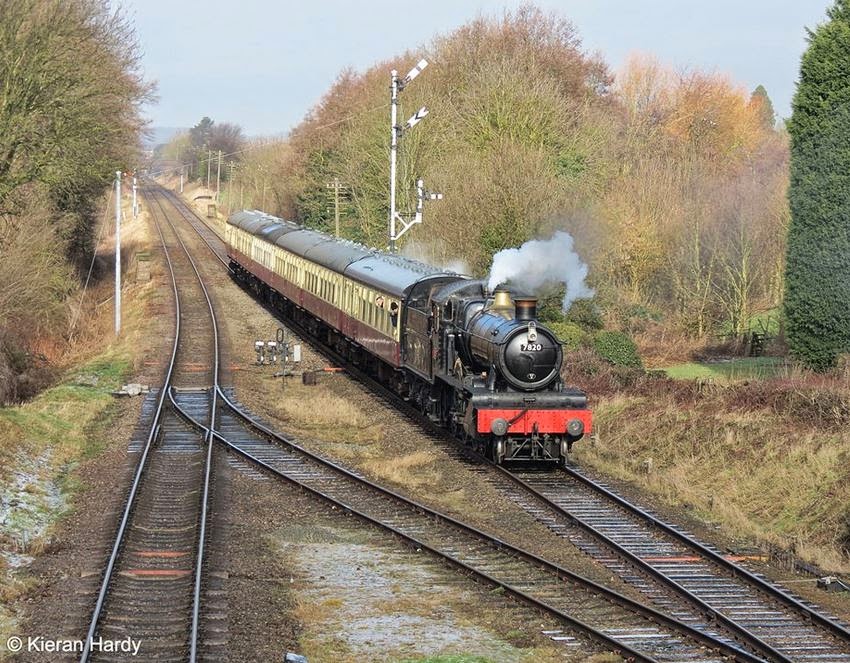
Photo courtesy of Kieran Hardy

Left back at Toddington was the skeleton of Dinmore Manor's own tender.  Work has continued on that.
Some of the recently inserted rivets
Some lengths of angle bracket were required to support a replacement section of the frames.  The frame section was not parallel to the others though, offset from the others by 7 degrees.  This required lengths of angle bracket to be created set at 83 degrees and 97 degrees to support it in the correct plane.
Jeff cutting some angle brackets
Here's one that Ian prepared earlier
And here is another one being finished off
Mark looking very pleased at the trial fitting of the frame section
Also in the machine shop, a bit of welding was taking place on the brake rigging of 35006's tender.

And finally, I don't think that we've had had any cartoons on this blog before, but here is one.  Apparently sometime last year, one of our number decided to descend from the running plate of Foremarke Hall by jumping down rather than walking back to the cab end and using the steps.  This amused those who observed this unexpected feat of athleticism as all they could see of him when he landed was his head and boots, thus prompting the cartoon.
He'll be using the steps next time I expect.