Monday, 17 March 2014

Dinmore Manor's First Moves on the GWSR

No sooner had I uploaded last week's blog, than I discovered an email from Frederick Lea containing a photo taken of Tina on the footplate of 5542 at Winchcombe.  Being skilled at artistic composition, he has carefully chosen a moment when I wasn't visible on the footplate.  Frederick has painted a number of excellent water colour images of scenes from the line, more details of which can be found on his website. 
Tina in 5542, Photo courtesy of Frederick Lea
 Last week saw the railway running race specials on most days to the Cheltenham Gold Cup.  The timetable is a fairly relaxed one, taking the race goers from Toddington to Cheltenham in the morning, returning to Toddington with empty coaching stock, then waiting there until the races are over and it's time to go back to Cheltenham and fetch them back again.  The quandry as to what to do with all the free time between trips was solved by Derek and Howard who both managed to fall asleep.  Somehow Derek dozed off sat upright.  Reports that their snoring could be heard as far away as Cheltenham have been refuted.
Asleep on the job. Photo courtesy of Tim Pickthorn.
Firemen need to arrive on the railway with some means of igniting their fires.  A box of matches or a cigarette lighter being the preferred options, though rubbing two boy scouts sticks together or focusing the suns rays using a magnifying glass are useful standbys.  Once the fire has taken hold, it's usually considered a good idea to put your means of commencing combustion away in a safe place. The warming tray whilst being conveniently located, is not a safe place as Phil discovered:
Spontaneous combustion.  Photo courtesy of Andy Beale.
By Saturday, the races were all done and dusted, large sums of money had doubtless changed hands and I suspect that more than a few sore heads were bearing testimony to the consumption of prodigious quantities of alcohol.

Saturday being a blue timetable day meant that only one steam loco was running, the 8F was in an advanced state of being prepared for service by the time I arrived.  I'd not quite finished cleaning the smoke box when Cliff needed to move her a bit to give access to some of those hard to get at oiling points.  As usual, the use of the ejector to create a vacuum and release the brakes caused plenty of water to be sprayed out of the chimney and onto the nicely cleaned smoke box much to the amusement of all present.
It was clean a moment ago, honest!
She was soon off shed and round to the ash pit to empty her ash pan
I noticed inside the oil store that what last week had been a pair of scissors chained to the bench at the back was now just a scissor:
Doing things by halves
Clive has the other half and would like to reconnect them however the screw in the middle has gone AWOL.  Should you be the guilty party that broke the scissors and happen to know where the missing screw is, please return it to Clive.  He was last seen muttering dark things about sticking pins into a voodoo doll of the culprit, so if you are suddenly experiencing sharp and otherwise inexplicable pains, you'll now know why. 

We have another new hose by the ash pit now, for connecting up to locos that have fitments to sprinkle water directly into the ash pan:
Steve, Ade and Cliff wait for the new hose to finish damping down the ash pan
 Chris was firing the 8F today.  Being one of the leading lights of the Churchill 8F group, he was more than happy to be firing his own loco.  I think he was saying something about having slightly over-prepped his fire at this point, but I couldn't hear him over the background noise.
Chris and some rather low cloud formations over the safety valves
Chris claimed mitigating circumstances when he got back at the end of the day saying that the safety valves were blowing light at 215 rather than 225 PSI.  I'll try and remember that for next week when I'm down for a training turn on the 8F.

Once the 8F had set off to join the stock in the platform and breakfast had been consumed, it was time to check up on the jobs that were in progress in the yard.  Andy was cracking on with 4270 and by the time he had finished her smoke box was a very smart looking gloss black:
Photo courtesy of Andy Beale
 Several others carried on with stripping down Foremarke Hall:
Tim repainted the smoke box...
...whilst John & Ade removed the brakes
Paul got the job of pressure washing the elements of the brake assembly that were removed:
How many footplate men does it take to fix a pressure washer?
John gets it going at last.  Paul is ready to start cleaning the brake parts.
One of the recent batch of fork lift truck graduates discovered that using it to shift things such as re-railers out of the oil store means having to turn the thing round in a fairly confined space.  A task which proved to be rather difficult as it turns out.  I won't name the culprit for fear of getting an even worse report than usual on my next firing lesson.  He won't like the fact that I was reminded of this classic song that describes the difficulties that can be experienced getting vehicles out of tight spaces. 
Fork lift in a fix
I have an interest in getting Dinmore Manor ready for service on our line, for reasons which will become apparent in a few weeks time, so I rather foolishly approached Mark and asked what needed doing on her.  Well the answer was that we have taken delivery of a tender borrowed from the Dukedog, 9017 Earl of Berkeley. Earl of Berkeley is a resident of the Bluebell railway in Kent and has been out of ticket for a few years.  The tender is already in BR black however it needed a bit of a clean, both internally and externally as well as a few coats of paint in the coal space and around the water inlet before it could be used.  I've been inside a tender before and knew that it wasn't going to be a pleasant job.  Sure enough, everybody within earshot either made themselves scarce, pretended to be extremely busy doing important things or came up with lame excuses why it shouldn't be them "Old war wound don't you know". Some thought that I might fall for flattery "Well you're far thinner than me Ray".  Having just devoured a full English breakfast in the Flag and Whistle,the last thing I was feeling was thin
Three Churchward 3500 gallon tenders in this shot.
Before heading into the bowels of the tender, I took a few photos of the people who grabbed the cleaner jobs.  I'm sure that one of the reasons they wanted me to go in there was that they'd be safe from my camera for a while:
Ralph painting the coal space
Ade (l) and Martin (r) got on with painting the water tank filler end
Martin recommended that the best way to clean the inside of a tender is to get a cat, strap a banger onto its tail and throw it in.  As Toddington has no station cat we couldn't follow up on that plan, so it was down to me to get in there. Mercifully nobody strapped a firework to my tail before I went in.   

Tender water tanks are usually rather damp inside (the clue is in the name) however this one had been out of use for a while, so if I was lucky it might be fairly dry: 
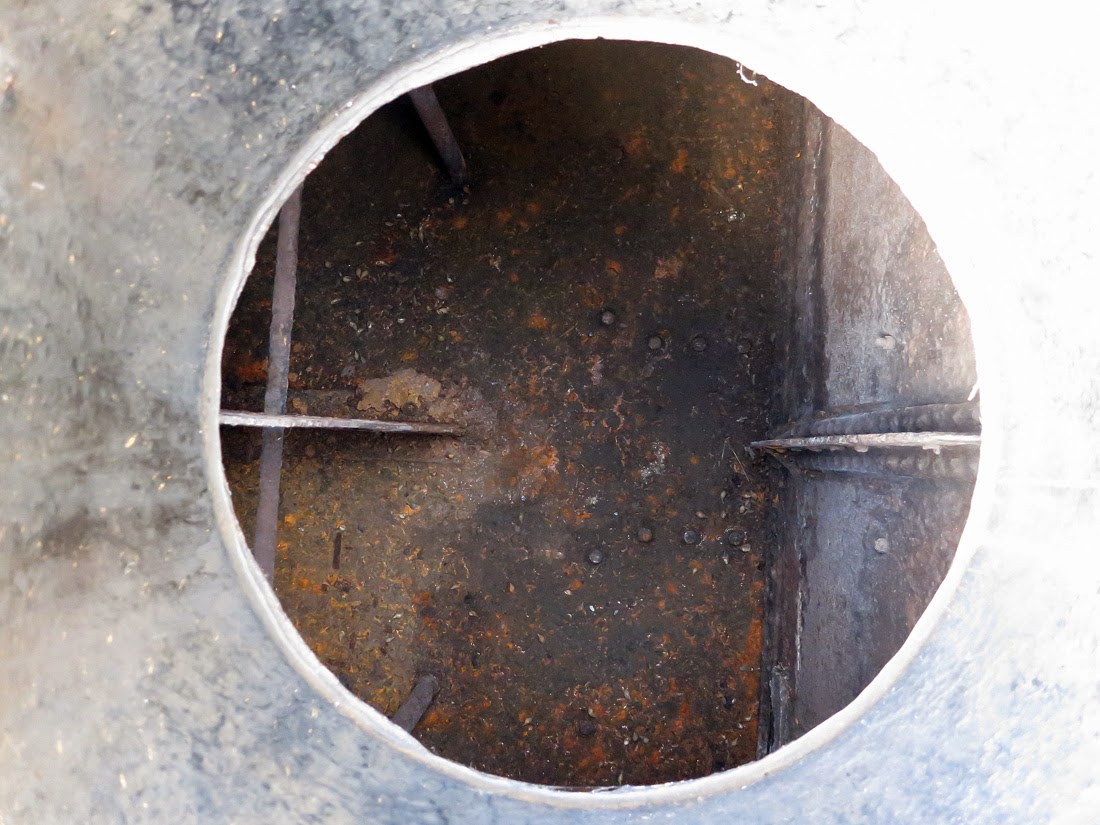
Perhaps my luck is in, it looks dry down there.
Only one way to find out, I dropped down inside and once a light had been hooked up and passed in had a look around. I was in luck, it was bone dry in there.  Aside from the expected industrial quantities of loose flaky rust, I was surprised to find quite a large number of what appear to be shells from dead water snails:
It would seem that the Bluebell railway gets their water from a river
No live ones in there, I suppose that they don't fare very well without water to live in.

For those of you that have never inspected the inside of a tender before, they have baffle plates inside to stop the water sloshing around whilst traversing bends and potentially destabilising them.  That's all well and good until you need to get in there and move from one section to another.  Churchward designed these things in an era when the practice of sending 5 year old children up chimneys to sweep them had not long since been discontinued, consequently the passages through the baffle plates had been designed to accommodate at best teenage boys, malnourished teenage boys at that.  
Anorexics only need apply
There's no real sense of scale to that photo, but the bucket I was using to sweep the rust into wouldn't fit through any of those apertures.  I had to ask Ade to fetch me the smallest bucket he could find, which only just made it through the largest of those round holes.  I managed to squeeze through the one at the bottom, just, by lying on my back and shimmying in. When my feet hit the next baffle plate I had to twist sideways to get the rest of me in.  I really wouldn't have wanted to try to get from one section to another if there had still been any water in there.

The tender is split internally into 4 sections on each side.  In the third section, the water level gauge float is strategically placed to block entry into the fourth section:
Water level gauge float impeding progress.
The float raised and lowered quite easily, but I didn't fancy trying to shimmy into the fourth section as it would be resting on my face as I crawled underneath it.  I elected to poke a broom in through one of the holes and sweep it out from the third section on each side.
I could almost reach all the way to the front this way.
One of a number of bucket loads of rust and water snail shells emerging into daylight
Yes, I was using the 'light up bucket'.  I cleaned it up afterwards and put it back where it came from.  Hopefully Clive won't notice that I've used it for the wrong thing, apparently he has quote an extensive collection of voodoo dolls!

At one point, I heard a muffled voice outside ask "Who's in there?".  When the disembodied voice had discovered that it was me, there was a considerable clanging as hands hammered on the tender sides. It was quite deafening in the confined space.  Mike confessed to being the culprit later.  I might be able to find a use for one of Clive's voodoo dolls myself!

I finally emerged back into the daylight with the last bucket load of rust etc from inside the tender looking rather like I had used my overalls to clean it with.  Needless to say, it was the first wearing of a freshly laundered pair of overalls.  

Inside of the tender cleaned, it was now time to crack on with the outside.  It had only been painted black a few years ago and it scrubbed up rather well.  I was quite pleased with the end result:
Not looking at all bad
Meanwhile, feverish activity was taking place on Dinmore Manor herself.  Not least of the outstanding tasks was weighing her to make sure that her weight was evenly distributed across each wheel.  Without doing this, she might end up with too much weight being placed on one of her springs causing the spring to break.
On the scales
She'd had a warming fire put in her on Friday and Dan had re-lit her and got her slowly into steam during the course of the day:
Still with Foremarke Hall's tender whilst the Dukedog's was being cleaned & painted
Slowly building up the fire during the day
By the time that the 8F was back on shed at the end of the day, Dinmore Manor was pretty much up to the red line on her pressure gauge:
All steamed up and ready to go
Well it would have been a shame to let all that steam go to waste wouldn't it!  So as sun was starting to go down, Dinmore Manor moved under her own steam to the south head shunt and back for the first time:
Getting ready to go
Drain cocks open....
.... and she's off.
Underway at last.
The use of the 4000 gallon Hawksworth tender from Foremarke Hall is quite possibly a first for a Manor.  A little research has shown Manors occasionally ran with a Churchward 4000 gallon tender and briefly with a Collett one, but not as far as I have been able to determine with a Hawksworth 4000 gallon tender.  Another first for the GWSR.  Now that the Dukedog's 3500 gallon Churchward tender is pretty much ready for service, she'll soon be back to looking as BR intended back in 1950, so this curious pairing will be short lived.

After the first run, there was a stop for checking that nothing was hotter than it should have been and that there were no leaks from places that shouldn't be leaking:
Dinmore Manor appears to have eaten Mark
Andy checks for leaks in the smoke box
The inspection process took a fair while, which was a bit of a shame as there was a spectacular sunset going on, all it needed was Dinmore Manor placed in the foreground.  By the time she did steam up and down the yard again, the light had all but gone and I couldn't get enough shutter speed and the depth of field for the shot that I really wanted:
Afterglow
Light all but gone
15 minutes earlier and I'd have been on to a winner.

Tuesday, 11 March 2014

The 2014 Season Kicks off in Fine Style

Clive has been very active in his new role as the 'Working Engine Manager' and has made considerable improvements in the organisation of the oil store.  From a cleaners point of view, your first task if you required a bucket of soapy water to wash over the boiler cladding with was to find the least dirty bucket of those available, take it off and clean all the oil/diesel/grime out of it before it was in a fit state use.  We now have a couple of buckets that are for soapy water and nothing else, so you can be reasonably confident that they will be fairly clean to start with:
No diesel/oil
You'll also notice that there is a pair of scissors and a Stanley knife chained to the bench for use in cutting up cleaning rags.   

The three oil bunds have now been labeled so that you know what you'll find in each one:
No more surprises
Firemen will appreciate the fact that we now have a bin clearly labeled to contain oily rags only.  Previously old rags whether wet with water, diesel or oil all seemed to get bundled in together.  If your rags fizzled when you tried to light them, but not actually burn, then you knew that you had inadvertently found some that were wet with water rather than something more combustible.
No wet rags
There is even a washing line in there, for drying wet rags on, so that once dry they can then be used for lighting up.  I'd have shown you a photo, but I don't believe in airing dirty laundry in public.

There is also a small tin bucket for transporting oily rags to the locos:
Already being misused, it's got wood in it
I've been informed that this particular bucket has a small hole in the bottom (I know a song about that) and that excessively liberal application of accelerants to the rags will result in you leaving a trail of diesel from the oil store to the loco and quite likely all over the cab floor too.  Lighting up under those circumstances might be ill advised.  That said, at least one of our firemen isn't averse to burning cab floors, though he usually puts the cab floor into the firebox before setting it alight.  
Clive relaxing after his endeavours with a well earned cup of tea in the Flag and Whistle
Clearly there is a strong element of favouritism going on here, you'll notice Clive has a cup to put his tea in, I wasn't deemed worthy a cup.  Sean was deemed worthy of getting a cup, along with what appeared to be about a gallon of coffee.  We came to the conclusion that this is a new ploy by the GWSR to keep volunteers awake and busy doing things.  Sean is probably still wide awake even now, several days later.
Sean wishing he hadn't drunk all that coffee
Finally, the long awaited first train of the season pulled out of Toddington.  As mentioned in the last blog post, the honour of being the first loco fell to the 8F, 8274:
Kicking off in style
Jamie, Cliff and Dan had the honour of being the first crew.

Dinmore Manor's most recent Facebook page suggests that she may be ready to run within the next week or so.  To that end, feverish activity was taking place all over her.  Setting the valve timing was continuing on from Friday and at one point it involved Steve apparently acting as a human frame stretcher:
Steve between boiler and frames
I have no idea how he managed to get himself under the boiler like that, or how he managed to get back out.  I don't think that we had to call the fire brigade to extricate him though.

On to Sunday, I was down to clean 5542.  The previous plan that the 8F would work on both Saturday and Sunday had changed yet again.  I have to say that I felt a bit of a fraud, 5542 was already spotlessly clean as several people including me had descended on it on Saturday and cleaned and polished her to within an inch of her life.  There was really very little to do.  I found myself as much as anything hunting around trying to find odd bits that had been missed the day before.
Ship Prairie shape and Swindon fashion and the sun hasn't peeped over the horizon yet
Later on, 5542's shadow on Foremarke Hall's tender
Alongside her new stable mate, Dinmore Manor
 There was a small amount of shunting to do before we could set off.  The Saturday had been heaving with passengers, we'd had a couple of coach parties turn up at Toddington as well as numerous cars.  2807's tender was in the car park awaiting turning and had proved to be a bit of an impediment to the coach drivers, so we needed to shunt it out of the way before we set off.
Fetching 2807's tender back in from the car park
If you've been reading this blog through the closed season, you'll have hopefully been keeping an eye on the other blogs too.  If so, like me, you can't fail to have been impressed by the sheer amount of work that has been going on up and down the railway by other departments.  Some of the fruits of their labours can be seen from the train.
Replaced track section at Hailes bridge
Replaced bridge at JJ Farms
Cheltenham Race Course platform 2 is much extended since last season
A few slips have been shored up:
Dixton cutting
That's not to mention all the things that you can't see from the train like the continued Pheonix like resurrection of Broadway station.  I daresay that some of the carriages that we were pulling around had recently been out-shopped by the C&W team at Winchcombe.The fact that the line wasn't flooded after all the recent rain is testament to the sterling efforts of the lineside drainage team.   There has been much more activity amongst the various departments of the railway too, check their blogs to find out more if you haven't done so already.

The crew for Sunday was John (driver) and Tina (firewoman fireperson fireman):
John and Tina
The hose at the Cheltenham water tower still has several leaks which seem to spray water in all directions.  John and Tina decided sheltering in the hut beneath the water tower was safest whilst the water valve was open:
Tina nearly got caught by one of the leaks...
... and joined John out of harms way in the hut under the water tower
The return journey proved to be a little interesting, when we were getting close to Toddington, we discovered that the three signals leading up to the platform were against us:
Board on.
 We couldn't realistically claim that it was foggy or that snow was falling, so we waited for two minutes before I descended from the cab and called the signal box to find out what the delay was.  I was informed that the signals weren't working and that we had permission to pass the next three signals at danger and proceed at caution into platform one.  The rule book allows for this along with a few other situations, where with the signalman's permission it is allowed to pass a signal at danger; to approach the signal box for further instructions, for shunting purposes, for a defective signal that can't be cleared, with an engineer's train into a section under an absolute possession, to render assistance to a broken down train and during pilotman operation.  Before we set off, I needed to take the token back along the North West (Malvern) side of the train to the meet the guard and inform her of why we were about to pass a signal at danger.  If I hadn't done that,  she would have assumed that we were about to unintentionally pass the signal at danger and would have halted the train from the brake carriage.  Needless to say the brake carriage was at the far end of the train from the locomotive.  It's a long walk on the ballast.  

Before Sunday, I had never been on the footplate of a loco passing a signal at danger, it just felt wrong, even though it was completely in order and sanctioned by the signalman.  

Neil, our Operations Manager happened to be on the train as a passenger and we dropped him off at the signal box to fix it.  I have no idea what the problem was, but it was sorted by the time that we returned.

Bearing in mind that we've just endured the wettest winter on record, with what seems like solid rain since October and most of the low-lying parts of the country under water, it came as a more than welcome surprise to find that the sun shone all day long:
Running round at Laverton under a clear blue sky
In fact the only white blobs in the sky came from 5542
At the beginning of the season, most firemen are keen to get in as much practice at firing as possible to re-hone their skills and the chances of a humble cleaner being let loose with the shovel are slim.  Tina of course managed to make the whole thing look easy even though she hadn't fired since last year and decided after one round trip that she had got back into it well enough. She caught me by surprise at Toddington when one minute before departure she said "You'd best start building your fire up".  After the delays due to the broken signals etc and taking on water at Toddington, the scheduled reasonably sized break had evaporated and we were off pretty much as soon as we got back on the footplate from filling the water tanks.  The fireman has to managed three things:  boiler pressure, boiler water level and the fire.  If any two are good, you can recover the third.  If only one is good, you're in trouble, if none are good you're "Down the pan", "In the nick" and "Having to stop for a blow up".  There are other expressions in use, but those are the printable ones.  

The look on Tina's face suggested that I was being tricked here and sure enough a quick check suggested that I was in trouble.  The pressure was not too far off the red line, but the water gauge was showing precious little water and what little was left of the fire would be off up the chimney as soon as John opened the regulator.  What I really wanted at this time (other than a miracle) was for lots of small lumps of coal to get on the fire, which having a larger surface area than a similar weight of big lumps would burn quicker and thus give off their heat energy quicker.  Needless to say all that seemed to be coming down from the bunker was lumps the size of a small car and I had no time to break them up.  I got a few shovels full of these large lumps into the back corners, opened both dampers fully and we were off.  I'm sure I saw John wink at Tina as if to say "This will be entertaining".  Once we were safely moving, I opened the firebox doors, raised the flap and then started filling in the sides and front of the firebox. When I'd raised a few extra pounds of pressure, I stuck on an injector to slowly raise the water level.  

Things were looking a bit better by the time we reached Winchcombe.  I suggested to John that we wait in the platform for a while to recover a bit more, but he was confident that we had enough water and pressure to make it through the tunnel, so off we went. John was right of course and we emerged out of Greet tunnel quite safely.  By the time we got through Dixton cutting and were on the start of the long downhill section to Cheltenham, those large lumps of coal were now beginning to burn properly and it didn't help that I'd thrown on way too many of them.  5542 was of course blowing off quite merrily by the time that we reached Cheltenham.  According to John I owed both him and Tina £5 each every time 5542 blew off.  This was looking like it was going to be an impoverishing experience.  Mercifully I had 5542 back under control by the time we left Cheltenham and my wallet wasn't too badly damaged in the process.  On the plus side, you learn far more when things don't go according to plan.  I re-learned that I should be careful not to 'panic fire', especially when it comes to 5542.  I also learned not to trust Tina or John!

We have a new volunteer in the steam loco dept, it was Aaron's first day on Sunday.  Steve was busy giving him a guided tour of the railway which included joining us on the footplate for the run around at Cheltenham:
Aaron tries the cab of 5542 for size.
Thanks to both Steve and Aaron for helping empty out the ash pit later on at disposal time.

Original forged steel BR or big four firing shovels can fetch exorbitant prices. I had promised myself that I wouldn't bother trying to obtain one, but get by with one of the perfectly good modern day pressed steel firing shovels.  My resolve was put to the test recently, when Mark Shere-Massey who will shortly be emigrating to Canada (it's amazing the lengths people will go to in order to avoid being on this blog) announced that he had an ex-LMS Bulldog brand firing shovel for sale.  I can overcome everything except temptation.  You've guessed it, a certain quantity of beer vouchers bearing her majesty's likeness have changed hands and the shovel is now mine.  Mark brought it along on Sunday and handed it over to me.  This was at the precise moment that Tina had announced that I might want to think about building up the fire, so in my panic, I'm not at all sure that I managed to thank Mark or not.  Anyway, many thanks Mark and best wishes for your new life in Canada.  I'm reliably informed that the interweb works over there, so I hope you'll be keeping in touch with all your old friends here on the GWSR via this and the many other blogs that the railway has.
An old photo of Mark from last year's gala
The shovel itself is a little on the big side for 5542, there isn't room to swing a cat on 5542's footplate, a small kitten perhaps, but definitely not a cat. It will be perfect for all of our tender locos though and possibly 4270 when that is in steam.   I lined up my new (well new to me) shovel alongside Tina's (Lucas brand, stamped BR(S)) shovel which she has on indefinite loan from Tom Couling.
If only they could talk, I wonder what stories they could tell
I can just imagine what Ade will say on my next proper firing lesson, something along the lines of "Well you've got no excuse now".  I'm obviously going to have to think of something before then.

A little later during a quick cake break at Winchcombe whilst waiting for the DMU to cross us, I took this photo of Tina in front of the gun powder van.  I was sorely tempted to put this out as a 'Photo Caption Competition', but I'll spare her that.
X marks the spot!
The warm weather brought a few of the lines stalwarts out to ride in the train and generally heckle the crew:
Derek and Ben took first and second places in the  "Inappropriate t-shirt competition"
Mike took a break from working on Dinmore Manor and very kindly bought us all ice creams
Finally, we rolled back into Toddington for the last time of the day and it was time to dispose of 5542 and put her to bed.  The job has been made much easier thanks to the new concrete apron by the ash pit that allows her to be coaled up by the pit rather than having to specially run round onto the unloading road in the car park.
John coals up 5542 on the ash pit
Damping down the ash pan and cleaning the residue ash off of the brake rigging has been made easier by the installation of a hose pipe and tap inside the ash pit.  It greatly reduces the likelihood of the hose being inadvertently run over by the loco too.
New hose pipe installed in the pit


Saturday, 8 March 2014

On the starting blocks

Once again, my day job had me passing near to Toddington on my way home on Friday, I couldn't resist the urge to pop in and check up to see how the steam tests had gone for the 8F and for Dinmore Manor.   By the time I got to Toddington of course, the steam tests had both finished, but I'm pleased to be able to report that both had passed successfully.   It was nice to see some locos in steam again, the last time had been new year's day, which seems like an eternity ago now.

The 8F was merrily blowing off when I arrived:
It was a joy to see one of our locos in steam again
Kev was cleaning her a little later on.  I felt a bit guilty about not helping out, but I had no overalls with me and was wearing what I hoped to maintain as a clean white shirt. Helping clean the 8F didn't seem like a good way of keeping the shirt white.
Kev cleans the 8F's smoke box
A little while later, the 8F took a few test moves up and down the yard to stretch her legs again:
All steamed up
The main GWSR web site says that 5542 will be working the first weekend of the new season's trains, but in a late decision as the 8F is now already warm after her steam test, it was decided that she would get that honour instead.  5542 will now probably work some of the race trains to Cheltenham race course in the middle of the week.
5542 basks in the sun along with 2874
Inside the David Page shed, work continued on Foremarke Hall:
Tim and John removing paint from the smoke box
Tim had been informed by some wag that he looked like a tank commander with his head poking out of the chimney hole and wearing headphones etc.  I can see what he meant.

There was of course something of a flurry of activity around our newest arrival, Dinmore Manor:
Dinmore Manor in steam
The more observant readers of this blog might just have noticed that the tender doesn't look quite as it should.  Not only is it green, whereas Dinmore Manor is black, but it is also a Hawsworth 4000 gallon tender whereas manors are more usually associated with Churchward 3500 gallon tenders.  This tender is of course Foremarke Hall's and was borrowed for the steam test as Dinmore Manor's tender still requires some work before it is ready for use.  In the short term, I can now inform you that the Churchward 3500 gallon tender currently fitted to 9017, Earl of Berkeley on the Bluebell Railway will soon be making its way to Toddington for use with Dinmore Manor.  9017's tender is already in black, and will look perfect when attached to Dinmore Manor.
9017, Earl of Berkeley on the Llangollen Railway a few years ago.
As of a few days ago, the outstanding list of tasks required to get Dinmore Manor ready for service, apart from the steam test, included installing the cab floor, fitting the steam pipe cladding, damper door linkages, painting inside the cab and setting the valve timing.  Work was taking place on the valve timing and a few other odds and ends whilst I was there:
Apparently the steam pipe is hot.... who'd have thought it!
Valve covers off
Mike and Mark tightening up some of the vacuum brake pipe connections
Mark adjusting the valve timing
Mark seems to think that poking his tongue out will make the daft man with the camera go away.
Sorry to disappoint many of you, but even after disappearing off into the pit under Dinmore Manor, I somehow managed to keep my shirt clean.  I really must learn to keep a pair of overalls in the boot of the car at all times, for occasions such as this.